
Work, AI, and Human Dignity
There is a question that millions of people around the world are quietly carrying right now, often too afraid to say out loud.
Will I still have a job in ten years?
It is not an irrational fear. Across industries, in offices, factories, call centers, newsrooms, legal firms, and hospitals, artificial intelligence is doing things that were until very recently considered exclusively human work. And the pace is not slowing down.
Magnifica Humanitas takes this question seriously. Not with false comfort. Not with techno-optimism. But with the full weight of Catholic Social Teaching behind it.
Work Is Not Just a Job
Before the Pope addresses AI and employment specifically, he does something important. He reminds us what work actually is.
Work, in the Catholic tradition, is not simply a means of earning income. It is a fundamental dimension of the human person. Through work, human beings express their creativity, exercise their freedom, contribute to the common good, build relationships, and participate in the ongoing act of creation that God began.
Saint Benedict understood this when he united prayer and work in the rhythm of monastic life. Saint John Paul II built an entire encyclical, Laborem Exercens, around the conviction that work is the essential key to the entire social question.
Pope Leo XIV stands firmly in this tradition. Work is not a commodity. It is not a cost to be minimized. It is a path to human dignity and social participation. And anything that threatens it on a massive scale threatens something deeply human.
What AI Is Actually Doing to Work
The encyclical does not traffic in vague warnings. It names specific dynamics that are already unfolding.
First, there is the problem of deskilling. Contrary to the advertised benefits of AI, the Pope notes, current approaches to technology can paradoxically de-skill workers, subject them to automated surveillance, and relegate them to rigid and repetitive tasks. The promise was that AI would free humans from drudgery. The reality, in many workplaces, is that workers are being forced to adapt to the speed and demands of machines rather than the other way around.
Second, there is the concentration of reward. AI is generating enormous wealth. But that wealth is flowing disproportionately to a small number of highly specialized individuals and the companies that own the technology. Meanwhile, wages for a large portion of the workforce are declining. The gap between those who own AI and those who are replaced by it is widening rapidly.
Third, there is the threat of mass unemployment. Saint John Paul II recognized unemployment as a grave evil. Pope Leo XIV takes that assessment and applies it to the current moment with even greater urgency. In some contexts, there is a legitimate fear of a significant and rapid contraction in available jobs that would create a chain reaction deeply impacting families, young people, and local economies.
The Human Person Is Not a Cost
At the center of the encyclical’s argument on work is a principle that sounds simple but cuts against almost everything the current economic system assumes.
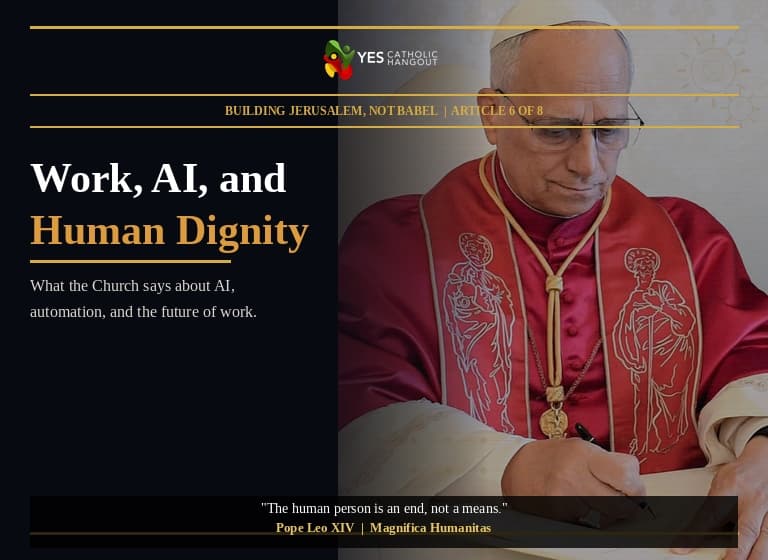
The human person is an end, not a means.
This means that the pursuit of greater profits cannot justify choices that systematically sacrifice jobs. It means that efficiency is not the supreme measure of economic value. It means that when a company automates a process and eliminates a hundred positions, it cannot simply point to the profit margin and consider the matter closed. It must ask what happens to those hundred people. What happens to their families. What happens to their communities.
The economy, the Pope insists, must remain subordinate to human dignity and the common good. Not the other way around.
What the Church Asks of Businesses
Magnifica Humanitas does not let the business world off the hook with vague encouragements. It makes specific demands.
Every introduction of automation and AI, the Pope argues, should be accompanied by verifiable measures to protect employment, provide retraining, and ensure the participation of workers. Innovation should be oriented toward freeing up human time and capabilities, not producing exclusion.
Companies are asked to include the quality and dignity of work among their indicators of success, alongside revenue and productivity. This is not an optional add-on. It is a condition for the economy to be genuinely human.
The Pope also calls on labor unions to adapt and remain relevant. They are encouraged to represent new types of workers, including those in gig economies, digital platforms, and precarious employment, not just the traditional industrial worker.
What the Church Asks of Governments
Governments, too, bear specific responsibilities in this transition.
Pope Leo XIV calls for proactive policies that make continuous training and professional development accessible to all, so that the cost of adaptation does not fall solely on individuals. He asks for social criteria for innovation, meaning that technological change should be evaluated not just for its economic output but for its human impact.
He also challenges the metrics we use to measure success. Moving beyond GDP, he argues, is essential. The development of parameters that measure the dignity of work, shared prosperity, inequality reduction, and environmental protection would allow for a more honest assessment of whether economic and technological choices are actually serving the human family.
For Young People Specifically
One of the most tender sections of this part of the encyclical is directed at young people. And it is worth quoting the underlying concern directly.
For young people, job insecurity is particularly devastating. Work is not merely a source of income but a crucial sphere in which identity is formed, friendships and relationships are forged, practical responsibilities are learned, and one’s vocation is discerned.
When young people cannot find stable, dignified work, it is not just their bank accounts that suffer. It is their sense of self, their capacity for commitment, their ability to form families and build futures. The Pope recognizes this with the eyes of a pastor, not just an economist.
Hope, Not Despair
It would be easy to read this article and feel overwhelmed. The forces reshaping work are enormous, largely invisible, and moving faster than most regulatory or social responses can track.
But Magnifica Humanitas is not a document of despair. It is a document of demanding hope.
Pope Leo XIV believes that the direction of technological change is not predetermined. It can be guided. It can be shaped by values. It can be oriented toward justice rather than mere efficiency. But only if enough people, in enough places, insist on it.
That insistence begins with understanding what is at stake. And what is at stake, in the end, is not just jobs. It is the human vocation itself.
Coming Up in This Series
Article 7 asks a question that cuts to the heart of why Yes Catholic Hangout exists. Does the Church have any business being online? And if so, what does it actually mean to evangelize in the digital world rather than simply occupy it?
The series continues. Stay with us.
Yes Catholic Hangout. Digital Faith. Real Mission.