
Who Defines Truth in the Age of AI?
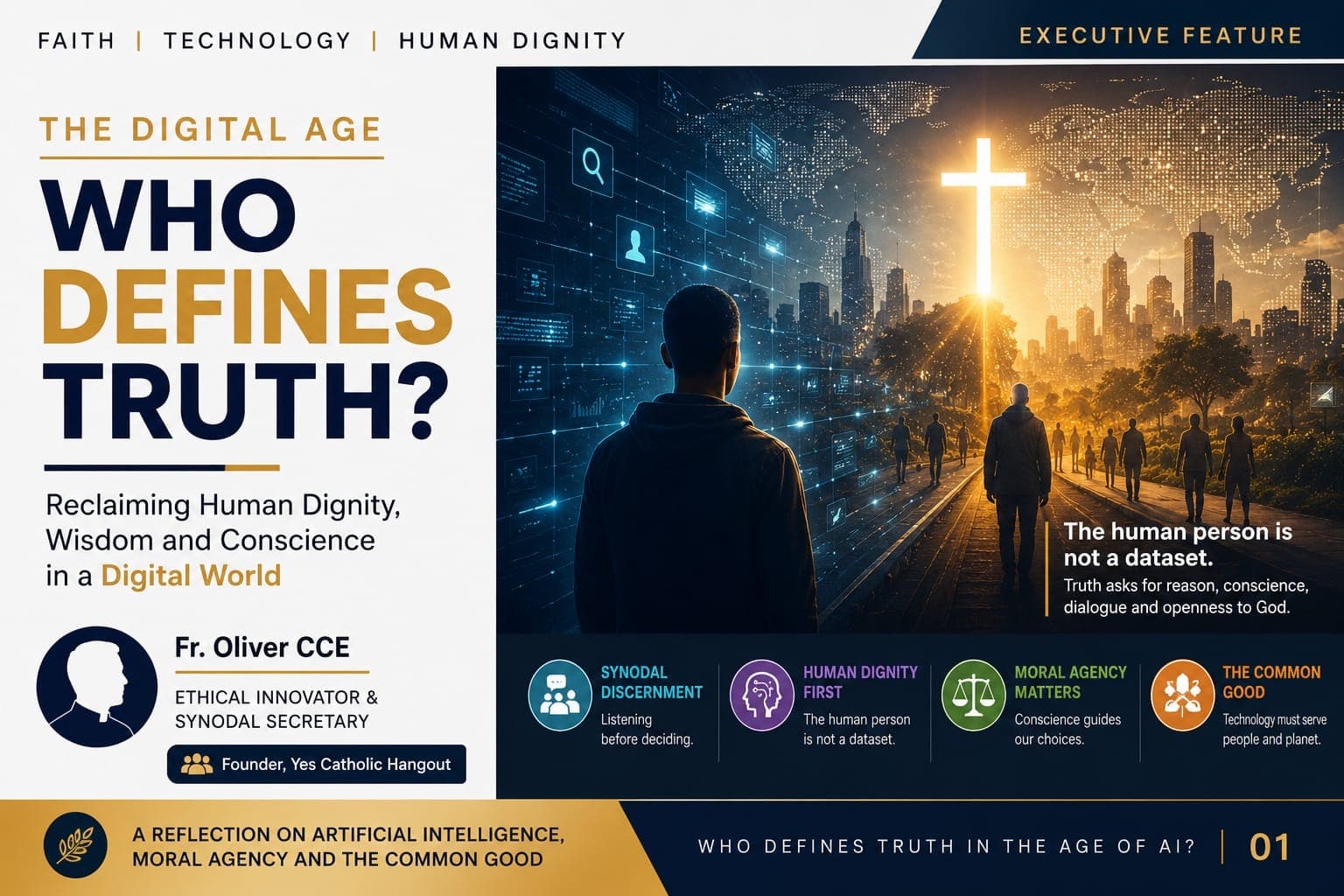
Reclaiming Human Dignity, Wisdom and Conscience in a Digital World
A Vatican News-inspired reflection on artificial intelligence, moral agency and the common good. This article is an independent contribution and does not represent an official Vatican News publication or imply Vatican endorsement.
Artificial intelligence is changing more than the speed at which information moves. It is changing the conditions under which people decide what is credible, whose judgment is trusted and which lives are made visible. A generated answer can arrive with the confidence of an expert. A recommendation can feel like a personal intuition. A ranking can quietly determine whose voice is heard, whose application is noticed and whose suffering remains statistically invisible.
The central question of the AI age is therefore not simply what machines can do. It is: who gets to define truth in the age of artificial intelligence?
The question is spiritual as well as political, technological and philosophical. It concerns the authority we assign to systems, the habits we cultivate in ourselves and the kind of society we are preparing for those who will inherit the digital world. Catholic Social Teaching offers no catalogue of ready-made technical answers, but it offers a demanding anthropology: every system must be judged by how it serves the human person, the common good and the created world.
AI can organize information, identify patterns and produce persuasive language. It cannot, by those capacities alone, establish the meaning of a human life. It can support judgment, but it cannot replace conscience. It can widen access to knowledge, but it cannot become the final court of truth. Its usefulness must remain subordinate to human responsibility, moral reasoning, dialogue and openness to God.
The path ahead can be traced through six movements: Truth, Conscience, Wisdom, Discernment, Responsibility and Human Dignity.
1. Truth
The first danger in a world of generative systems is not that every answer will be false. It is that fluent answers may be mistaken for true ones. The difference matters. A system may assemble sentences from patterns in data without understanding the moral weight of what it says, the history of the people involved or the consequences of a claim repeated at scale. Persuasion can be generated without knowledge, and knowledge can be circulated without wisdom.
George Orwell’s Nineteen Eighty-Four remains relevant here not because it predicts today’s technologies in detail, but because it explores the relationship between power, language and reality. When institutions control the terms by which events are named and remembered, truth becomes vulnerable to whoever controls the channels of communication. Contemporary digital systems do not need to resemble Orwell’s fictional Ministry of Truth to raise a similar concern. A combination of platform incentives, opaque moderation, targeted persuasion and synthetic media can make it difficult for citizens to distinguish evidence from performance.
Yet the answer is not nostalgia for a simpler media age. Human beings have always manipulated language, suppressed inconvenient facts and confused confidence with authority. AI intensifies the problem by making production cheap, rapid and personalized. It can place a different persuasive world in front of each person, while appearing to offer neutral information.
Truth, in the Christian understanding, is not merely a successful output. It is a reality to which the mind and the will are answerable. It requires intellectual humility: the readiness to ask how a claim was formed, whose experience is absent and what interests may be served by its circulation. It also requires institutions that protect transparency, contestability and the freedom to seek what is real.
This is why the common good cannot be reduced to the maximum availability of information. A society can have more content and less truth. It can have instant access to answers and less capacity to ask whether the questions are worthy. The public task is to build digital environments in which evidence can be examined, disagreement can be sustained without dehumanization and correction is treated as a strength rather than a defeat.
2. Conscience
If truth is not identical with information, neither is conscience identical with a system prompt, a compliance checklist or an automated risk score. Conscience is the interior place where a person recognizes a moral demand and accepts responsibility for responding to it. It must be educated, tested and brought into dialogue with reason, tradition, community and the presence of God. It cannot be outsourced to a machine simply because the machine is faster or appears more consistent.
C. S. Lewis warned, in The Abolition of Man, against a technological and educational culture that could weaken the human capacity to recognize objective value. His concern was not a rejection of tools. It was the possibility that human beings might become so confident in their power to manipulate nature and behavior that they would lose the moral vocabulary needed to judge the direction of that power. His theme of the technological man remains a useful lens: the deepest danger is not only what technology does to the world, but what it does to the people who design, deploy and obey it.
In workplaces, schools, hospitals and public services, automated recommendations can gradually become decisions without anyone formally deciding to surrender judgment. A teacher may treat a predictive score as a student’s destiny. A recruiter may interpret a model’s ranking as an objective assessment. A public authority may allow a fraud system to determine whose needs deserve suspicion. In each case, accountability can disappear into a chain of technical explanations.
The moral response is not to reject every aid to judgment. It is to insist that assistance remain assistance. A person must be able to question a recommendation, understand its relevant grounds, appeal an adverse decision and receive a human hearing when the stakes are high. The right to explanation is not a luxury for specialists; it is part of respecting the person affected.
For Catholics, conscience is neither private preference nor automatic obedience. It is a responsibility to seek the good truthfully. That responsibility becomes more, not less, important when machines speak with apparent neutrality. The system may be impartial only in the narrow sense of applying a rule. It cannot carry the full burden of compassion, justice or repentance. Those remain human tasks.
3. Wisdom
A culture that can generate endless answers must recover the art of asking what an answer is for. Wisdom is not the accumulation of data, nor is it the same as technical expertise. It is the capacity to perceive relationships, consequences and the proper place of a particular good within the whole. It asks not only whether a goal can be achieved, but whether it should be pursued, whom it will serve and what kind of people it will form.
This is the larger horizon of Laudato Si’. The document’s critique of a technocratic paradigm is not a critique of science or invention. It is a critique of a mindset in which technical power becomes the main measure of progress and every limit is treated as an obstacle. When applied to AI, the warning is clear: efficiency cannot be the sole language of social improvement. A system that saves time while eroding trust, privacy, attention or solidarity may be technically impressive and socially destructive.
The question becomes particularly urgent in Africa and across the Global South. Digital systems often arrive in contexts marked by unequal infrastructure, limited access to computing resources and data that inadequately represent local languages, histories and forms of knowledge. A model trained primarily on dominant languages can misread a community not because the community lacks intelligence, but because the system’s world is too narrow. Extractive data practices can reproduce an older pattern in which value is taken from communities while decision-making remains elsewhere.
Wisdom therefore requires more than including a few local examples in a global product. It requires listening to local educators, families, researchers, entrepreneurs, artists, health workers and faith communities. It requires asking who owns the data, who can correct the record and who benefits from the resulting capability. Young people across the Global South are not merely future users waiting to be trained by distant institutions. They are creators, interpreters and custodians of knowledge whose agency must shape the systems that affect them.
Subsidiarity gives this concern a precise ethical form. Decisions should be made as close as possible to the people affected, while higher levels of authority provide support when the common good requires coordination. In digital governance, subsidiarity resists both fragmentation and centralization. It encourages international standards where necessary, but it also protects the authority of communities to define their own priorities, languages and boundaries.
The wiser society will not ask AI to make human beings unnecessary. It will use AI to make human attention more available for the work machines cannot do: accompaniment, interpretation, moral courage, care and the patient building of trust.
The Anthropological Theoalgorithm asks: “Who is the human person that this technology is meant to serve?”
This is an ethical question for the entire technological process. It should be present in research laboratories, boardrooms, classrooms, parliaments and parish conversations. It turns the design process outward, toward the person and the community, and upward, toward a view of human life that cannot be exhausted by measurable behavior.
4. Discernment
Discernment is often misunderstood as hesitation. In fact, it is a disciplined way of moving toward action without confusing speed with clarity. A synodal approach begins by listening: to those who carry expertise, to those who bear the risks, to those whose voices are usually missing and to the signs of the times. It then brings what has been heard into dialogue, prayer, reason and the search for the common good.
This approach has practical consequences for AI. Decisions about a new system should not be made only by developers or only by executives. They should include workers whose tasks may change, citizens whose data may be used, teachers and parents who will guide children, people with disabilities, communities facing linguistic exclusion and those who may suffer from error without having the power to contest it. Consultation is not a decorative exercise. It is a way of discovering realities that a technical specification may not reveal.
The Rome Call for AI Ethics highlights principles such as transparency, inclusion, accountability, impartiality, reliability, security and privacy. These principles are valuable because they translate a moral concern into a public vocabulary. But principles must be embodied in institutions. Transparency should mean more than publishing a document no ordinary person can understand. Accountability should include named responsibility and accessible remedies. Inclusion should involve real participation, not merely a wider market.
Synodal discernment also resists the temptation to treat every technological question as an emergency that justifies bypassing reflection. Some systems may need to be paused, limited or refused. Others may be used under conditions that protect human agency. The question is not whether the Church, governments or civil society can stop every innovation. The question is whether they can distinguish innovation that enlarges human freedom from innovation that quietly narrows it.
Discernment is especially important in the information life of faith communities. Digital tools can help people encounter Scripture, access education and connect across distance. They can also flatten theological complexity, imitate spiritual authority or encourage users to seek instant certainty where patient formation is needed. No generated devotional response can replace the lived wisdom of a community, the care of a pastor or the freedom of a person before God.
To discern is to ask what kind of communion a system creates. Does it deepen encounter, or does it make every relationship transactional? Does it help people attend to one another, or does it keep them in a cycle of prediction and persuasion? The answer will rarely be visible in a product demo. It emerges over time, in the habits a system forms.
5. Responsibility
Responsibility is the bridge between ethical aspiration and public life. It means that every actor in the AI ecosystem must be able to answer for the effects of the systems they build, buy, govern, teach and use. Responsibility cannot be dissolved into the phrase “the algorithm decided.” Algorithms do not appear from nowhere. People select objectives, training data, thresholds, business models and deployment contexts.
Governments have a duty to protect rights, prevent discrimination and ensure that powerful systems serve the common good rather than merely the interests of the strongest market actors. Technology companies have a duty to test for foreseeable harms, disclose meaningful limitations, protect data and provide remedies. Developers have a duty to treat design choices as moral choices, especially when a tool will shape access to work, education, healthcare, information or political participation.
Educators carry a responsibility to form judgment, not just digital fluency. Students need to know how to use tools, but also how to question outputs, cite sources, protect another person’s dignity and recognize the difference between assistance and authorship. Faith communities can contribute spaces in which technology is discussed without either panic or naïveté. They can help communities name what is being lost when convenience becomes the measure of every good.
Ordinary digital citizens also have a role. Sharing unverified material, treating a generated image as evidence or allowing personalization to replace independent thought may seem small in isolation. At scale, such habits shape the moral climate in which institutions operate. Digital citizenship includes restraint: refusing to forward what humiliates another person, pausing before rewarding outrage and making room for sources that do not confirm one’s preferred view.
The principle of solidarity adds an essential test. Who bears the cost when a system fails? In many settings, it will be the poor, migrants, children, minorities, workers with little bargaining power and communities whose languages are poorly represented. A responsible system must be judged from the standpoint of those who are easiest to overlook. This is not a call to stop innovation. It is a call to define progress so that vulnerability is not treated as an acceptable externality.
In Fratelli Tutti, the vision of social friendship challenges the isolation and rivalry that can be intensified by digital culture. AI should not deepen a society in which people are reduced to profiles competing for attention. Its promise will be credible only when it supports encounter, protects the excluded and strengthens the bonds through which people become responsible for one another.
6. Human Dignity
All six movements return to one foundation: the human person possesses a dignity that no data profile can confer and no system can revoke. Dignity is not a reward for productivity, predictability or usefulness. It belongs equally to the powerful and the forgotten, to the connected and the offline, to the person whose contribution can be measured and the person whose care can never be captured in a spreadsheet.
This conviction places a boundary around technological ambition. Human beings may use computation to extend their capacities, but they must not accept a social order in which a person’s worth is inferred from a score, a prediction or a commercial category. The more capable systems become, the more important it is to preserve spaces in which people can be encountered without being reduced to data.
The Global South makes this boundary visible. A community that lacks reliable connectivity should not be treated as a market waiting for extraction. A language that appears rarely in a dataset is not a language of lesser value. Local knowledge is not raw material for distant innovation. Subsidiarity and solidarity together insist that technology be shaped with communities, not simply delivered to them. The goal is not to reproduce a digital hierarchy in which some countries supply data and labor while others retain ownership, compute and authority.
Human dignity also has an ecological dimension. The material infrastructure of AI depends on energy, land, water, minerals and labor. Laudato Si’ reminds us that environmental questions and social questions belong together. An apparently weightless digital service rests on physical systems and human bodies. A serious ethics of AI must therefore ask about its resource demands, supply chains and effects on communities near extraction and data infrastructure. Care for persons and care for our common home are not competing priorities.
A hopeful future is possible, but hope is not a prediction. It is a practice of moral freedom. It asks institutions to design for human flourishing before they optimize for scale. It asks researchers to name limits without embarrassment. It asks religious communities to accompany technological change with spiritual intelligence. It asks citizens to keep their capacity for attention, wonder and refusal.
The Anthropological Theoalgorithm can become a shared examination of conscience: who is this system for? Whose voice shaped it? Who may be harmed? What forms of dependence could it create? Does it strengthen human agency, relationships and the common good? Is it open to correction? Does it protect the vulnerable? These questions do not make innovation weaker. They make its purpose visible.
Artificial intelligence will continue to generate answers. The moral task is to ensure that human beings remain capable of recognizing which answers are true, which are just and which lead toward life together. The future will not be secured by machines that imitate wisdom, but by communities willing to cultivate wisdom in the presence of machines.
An Ethical Challenge for the AI Age
The defining question of the AI age is not simply whether machines can generate convincing answers, but whether humanity will preserve the wisdom, freedom and moral courage necessary to recognize and serve the truth.
Documents and themes engaged
This article engages themes from Pope Francis’ Fratelli Tutti and Laudato Si’, the Rome Call for AI Ethics, and the principles of Catholic Social Teaching concerning human dignity, the common good, solidarity, subsidiarity, justice and responsibility. George Orwell’s Nineteen Eighty-Four is used as a literary reference on language, power and manipulated truth. C. S. Lewis’ The Abolition of Man and his wider theme of technological domination are referenced as philosophical prompts for examining how power can reshape the human person. These references are paraphrased and are not presented as direct quotations.