
When Code Begins to Judge: The Church’s Vigil Over Governance in the Age of Legal AI
A Reflection on AI, Democracy, and Nigeria’s Moral Reckoning
I. The Threshold: When the Algorithm Becomes the Arbiter
In a Lagos courtroom, a young man sits across from a judge who has never seen his face before today. His bail was set not by a magistrate’s discernment but by a risk-assessment algorithm, a system trained on data from neighborhoods like his, scoring him on variables he cannot see, cannot challenge, and cannot understand. The machine said he was a flight risk. The machine did not know his mother was dying in the next ward. The machine did not care.
This is not fiction. This is the frontier of governance in the twenty-first century: a world where code begins to judge, where algorithms draft legislation, where artificial intelligence decides who gets a loan, who gets bail, who gets welfare, and, increasingly, who gets to vote.
And this is precisely where the Church must stand: not against the future, but between the future and the human person, insisting that governance remain what it was always meant to be: a moral act performed by accountable human beings for the sake of the common good.
The question before Nigeria, before any nation that dares to automate its institutions, is not whether AI will shape governance. It will. The question is: who governs the algorithm?
II. Magnifica Humanitas: What Machines Cannot See
In May 2026, Pope Leo XIV published his landmark encyclical Magnifica Humanitas, “Magnificent Humanity.” In it, the Holy Father issued an unprecedented papal apology for the Church’s centuries-long delay in condemning slavery and its role in legitimizing the transatlantic slave trade. He wrote:
“It is impossible not to feel deep sorrow when contemplating the immense suffering and humiliation endured by so many in stark contrast to their immeasurable dignity as persons infinitely loved by the Lord. For this, in the name of the Church, I sincerely ask for pardon.”
This act of penitence was not weakness. It was the deepest expression of strength, the moral courage to name injustice, even when it implicates the institution you lead. And it carries an immediate, urgent lesson for every government that governs by algorithm.
The human person is not a data point.
The Second Vatican Council declared in Gaudium et Spes that the human person is the only creature God willed for its own sake. No algorithm, however sophisticated, can perceive this dignity. AI operates on pattern; the human soul operates on meaning. A machine can predict recidivism rates across a population. It cannot read the face of a young man whose mother is dying and know that mercy is the only just response.
This is what I call the Magnifica Humanitas test: before any automated system touches a human life, ask, does this system see the person, or only the pattern?
For Nigeria’s Gen Z, a generation raised on algorithms that score your creditworthiness before you turn twenty, that rank your employability before you finish university, that sort you into categories you never consented to, this is not an abstraction. You are already being judged by code. The Church sees you, and the Church says: you are more than your data.
For Nigeria’s Gen X, the generation that watched institutions crumble, that saw trust erode in public systems, that now holds leadership positions in government, banking, education, and technology, the call is equally direct: you built these systems. Now walk with us toward responsibility.
III. The Algorithmic Leviathan: Power Without Presence
The Book of Samuel tells a story Nigeria should know well. The people of Israel demanded a king. God warned them: a king will take your sons, your daughters, your fields, your grain. He will make you servants. But the people insisted, no, we want a king to govern us, like all the nations (1 Samuel 8:10-20).
Today, the demand is not for a king but for a system. Give us an algorithm to govern us. Give us AI to decide. Give us code we can trust. And like Israel’s demand, it comes from a legitimate desire, the desire for fairness, for efficiency, for the elimination of corruption. Nigeria has suffered enough from human vice to believe that machines might do better.
But the prophetic warning stands: when power becomes invisible, it becomes unaccountable.
A corrupt official you can vote out. A biased judge you can appeal. But an algorithm that denies your loan application at midnight, with no explanation, no office to visit, no face to confront, that is a new kind of tyranny, gentle in its mechanics and absolute in its reach.
I distinguish clearly between AI as tool and AI as arbiter:
AI as tool, acceptable, even beneficial. An algorithm that helps doctors read X-rays faster, that translates Mass into three hundred Nigerian languages, that optimizes supply chains for food distribution, this is technology in service of human dignity.
AI as arbiter, morally hazardous. A system that decides who gets bail, who gets welfare, who enters the country, whose vote counts, without transparent human oversight, without contestation, without accompaniment, this is the abdication of moral agency.
The Church does not oppose technology. The Church opposes the surrender of conscience to technology. Fratelli Tutti reminds us: authentic politics is service, not technique (FT 187-190). Governance optimized for efficiency without fraternity is governance that has lost its soul.
IV. Nigeria’s Reckoning: The Missionary Legacy and the Demand for Justice
And here I must speak as a Catholic priest, as a Nigerian, and as a diplomat.
Before Nigeria can govern its future with integrity, it must reckon with its past.
In January 1970, following the Biafran War, the Federal Military Government deported approximately three hundred Irish Spiritan missionaries, men who had remained in the war zone not as political agents but as humanitarian workers, distributing food and medicine to starving civilians. They were expelled because their passports bore the stamps of a secessionist enclave. They were punished for loving the people they served.
In the mid-1970s, the government seized mission-built schools across the nation. Let me name what was taken:
• 2,419 primary schools serving 561,318 pupils
• 47 hospitals serving 714,441 patients
The moral and academic infrastructure that, in the mid-twentieth century, saw 500 out of 800 Catholic priests in Nigeria as Irish expatriates, men who had given their lives to build what Nigeria could not yet build for itself.
These missionaries did not merely educate. They integrated into local cultures, learned Igbo, Yoruba, Hausa, and Tiv, and laid the groundwork for the 29-million-strong Catholic community that exists in Nigeria today.
And what followed the seizure?
Today, Nigeria’s primary school completion rates stand at 59% for boys and 51% for girls. Over two million children in the northeast are displaced from schools by insecurity. The moral decay, the corruption, the crisis of values that plague our public institutions, these are not coincidences. They are the harvest of a rupture. When you expel the teachers and seize the schools, you do not merely close buildings. You sever a lifeline of moral formation.
I have written directly to His Excellency, President Bola Ahmed Tinubu, calling for a formal state apology to the families of the deported missionaries, to their religious societies, the Spiritans, the Kiltegan Fathers, and to the Catholic Church in Nigeria. This appeal was published on the Feast of the Immaculate Heart of Mary, June 22, 2026, and it has been echoed by Nigerian lay Catholic groups across the diaspora.
My demands, our demands, are four:
Issue a formal state apology to the families of the expatriate missionaries and their religious congregations.
Acknowledge the historical injustice, that humanitarian workers were treated as political adversaries for serving the suffering.
Acknowledge the educational damage, that the forced seizure of mission-built schools severed a partnership of excellence and contributed to the current crisis.
Choose reconciliation over political convenience, demonstrating that Nigeria values historical truth, which elevates sovereignty rather than diminishing it.
Pope Leo XIV modeled this courage. The head of the Catholic Church publicly apologized for institutional failures spanning centuries. If the Vicar of Christ can kneel before history, surely a republic can stand before its own.
This is not about the past alone. A nation that cannot apologize for what was done wrongly cannot build what must be done rightly. And if Nigeria is to govern its future with AI, and it must, for the world will not wait, then it must govern from a foundation of moral clarity, not historical amnesia.
V. The 2027 Vision: AI-Powered Elections and the Promise of Integrity
This brings me to a concrete, urgent proposal.
Nigeria’s elections have long been marred by violence, ballot-box snatching, voter intimidation, inflated register counts, and the wholesale purchase of Permanent Voter Cards. The Independent National Electoral Commission (INEC) has tried, with manual systems, with card readers, with electronic transmission, and still, after every cycle, the verdict from citizens and observers is the same: we do not trust the result.
I propose a different path: an AI-powered electoral system that renders the PVC obsolete, not by abandoning verification, but by replacing it with something far more secure: biometric authentication, blockchain-verified ballots, and real-time transparent monitoring.
Here is the vision:
Secure and tamper-proof. Advanced encryption, blockchain, and biometric authentication ensure that every vote is cast by a verified citizen and counted exactly once. No ghost voters. No stuffed boxes. No “technical glitches” that conveniently appear at collation centers.
Transparent and auditable. Real-time monitoring with open-data access. Every Nigerian, in Lagos, in Maiduguri, in Halifax, can watch the count as it happens. Verifiable results that do not require a Supreme Court petition to confirm.
Inclusive and accessible. Every eligible voter, whether in a megacity or a riverine community, can participate seamlessly. Biometric systems do not require you to stand in line for hours to collect a plastic card that may never arrive.
Efficient and cost-effective. Automated workflows eliminate the fraud machinery and reduce the staggering cost of Nigerian elections. The billions spent on printing, logistics, security deployment, and litigation could be redirected to schools, hospitals, and the infrastructure our stolen missionaries once built.
Trustworthy and credible. The ultimate prize: restoring public confidence. Not faith in a party, not faith in a candidate, faith in the process itself.
The formula is simple: AI + integrity + collaboration = free, fair, and future-ready elections.
I call on INEC, the Federal Government, tech innovators, telecoms, banks, civil society organizations, and the citizens of Nigeria: let us collaborate to build an automated voting system that sets a global benchmark for democracy. Not a system that replaces human judgment, but a system that protects it from the corruption that has made our elections a source of shame rather than pride.
VI. Synodality as Method: Walking Together Toward Just Governance
But technology alone will not save Nigeria. We have seen this before: new systems deployed without consultation, without accountability, without the patient work of building trust. The same instinct that seized mission schools without consulting the communities they served now threatens to deploy AI without consulting the citizens it will govern.
The Church proposes a different method: synodality, walking together, listening together, deciding together.
Synodality is not merely an ecclesial practice. It is a civilizational proposal. Governance, whether of a diocese or a democracy, requires listening, transparency, and shared deliberation. These are precisely what opaque AI systems eliminate. A black-box algorithm is the anti-synodal decision-maker: it listens to no one, explains nothing, and walks alone.
I propose three pillars for just AI governance in Nigeria, and everywhere:
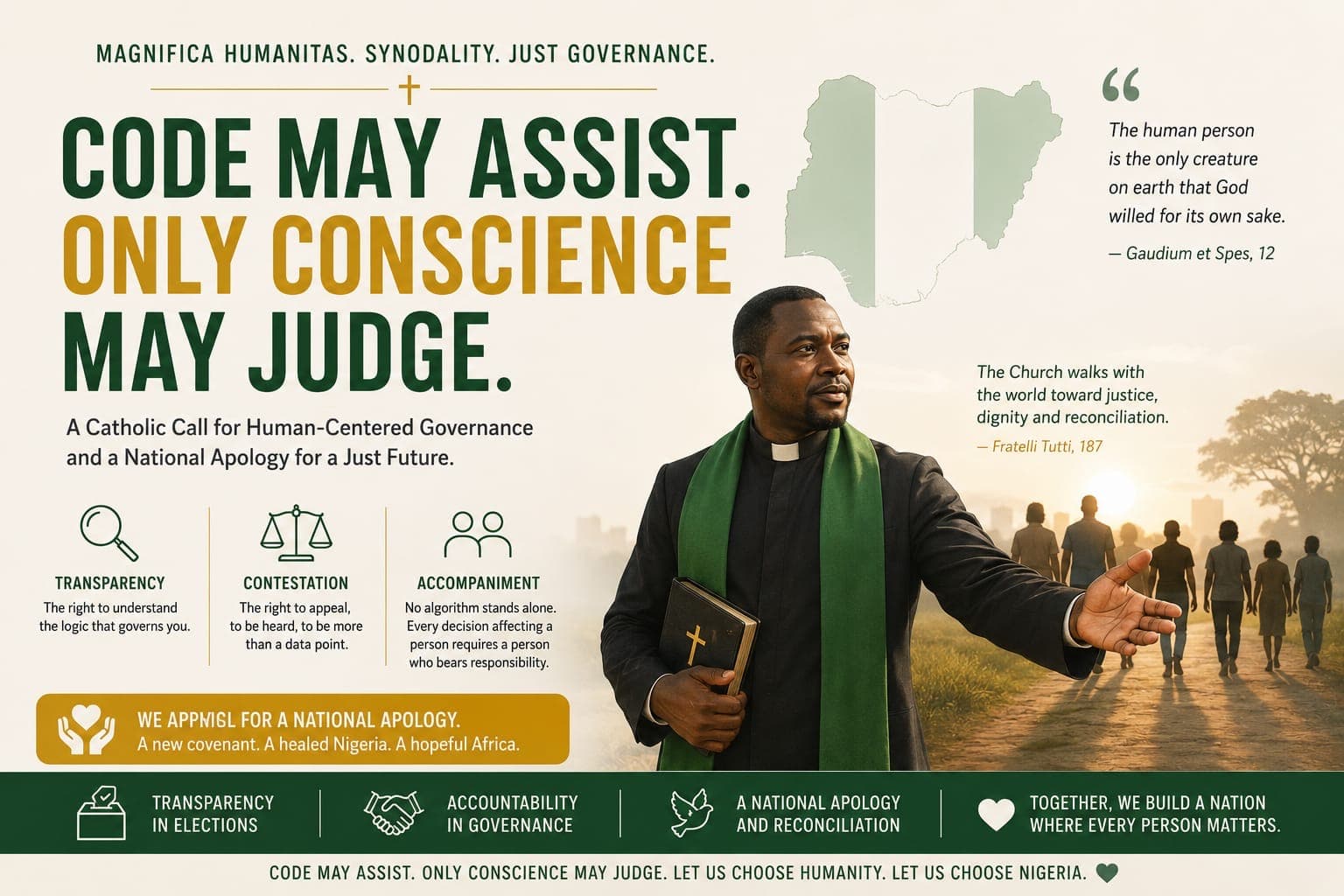
Transparency. The right to understand the logic that governs you. If an algorithm denies your loan, your bail, your welfare application, you have the right to know why. Not the mathematical formula, the reason. Every AI system deployed in public governance must be auditable by independent bodies.
Contestation. The right to appeal, to be heard, to be more than a data point. If a machine decides against you, a human being must be available to review that decision. This is not optional. It is a human right. The dignity of the person requires it.
Accompaniment. No algorithm stands alone. Every system that affects a human life requires a human being who bears moral responsibility for its outcomes. The engineer who builds the system, the official who deploys it, the agency that funds it, none of them may hide behind the code. The Catechism’s principle of moral cooperation (CCC 1868-1869) applies: you are not exempt from the consequences of the systems you build simply because you built only one part.
These pillars are not anti-technology. They are pro-human. They are the synodal method applied to the digital age: walk together, listen together, build together, and never let the machine walk alone.
VII. A Word to the Builders
To Gen Z technologists in Lagos, Abuja, Nairobi, and Accra, you who code, you who design, you who dream of building systems that will change Africa:
The Church does not come to condemn you. The Church comes to accompany your conscience.
If you write the code, you carry the moral weight of what it does. You are not merely a developer. You are a moral agent. The system you build tonight in a co-working space in Yaba may tomorrow decide whether a woman in Maiduguri receives her social welfare payment. You carry that woman in your hands.
I propose concrete formation:
Ethics embedded in computer science education, not as an elective, but as a core requirement. Every computer science student in Nigeria should study the moral implications of algorithmic decision-making.
Mandatory human-impact assessments before deployment, just as we require environmental impact assessments for construction, we must require algorithmic impact assessments for governance systems.
Diverse voices at the design table, synodality in practice. If your development team does not include women, persons with disabilities, rural community members, and representatives of the populations your system will govern, your system is not ready for deployment.
To Gen X institutional leaders, in government, in banking, in INEC, in the judiciary:
Your experience is needed at the table that AI is trying to remove you from. You have seen systems fail. You have seen promises broken. You know that trust is built slowly and destroyed quickly. Bring that wisdom to the governance of AI. Do not let the technologists build alone. Do not let the politicians deploy alone. Walk together.
VIII. Vigil, Not Surrender: The Church Keeps Watch
I return to the young man in the Lagos courtroom. He is not a statistic. He is not a risk score. He is a someone, a son, a neighbor, a citizen, a creature made in the image of God. The algorithm that scored him did not know his name. It knew his zip code, his age, his arrest record, his neighborhood’s crime rate. It knew everything except what mattered: who he is.
The Church keeps vigil, not because it opposes the future, but because it refuses to let the future forget what a human being is.
We keep vigil over the ballot box, insisting that democracy remain a human act of conscience, not a technical exercise in data processing. We keep vigil over the courtroom, insisting that justice require a judge with a face, not a score from a server. We keep vigil over the classroom, insisting that education form the soul, not merely train the workforce. And we keep vigil over history, insisting that a nation which refuses to apologize for its wounds cannot heal them.
To Nigeria: your elections are approaching. The world is watching. You have the talent, the technology, and the moral tradition to build something extraordinary, an electoral system that restores the dignity of your vote, that honors the memory of the missionaries who built your schools, and that sets a standard the world will follow.
To the Church in Nigeria: we walk together. We discern together. We build together. The call of Magnifica Humanitas is not only for Rome, it is for every parish, every school, every hospital, every voting booth in this nation.
Code may assist. Only conscience may judge.
Let us innovate for a better democracy. Let us build elections that Nigeria and the world will trust. And let us do it together, in the synodal spirit of listening, transparency, and shared responsibility, so that when our children ask what we did when the code began to judge, we can answer: we kept watch, we walked together, we chose the human person.
For partnership and collaboration:
Rev. Fr. Oliver (Ikenna) Nwagbara, CCE
Ethical Innovator & Synodal Secretary
Founder, Yes Catholic Hangout
Halifax, Nova Scotia, Canada