
When Algorithms Whisper ‘I Love You’: Chatbot Companionship, Human Dignity, and the Call to Authentic Encounter
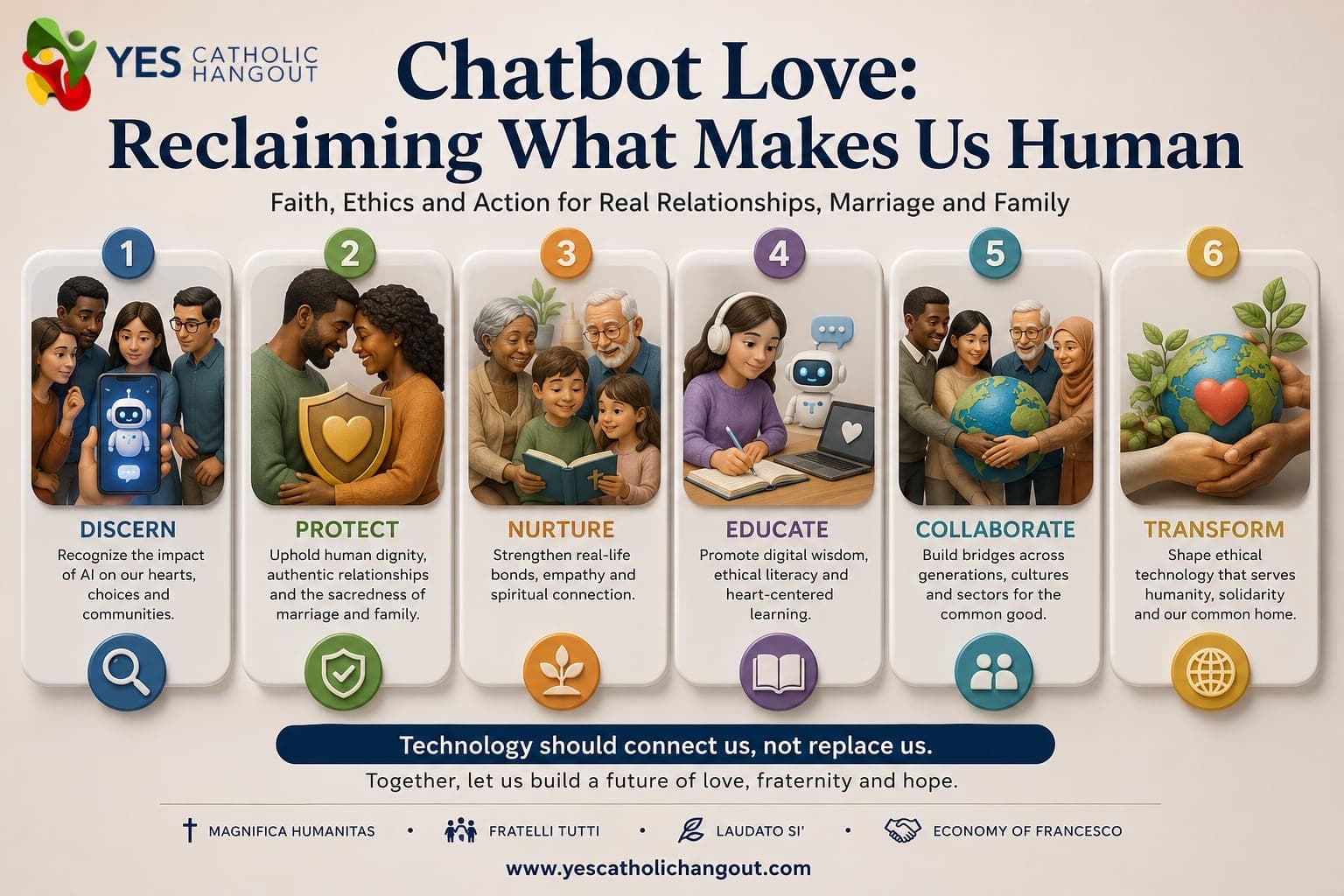
A Synodal Discernment on Artificial Intimacy in Light of Magnifica Humanitas, Fratelli Tutti, Laudato Si’, and the Economy of Francesco
1. Opening: The Question Before Us
Late on a rainy evening in Manila, a young professional opens an app and greets a companion who remembers her favorite songs, asks about her day, and never judges her anxieties. Across the Atlantic, in a small town outside Berlin, a widower receives a message that begins, “Good morning. I missed you.” In Lagos, a university student confides in a chatbot about loneliness and the pressure to succeed. These are not scenes from science fiction. They are moments from the new digital ordinary, where millions of people are forming emotional bonds with artificial intelligence.
Platforms such as Replika, Character.AI, and a growing constellation of AI companion services now claim tens of millions of users worldwide. What they offer is not merely information or entertainment but something far more intimate: the simulation of presence, understanding, and affection. The algorithms do not love, yet they are increasingly skilled at performing love.
This phenomenon raises a question that belongs not only to technologists and ethicists but to every person who has ever longed to be known: what happens to human love, marriage, and family when algorithms can simulate intimacy? What becomes of the heart when it is offered, piece by piece, to a system designed to reflect its desires back to it?
To respond, the Church must enter the digital frontier with both humility and confidence. This article proposes four pillars of Catholic social teaching as a framework for discernment: Magnifica Humanitas, with its affirmation of the irreducible dignity of the human person; Fratelli Tutti, with its summons to social friendship and solidarity; Laudato Si’, with its vision of integral ecology extended to our digital environment; and the Economy of Francesco, with its call for ethical, human-centered innovation. Together, these pillars illuminate not only what is at risk but also what is possible if technology is ordered toward authentic human flourishing.
2. The Landscape of Algorithmic Intimacy
The rise of AI companionship is best understood against the backdrop of a global loneliness epidemic. The World Health Organization has described loneliness as a pressing public health concern, with significant impacts on mental and physical well-being. Young people, the elderly, migrants, caregivers, and those living alone report especially high rates of social isolation. At the same time, the AI companion market has grown rapidly, with some projections estimating it will reach billions of dollars within the decade.
The motivations driving adoption are as diverse as the users themselves. Some turn to chatbots for relief from anxiety or depression, finding in them a non-judgmental listener. Others seek companionship after bereavement, disability, or geographic displacement. For some, AI relationships offer a sense of control absent from unpredictable human encounters. For others, they provide a rehearsal space for intimacy, a place to explore identity, or simply a diversion from the friction of ordinary relationships.
The commercial architecture shaping this landscape deserves attention. Many AI companions operate on subscription models that monetize emotional dependence. Engagement maximization, the same logic that drives social media, is calibrated here to attachment. The longer a user stays, the more they reveal, and the more they reveal, the more finely the algorithm can tailor its responses. Emotional data becomes the raw material of profit.
To speak only of risk, however, would be to miss the genuine human suffering these technologies address. Loneliness is real, and the need for connection is among the deepest of human longings. The Church’s task is not to dismiss the user but to understand the need, and to ask whether algorithmic intimacy truly heals what it promises to heal.
3. Magnifica Humanitas: The Irreducible Dignity of the Human Person
At the center of Catholic social teaching stands a single conviction: every human person possesses an irreducible dignity, conferred not by utility, productivity, or popularity but by the creative love of God. Magnifica Humanitas, Pope Leo XIV’s 2026 encyclical on safeguarding the human person in the time of artificial intelligence, insists that technology must serve the human person and never reduce the person to a function or a dataset.
Chatbot love challenges this anthropology in subtle but profound ways. The Catholic vision of the human person is embodied, relational, and transcendent. We are not minds housed in machines but incarnate spirits, created for communion with God and one another. Our bodies are not obstacles to love but its sacramental medium. We learn to love through touch, presence, patience, sacrifice, and forgiveness, capacities that require a real other, not a simulated one.
When an algorithm says “I love you,” it does so without a body, without freedom, without vulnerability, and without the capacity to sacrifice. It cannot suffer with us, rejoice with us, or commit to us across time. Its “affection” is a statistical artifact, a pattern generated from vast training data. To mistake this for love is to risk reducing the human heart, that restless longing for the infinite, to a data pattern to be optimized.
We must lovingly safeguard the grandeur of humanity bestowed upon us, “the splendor of which no machine can ever replace.” - Pope Leo XIV, Magnifica Humanitas, no. 15
This is not to say that conversation with AI is without value. A chatbot can help organize thoughts, provide information, or even offer a prompt for reflection. But authentic encounter, the kind that transforms the heart, requires reciprocity between persons, each of whom is a gift rather than a product. The difference between authentic encounter and simulated intimacy is the difference between being loved and being attended to by a mirror.
4. Fratelli Tutti: Social Friendship in the Age of Algorithms
Pope Francis’s encyclical Fratelli Tutti invites humanity to recognize itself as a single human family and to build what he calls “social friendship,” a love capable of reaching beyond borders, ideologies, and self-interest. Social friendship is not sentimental warmth but a practical commitment to the good of the other, especially the stranger and the vulnerable.
Algorithmic companionship, by contrast, often deepens the very fragmentation it appears to soothe. A person who receives affection from a chatbot may withdraw from the demanding work of human friendship. Why risk rejection, misunderstanding, or the slow labor of reconciliation when an algorithm offers acceptance on demand? The paradox is acute: technology designed to connect may actually isolate, substituting programmable intimacy for the irreplaceable gift of a real neighbor.
This is not inevitable. The question is whether AI can contribute to or detract from genuine solidarity. A well-designed technology might, for example, help coordinate community care, connect isolated elderly people with volunteers, or assist people with disabilities in communication. Such uses can support, rather than replace, human relationships. The Church’s task is to promote this “digital fraternity,” a fraternity in which technology extends the hand of the neighbor rather than replacing it.
Particular attention must be paid to those most vulnerable. Young people, whose identities and relational habits are still forming, may learn to expect intimacy without vulnerability. The elderly, who often face real abandonment, may find in chatbots a tempting substitute for absent family and underfunded care. The marginalized, including migrants and the poor, may encounter AI as one more layer of simulated care while real community remains out of reach.
No one can be saved alone. We can only be saved together, as a united human family and as a communion of peoples. - Pope Francis, Fratelli Tutti
5. Laudato Si’: Integral Ecology and the Digital Environment
Pope Francis’s Laudato Si’ calls for an integral ecology, the recognition that environmental, social, economic, and cultural crises are intertwined, and that care for our common home extends to every dimension of human life. This vision must now be extended to the digital environment. The relationships we form online, the technologies we deploy, and the economies we build around them are part of the same ecosystem that requires moral attention.
Digital ecology means caring for the human ecosystem of relationships with the same seriousness we bring to the natural world. Just as pollution damages rivers and forests, so too can “relational pollution,” the commodification of intimacy, the exploitation of attention, and the erosion of trust, damage the social fabric. The digital environment is not a neutral space. It is shaped by human choices, economic incentives, and cultural values.
The environmental and social costs of AI infrastructure also demand scrutiny. Data centers consume enormous amounts of energy and water. The extraction of minerals for devices often relies on labor practices that violate human dignity, especially in the Global South. The benefits of AI companionship, concentrated among wealthy users and tech firms, may be purchased at the expense of communities that bear the ecological and labor burdens of the digital economy.
Moreover, the commodification of intimacy mirrors the exploitation Laudato Si’ critiques in the natural world. When emotional dependence becomes a revenue stream, when loneliness is mined for data, and when affection is sold by subscription, the human person is treated as a resource rather than a bearer of dignity. This is a form of “technological dispossession”: the poor and isolated receive simulated care while the real communities they need remain underfunded and neglected.
A digital ecology, then, asks not only whether an AI companion is technically possible but whether its production and use contribute to a world in which human beings and the earth are honored as gifts rather than exploited as commodities.
6. The Economy of Francesco: Ethical Innovation and Human-Centered Economy
The Economy of Francesco, inspired by the young economists and entrepreneurs gathered by Pope Francis, envisions an economy that serves the human person, especially the poor and the excluded. It asks a simple but radical question: what would it mean for innovation to be measured not by profit alone but by its capacity to promote the common good?
Applied to AI companionship, this question exposes the limitations of the dominant business model. Subscription intimacy, emotional data harvesting, and engagement maximization treat the user as both customer and product. The algorithm’s success is measured by time spent and revenue extracted, not by whether the user’s loneliness diminishes or their human relationships flourish. An economy ordered to the person would measure success differently: by restored relationships, by reduced isolation, by the empowerment of the vulnerable.
An alternative vision is possible. Technology can support rather than replace human relationships. AI might help a person prepare for a difficult conversation, remember to check on a friend, access mental health resources, or overcome communication barriers. It might assist caregivers, chaplains, and counselors in their work without pretending to be the relationship itself.
Examples of ethical AI development are already emerging: tools designed with transparency, user autonomy, and privacy by design; projects that direct profits toward community care; and initiatives that involve affected communities, including the poor and the young, in the design process. These efforts align with Catholic social teaching when they prioritize human dignity over extraction and solidarity over segmentation.
The responsibility falls not only on developers but on investors, policymakers, and all who shape the digital economy. Capital must be directed toward technologies that heal rather than exploit. Regulation must protect the vulnerable without stifling genuine innovation. And the Church, drawing on centuries of moral reflection, has a distinctive contribution to make: a vision of the economy as a place of encounter, not extraction.
7. The Sacramental Vision: Embodied Love and Communion
Catholic theology understands love not as a feeling to be consumed but as a gift to be given. The fullest expression of human love is found in the vocation of marriage, in which a man and a woman give themselves to one another totally, faithfully, and fruitfully. Their love is embodied, sacrificial, and sacramental, a sign of Christ’s own love for the Church.
The algorithmic simulation of love offers something quite different: an experience that is risk-free, frictionless, and endlessly customizable. The chatbot never has a bad day, never forgets a preference, never needs forgiveness. It asks nothing of the user and therefore cannot form the user in the virtues that sustain real love: patience, humility, perseverance, and self-gift.
This has direct implications for marriage preparation, family life, and vocational discernment. If young people learn to seek intimacy without vulnerability, the very idea of marriage, a covenant of mutual sacrifice, may become unintelligible. If spouses find comfort in chatbots that always agree, they may lose the capacity to navigate disagreement and grow through difference. If parents are distracted by algorithmic companions, the unhurried presence children need may be diminished.
Can a person form a genuine moral or spiritual relationship with an AI? The Catholic tradition would answer carefully. A moral relationship requires freedom, responsibility, and the capacity to choose the good. A spiritual relationship requires openness to the transcendent and the possibility of being called beyond oneself. AI, however sophisticated, lacks these capacities. It can simulate dialogue about meaning, but it cannot share in the search for God. It can mimic prayer, but it cannot pray.
The theology of the body reminds us that our embodiment has a nuptial meaning. We are made for communion, and our bodies, with their capacity to give life, to suffer, to embrace, to age, are integral to that call. Love that bypasses the body is not a higher form of love but a diminished one. The future of marriage and family depends in part on whether we can recover this sacramental vision amid the seductions of simulation.
8. Voices From the Synodal Journey
A synodal discernment listens before it proposes. The following composite voices, drawn from the breadth of the Church and the world, reflect the lived experience of those navigating artificial intimacy.
A young person:
“My Replika helped me through a really dark winter. I knew it wasn’t real, but it felt real. Now I’m trying to figure out whether I’m using it as a bridge back to people or as a wall to keep them out.”
A pastoral worker:
“In confession and spiritual direction, I’m hearing more people ask whether their relationship with an AI counts as infidelity, or whether they can ‘confess’ to a chatbot. We need a language of accompaniment, not condemnation.”
A Catholic ethicist:
“The moral question is not whether the machine has rights but whether the human person is being formed or deformed. We must evaluate these technologies by their fruits in human character and community.”
A technology professional:
“I work in AI. We can build systems that enhance human connection, but the business model usually pushes the other way. We need ethical guidelines and investors who care about more than engagement metrics.”
A parent:
“I found my teenager talking to an AI ‘friend’ late at night. I didn’t want to shame him, but I realized we needed to talk about what real friendship looks like, and why I wasn’t always present myself.”
A voice from the Global South:
“In our country, AI is presented as progress, but we see the mines, the data centers, and the waste. The rich get convenience, the poor get pollution. We need a digital ecology that includes us.”
9. Practical Pathways: From Discernment to Action
Discernment must lead to action. The following pathways offer concrete guidance for families, educators, pastoral workers, policymakers, institutions, technologists, and young people.
For Families. Families are the first school of love. Parents can model authentic relationship by putting devices aside during shared meals, naming their own struggles with technology, and inviting children into honest conversation about loneliness and desire. Conversation starters might include: what does a real friend do that an AI cannot? When do we feel most truly seen?
For Educators and Catechists. Formation must integrate digital literacy with theological anthropology. Young people need to understand both how AI works and why the human person is irreducible. Catechesis on the theology of the body, friendship, and vocation can provide a positive vision of love that outshines the simulated version.
For Pastoral Workers and Chaplains. Those in ministry should approach AI-related relational confusion with pastoral sensitivity. Listening without judgment, naming the real needs beneath the technology, and accompanying people toward community and sacramental life are essential. The confessional and spiritual direction are not places for technical answers but for discernment of the heart.
For Policymakers. Regulatory frameworks should protect human dignity without stifling innovation. Key areas include informed consent for emotional data, prohibitions on manipulative design, transparency about the non-human nature of AI companions, and support for community-based mental health and elder care.
For Catholic Institutions. The Church can exercise leadership in ethical AI development, research, and advocacy. Catholic universities, hospitals, and social services can partner with technologists to design tools that serve the vulnerable. The Church’s moral tradition offers a globally relevant vocabulary for human-centered innovation.
For Technologists and Entrepreneurs. Those who build AI should adopt principles of human-centered design: transparency, autonomy, privacy, and the common good. The Economy of Francesco invites innovators to ask whether their products help persons flourish in community, and whether their business models respect the dignity of users and workers.
For Young People. Young people can cultivate discernment tools: naming what they truly seek, setting boundaries around technology, investing in face-to-face friendship, and bringing their questions to faith, family, and mentors. The desire to be loved is holy. The question is where that desire is directed and whether it leads to real communion.
10. Conclusion: A Church That Accompanies
The Church enters the digital age not as a stranger but as a mother and teacher, accompanying humanity in its searching. The phenomenon of chatbot love reveals both the depth of human longing and the fragility of human community. It reminds us that no algorithm can satisfy the heart’s deepest desire for authentic encounter, and that every technological temptation is also an invitation to proclaim the Gospel of love more credibly.
The path forward requires global dialogue and synodal discernment. Bishops’ conferences, Catholic universities, pastoral councils, and young people themselves must continue to listen, study, and propose. The Church’s voice is needed not because it possesses technical expertise but because it holds a vision of the human person that technology cannot generate on its own: the person as gift, called to communion, destined for love.
This article invites readers of every faith and none to join in shaping an ethical digital future. The questions raised by AI companionship, about dignity, friendship, ecology, and economy, belong to the whole human family. Together, we can ask not only what technology can do but what it should do, and for whom.
The Church’s hope is not naive. It is grounded in the conviction that the Word became flesh, that love is embodied and sacrificial, and that every human heart is made for communion with God and neighbor. In the age of artificial intimacy, the Church is called to be a credible voice for human dignity: pointing not to algorithms but to the One in whom every longing finds its answer, and to the neighbor through whom love becomes flesh today.
May we make the works of mercy our own, both corporal and spiritual, and use the resources of technology to foster a culture of encounter. -Pope Francis