
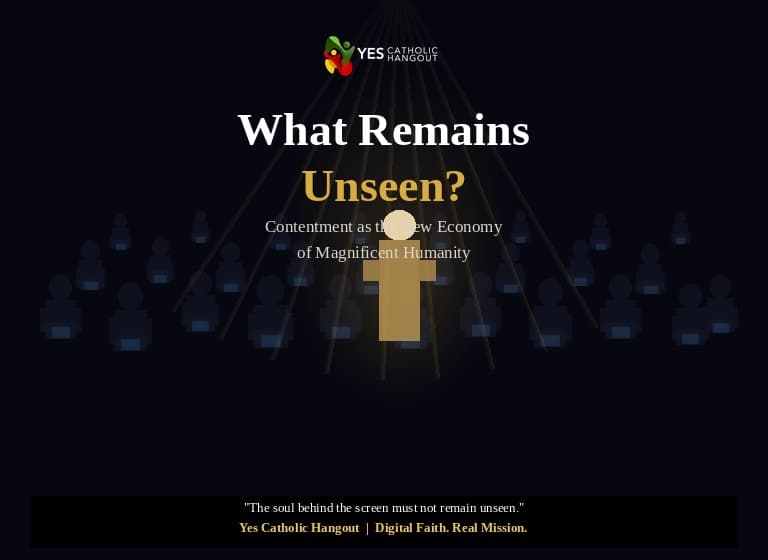
What Remains Unseen? Contentment as the New Economy of Magnificent Humanity
The Question the Digital Economy Avoids
The Fourth Industrial Revolution has taught the world how to measure almost everything. We measure clicks, outputs, views, speed, engagement, productivity, efficiency, conversion, growth, and market reach. We measure how fast a system performs, how long a user stays, how much a worker produces, and how much a platform earns. Yet the most important realities in human life often remain unseen.
We rarely measure whether a young person feels truly accompanied. We rarely measure whether a family has peace at home. We rarely measure the hidden exhaustion of workers, the dignity of the poor, the wisdom of elders, the tears of migrants, the loneliness behind online visibility, or the spiritual damage caused by a culture of endless comparison. We rarely measure whether our technology is forming saints or simply producing consumers.
This is the question Magnifica Humanitas places before the digital economy: what remains unseen when humanity measures growth but forgets the human person?
In the age of artificial intelligence, automation, digital manipulation, autonomous systems, economic exploitation, ecological crisis, ideological polarization, and war, the Church must lead with a new moral imagination. The future cannot belong only to those who control data, weapons, markets, or machines. The future must belong to human dignity, fraternity, peace, integral development, and ethical innovation.
This is why contentment must be taught as a new economy. Contentment is not laziness. It is not fear of progress. It is not a rejection of enterprise, technology, or ambition. Contentment is the disciplined freedom to know what is enough, so that every person can have enough. It is the economy of dignity over domination, shared bread over greed, peace over profit, and human flourishing over endless accumulation.
Contentment Is What Growth Often Fails to See
Modern economies often celebrate what can be counted while neglecting what must be cherished. A nation can grow economically while families collapse emotionally. A company can become more efficient while workers become more anxious. A platform can increase engagement while deepening loneliness. A society can become technologically advanced while becoming spiritually poor.
Catholic Social Teaching asks a deeper question. It does not ask only, "Did we grow?" It asks who grew, who was left behind, who was wounded, who was excluded, who became more human, and who was treated as disposable.
Six contrasts reveal what Magnifica Humanitas asks us to see beyond what the old economy measures. Where the old economy measures productivity, Magnifica Humanitas asks whether work protects human dignity and allows rest, family life, prayer, and purpose. Where it measures efficiency, the question becomes whether speed serves the person or turns the person into a machine. Where it measures growth, the question becomes whether growth includes the poor, protects creation, and strengthens peace. Where it measures engagement, the question becomes whether digital platforms build authentic relationships or exploit attention. Where it measures innovation, the question becomes whether technology serves human dignity, truth, transparency, and accountability. Where it measures security, the question becomes whether peace is pursued through justice, dialogue, and fraternity rather than domination.
Contentment makes the unseen visible. It reveals that a human being is more than economic output. It reveals that the poor are not problems to be managed but persons to be welcomed. It reveals that creation is not raw material for endless consumption but a common home entrusted to humanity. It reveals that peace is not weakness but the highest intelligence of civilization.
The Church Must Lead, and the Priest Must Walk in Front
The Church must not stand at the edge of the digital age waiting to comment after the damage has been done. The Church must lead the way. Priests, religious, catechists, Catholic educators, parents, entrepreneurs, and digital missionaries must become moral guides for a generation being formed by screens, algorithms, economic anxiety, and ideological noise.
The priest who leads in this new economy is not a distant manager of religious services. He is a shepherd of human meaning. He teaches that productivity without dignity is poverty. He teaches that efficiency without mercy is violence. He teaches that growth without justice is not development. He teaches that artificial intelligence without conscience becomes another tower of Babel.
For Gen Z, the Church must become a place where digital creativity is blessed, purified, and sent into mission. For Gen X, the Church must become a place where wisdom, responsibility, memory, and mentorship are honored. The bridge between these generations is not nostalgia. It is synodality.
The International Theological Commission explains that the word synod indicates the path along which the People of God walk together, and recalls the ancient Christian image of the Church as a community that walks together in communion. This means the Church's leadership in the Fourth Industrial Revolution must be listening leadership. It must not silence young people. It must not discard elders. It must gather both into a shared mission.
A synodal Church teaches the digital world that the fastest voice is not always the wisest voice, and the loudest voice is not always the truest voice.
The Economy of Francesco and the Economy of Enough
The Economy of Francesco already gives young people, entrepreneurs, economists, and change-makers a language for this transformation. Pope Francis said that a new economy inspired by Saint Francis of Assisi "can and must become an economy of friendship with the earth and an economy of peace," transforming "an economy that kills into an economy of life."
In 2024, he told the Economy of Francesco delegation that the world of economics needs change and that young people will help change it by loving the economy in the light of God, prioritizing workers, the poor, and the situations of greatest suffering.
This is where contentment becomes revolutionary. An economy of life cannot be built on permanent dissatisfaction. An economy of peace cannot be built on competition that dehumanizes. An economy of friendship with the earth cannot be built on endless extraction. An economy that leaves no one behind cannot measure success only by the wealth of those already ahead.
Contentment is the interior foundation of the Economy of Francesco. It teaches entrepreneurs to innovate without greed. It teaches consumers to desire without addiction. It teaches investors to seek value without destroying values. It teaches digital creators to influence without manipulating. It teaches communities to share bread instead of worshipping abundance.
Fratelli Tutti: What Remains Unseen Is the Brother and Sister
Fratelli Tutti calls humanity to rediscover fraternity and social friendship. Pope Francis writes that no one can face life in isolation and invites the human family to "dream together" as one. In a digital culture where people can be visible and still feel abandoned, this teaching is urgent.
The unseen person is often the one hidden behind the metric. The refugee becomes a statistic. The poor child becomes a data point. The unemployed graduate becomes an economic trend. The lonely young person becomes a user account. The elder becomes a burden. The unborn becomes an inconvenience. The enemy becomes a target. The worker becomes a cost.
Magnifica Humanitas rejects this reduction of the person. It insists that every person must be welcomed, valued, heard, and empowered from conception to natural death. It recognizes war as one of humanity's greatest moral failures because every war makes the human person invisible. War reduces the brother to an enemy, the family to collateral damage, the land to a battlefield, and the future to ashes.
This is why the mission of peace belongs inside the digital economy. In a world of artificial intelligence, misinformation, autonomous systems, polarization, and economic competition, peace must be designed, taught, defended, and practiced. Peace is not merely the absence of violence. Peace is the presence of justice, solidarity, truth, mercy, and authentic human relationship.
Laudato Si': What Remains Unseen Is the Earth
Laudato Si' teaches that care for creation, justice for the poor, social commitment, and interior peace belong together in one integral ecology. This matters deeply in the Fourth Industrial Revolution because digital systems are not weightless. They use energy, minerals, devices, land, labor, water, infrastructure, and human attention.
The old economy asks whether a technology can scale. The new economy of contentment asks whether it should scale, how it should scale, who benefits, who pays the hidden cost, and whether creation can breathe under its weight.
Five digital-age questions and their Catholic contentment responses define this discipline. Can this technology grow quickly? Growth must be judged by whether it serves life, justice, and dignity. Can this platform capture attention? Attention is part of the human soul and must not be exploited. Can this system replace workers? Innovation must protect work, reskill people, and honor human contribution. Can this product generate profit? Profit must remain subordinate to the common good. Can this tool influence behavior? Influence must respect freedom, truth, conscience, and human dignity.
Contentment is therefore ecological. It is a way of saying that the earth is not disposable, the poor are not invisible, and the future is not for sale.
Magnifica Humanitas: Ethical AI Must See the Whole Person
Magnifica Humanitas brings Catholic Social Teaching into direct conversation with artificial intelligence and the digital economy. Its mission is to ensure that technology remains a servant of humanity rather than its master.
Pope Francis' message for the 57th World Day of Peace emphasized that artificial intelligence can contribute positively to humanity and peace only when it is developed and used responsibly, respecting values such as inclusion, transparency, security, equity, privacy, and reliability. This is precisely the moral field where Magnifica Humanitas must speak with courage.
AI systems can calculate patterns, but they cannot replace conscience. Algorithms can predict behavior, but they cannot define human dignity. Machines can increase efficiency, but they cannot decide the meaning of mercy. Data can reveal trends, but it cannot see the soul.
Magnifica Humanitas therefore asks the question the digital economy often avoids: what remains unseen by the machine, but must be protected by the human family?
The answer is clear. What remains unseen is the person behind the data, the worker behind the output, the child behind the statistic, the family behind the policy, the village behind the supply chain, the ecosystem behind the device, the prayer behind the struggle, and the soul behind the screen.
Yes Catholic Hangout: Making the Unseen Visible in Real Time
Yes Catholic Hangout is strategically positioned to make this mission practical. Its public identity already presents it as a Catholic mission at the frontier of the digital age, rooted in the Church's Social Doctrine and Magnifica Humanitas, promoting ethical AI and building digital solutions that serve human dignity rather than replace it.
Yes Catholic Hangout can become a living resource center for the economy of contentment. It can help Gen Z transform creativity into mission. It can help Gen X transform wisdom into mentorship. It can help priests and Church leaders understand the digital continent. It can help vulnerable learners gain skills in product design, data analytics, video editing, frontend development, backend development, ethical AI, entrepreneurship, and digital evangelization. It can help minority Churches build digital synodal platforms where people are not only reached, but heard.
Six functions define Yes Catholic Hangout's strategic contribution to the economy of contentment. As a digital skills formation platform, it equips young people and adults to participate with dignity in the Fourth Industrial Revolution. As an ethical AI education hub, it helps communities understand transparency, accountability, human oversight, and dignity-centered innovation. As a synodal digital platform builder, it creates spaces where Churches, youth, elders, migrants, and communities can listen, discern, and act together. As a mentorship bridge across generations, it connects Gen X wisdom and Gen Z digital creativity through accompaniment and shared mission. As a sponsor-a-learner pathway, it turns solidarity into concrete support for vulnerable people excluded from digital opportunity. As a relational evangelization space, it replaces algorithmic isolation with accompaniment, catechesis, community, and authentic friendship.
The strategic message should be bold: Yes Catholic Hangout is not simply online Catholic content. It is a Catholic digital mission infrastructure for human dignity in the Fourth Industrial Revolution.
The Five Pathways of Magnifica Humanitas
Magnifica Humanitas proposes five pathways that can become the practical architecture of this new economy, each responding directly to the unseen wounds of the digital age.
Synodal Listening makes visible the voices of people, communities, nations, and generations that are often ignored before decisions are made. Relational Evangelization makes visible the need for accompaniment, mentorship, catechesis, and community in a culture of algorithmic isolation. Ethical AI Governance makes visible the moral responsibilities hidden behind code, data, automation, and platform design. Integral Human Development makes visible the full human person: spiritual, social, economic, ecological, cultural, and relational. Digital Missionary Formation makes visible the young people and adults who can become builders of peace through technology, data, entrepreneurship, and evangelization.
These pathways show that contentment is not withdrawal from the world. It is a disciplined way of rebuilding the world around what is truly human.
A Message to Gen Z and Gen X
To Gen Z: your creativity is not an accident. Your digital instinct, your hunger for authenticity, your frustration with hypocrisy, and your desire for impact can become a mission. But do not let the attention economy disciple you more deeply than the Gospel. You were not created merely to be seen. You were created to love, build, serve, and become holy.
To Gen X: your wisdom is needed. Your resilience, memory, sacrifice, and practical intelligence can become mentorship for a generation facing pressures you did not inherit in the same way. Do not retreat from the digital world. Enter it as a guide. Help younger people build without burning out, create without losing their conscience, and lead without forgetting the poor.
To priests and Church leaders: this is the time to lead. Teach contentment as freedom. Teach peace as intelligence. Teach technology as service. Teach growth as responsibility. Teach synodality as the Church's way of walking with humanity. The people do not need a Church that fears the future. They need a Church that can bless what is good, resist what is dehumanizing, and reveal Christ in the digital continent.
The New Economy Begins With a New Measure
If the old economy asks, "How much did we produce?" the new economy asks, how much dignity did we protect? If the old economy asks, "How efficient did we become?" the new economy asks, who was cared for along the way? If the old economy asks, "How fast did we grow?" the new economy asks, did our growth make peace, justice, and human flourishing more possible?
This is the new measure. This is the unseen becoming visible.
We measure productivity. We measure efficiency. We measure growth. Now we must also measure dignity, peace, contentment, fraternity, ecological care, spiritual health, and the flourishing of every human person.
The future does not belong to weapons, domination, or technological control. The future belongs to fraternity, dialogue, ethical innovation, and the flourishing of every human person from conception to natural death.
Contentment is our economy. Shared bread is our wealth. Human dignity is our technology. Synodality is our way. Peace is our future.
Join the movement for Ethical Technology, Synodality, Integral Human Development, and the Economy of Contentment at www.yescatholichangout.com.
Companion Social Media Copy
Short Caption
We measure productivity. We measure efficiency. We measure growth. But what remains unseen?
The human person. The poor. The tired worker. The lonely young creator. The displaced family. The wounded earth. The need for peace. The soul behind the screen.
Magnifica Humanitas teaches that contentment is a new economy: an economy where technology serves dignity, AI serves peace, growth serves the common good, and every person is welcomed, valued, heard, and empowered.
Join the movement for Ethical Technology, Synodality, Integral Human Development, and the Economy of Contentment at www.yescatholichangout.com.
LinkedIn and Facebook Post
The digital economy measures almost everything: productivity, efficiency, growth, engagement, speed, and scale.
But Catholic Social Teaching asks the deeper question: what remains unseen?
What about human dignity? What about the poor? What about ecological cost? What about the mental health of young people? What about the wisdom of elders? What about families, migrants, workers, peace, prayer, and the human soul?
Magnifica Humanitas proposes a new way forward: contentment as a new economy. This is not laziness or fear of innovation. It is the moral discipline of knowing what is enough so that every person can have enough.
Inspired by the Economy of Francesco, Fratelli Tutti, Laudato Si', and synodality, Yes Catholic Hangout is positioned as a Catholic digital mission infrastructure for the Fourth Industrial Revolution, forming people in ethical AI, digital skills, relational evangelization, and integral human development.
The future must not belong to weapons, domination, or technological control. The future belongs to fraternity, dialogue, ethical innovation, and magnificent humanity.
Learn more at www.yescatholichangout.com.
Thread-Style Version
We measure productivity. We measure efficiency. We measure growth. But what remains unseen?
The poor remain unseen. The lonely remain unseen. The exhausted worker remains unseen. The migrant family remains unseen. The wounded earth remains unseen. The soul behind the screen remains unseen.
Magnifica Humanitas says the digital economy must recover the human person. Technology must serve humanity, not replace it.
Contentment is a new economy. It is the freedom to know what is enough so that every person can have enough.
The Economy of Francesco calls for an economy of life, peace, and friendship with the earth. Fratelli Tutti calls us to fraternity. Laudato Si' calls us to care for our common home. Synodality calls us to walk together.
Yes Catholic Hangout can help make this real through ethical AI formation, digital skills, synodal platforms, mentorship, and support for vulnerable learners.
The future does not belong to domination or technological control. The future belongs to human dignity, dialogue, peace, and integral development.
Contentment is our economy. Human dignity is our technology. Synodality is our way. Join the movement at www.yescatholichangout.com.
Suggested Hashtags
Magnifica Humanitas: #MagnificaHumanitas #HumanDignity #EthicalAI
Economy of Contentment: #ContentmentEconomy #EconomyOfEnough #EconomyOfLife
Catholic Social Teaching: #FratelliTutti #LaudatoSi #CatholicSocialTeaching
Synodality: #Synodality #WalkingTogether #ListeningChurch
Digital Mission: #DigitalEvangelization #CatholicTech #YesCatholicHangout
Peace: #ZeroWar #Peacebuilding #IntegralHumanDevelopment
Poster Text
We measure productivity. We measure efficiency. We measure growth. But do we measure dignity, peace, and the human soul? Contentment is the new economy.