
The Path to Communion in a Digital Age: Unity, Tradition, and the Mission of the Church Today
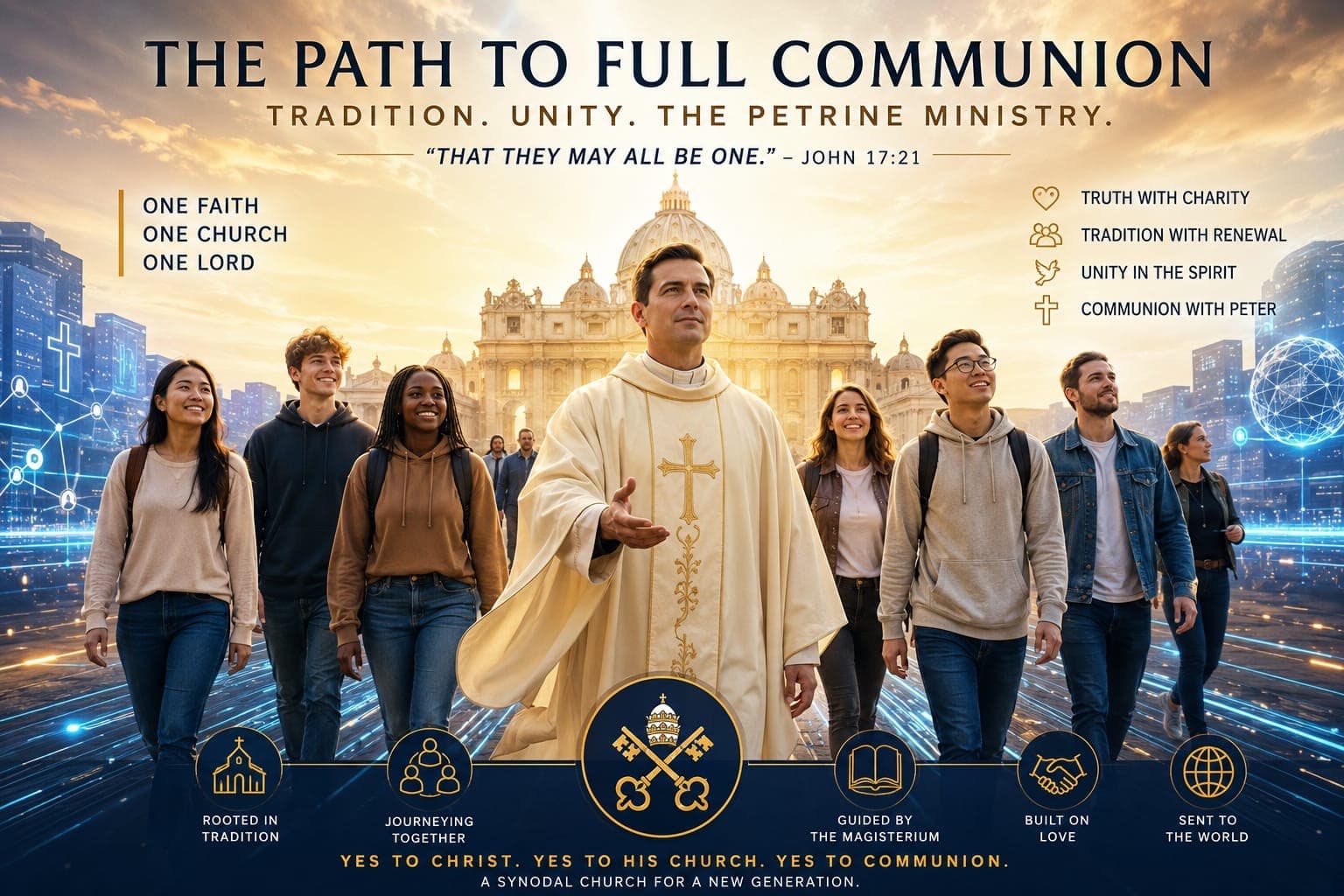
In every generation, the Church receives anew the prayer of Christ: «That they may all be one» (Jn 17:21). Today, that prayer resounds not only in parishes and dioceses, but across digital networks, global platforms, and emerging technological spaces that shape human relationships and understanding.
The question of unity is no longer confined to geographical boundaries. It now unfolds within a digital culture marked by rapid communication, fragmentation of narratives, and new forms of community. In this environment, the Church’s mission remains unchanged, yet her methods are called to develop with prudence and creativity—faithful to the message, and attentive to the signs of the times.
At the heart of this mission lies ecclesial communion. The Church understands communion as a visible and living reality, rooted in shared faith, sacramental life, and unity with the Successor of Peter (cf. Catechism of the Catholic Church, 815). This unity is not diminished by diversity; rather, it is enriched when lived in truth and charity.
In the digital age, however, the experience of belonging can become fragmented. Individuals may encounter aspects of Catholic tradition—liturgical, theological, or devotional—detached from the full life of the Church. This makes the Church’s call to communion all the more urgent: not as an institutional requirement, but as an invitation into a living relationship with Christ and His Body.
The Church’s ongoing efforts toward reconciliation, including dialogue with communities in irregular canonical situations, offer an important witness in this regard. They demonstrate that unity is pursued patiently, never imposed, and always oriented toward healing and truth.
Communion and Digital Responsibility
Digital culture offers remarkable opportunities for evangelization, but it also presents ethical and pastoral challenges. Algorithms can amplify division, reward polarization, and isolate individuals within self-reinforcing narratives. In such a context, the Church proposes a different path: a culture of encounter.
This vision resonates strongly with emerging initiatives that seek to align technological development with human dignity. Among these, Magnifica Humanitas represents a Vatican-inspired approach to ethical engagement in the digital economy.
Rooted in the Gospel and Catholic Social Teaching—including Laudato Si’ and Fratelli Tutti—this initiative emphasizes that technology must remain at the service of the human person. It calls for transparency, accountability, and human oversight in artificial intelligence systems, while promoting integral human development and peace.
Its guiding principle—“Adaptation: Faithful to the Message, Flexible in the Method”—captures a key dimension of the Church’s mission today. The content of the faith does not change, but its modes of communication must respond to new cultural realities.
Yes Catholic Hangout: A Digital Space of Encounter
Within this broader vision, Yes Catholic Hangout emerges as a concrete expression of digital evangelization rooted in communion.
As a Catholic pastoral outreach initiative, it is dedicated to fostering dialogue, accompaniment, and reconciliation in digital spaces. It seeks to build bridges where division exists, offering a witness that is both faithful to the Magisterium and attentive to the lived experiences of individuals.
Its mission is simple yet profound: to invite every person to say “Yes” to Christ, “Yes” to authentic tradition, “Yes” to the teaching authority of the Church, and “Yes” to unity with the Successor of Peter.
In practice, this means creating environments—both online and in-person—where people are heard, guided, and formed. It means engaging questions with patience, addressing misunderstandings with clarity, and accompanying individuals on a journey toward deeper communion.
Tradition and Innovation in Harmony
A recurring concern in contemporary ecclesial life is the relationship between tradition and change. In digital contexts especially, this tension can be amplified, as information is often presented without context or continuity.
The Church, however, understands tradition not as a static preservation of the past, but as the living transmission of the Gospel within the Church across time (cf. Dei Verbum, 8). This living tradition is safeguarded by the Magisterium and finds its fullest expression within ecclesial communion.
Thus, initiatives that engage digital culture must do so with both fidelity and discernment. Innovation is not opposed to tradition when it serves the same truth. Rather, it becomes a means through which that truth reaches new generations.
Toward a Culture of Peace and Communion
In a world increasingly marked by division—whether ideological, cultural, or technological—the Church’s witness to unity takes on renewed significance. The digital sphere, while often a place of fragmentation, can also become a space of encounter, dialogue, and reconciliation.
Magnifica Humanitas rightly emphasizes that humanity stands at a critical threshold. The development of artificial intelligence, autonomous systems, and global digital infrastructures raises profound ethical questions. In this context, the Church affirms that peace is not merely the absence of conflict, but the presence of justice, truth, and authentic human relationships (cf. FratelliTutti, 225).
The rejection of violence, the promotion of dialogue, and the commitment to human dignity are not abstract ideals; they are concrete responsibilities, especially for those engaged in shaping digital systems and narratives.
Take Home.
The path to full communion remains the same, even as the terrain evolves. It is a path marked by humility, conversion, prayer, and charity. It is sustained by fidelity to Christ and expressed through unity with His Church.
In the digital age, this path extends into new spaces, calling for renewed creativity and responsibility. Yet its goal remains unchanged: that all may be gathered into one, so that the world may believe.
«The Church never closes the door to reconciliation. Her deepest desire is that every member of Christ’s flock may journey together in truth, charity, and full communion, so that the world may believe.»