
The Eucharist Viz-à-Vis Magnifica Humanitas: A Recipe for Gen Z and Gen X Returning to the Church in the Age of Disarming Artificial Intelligence through an Anthropological Theoalgorithm
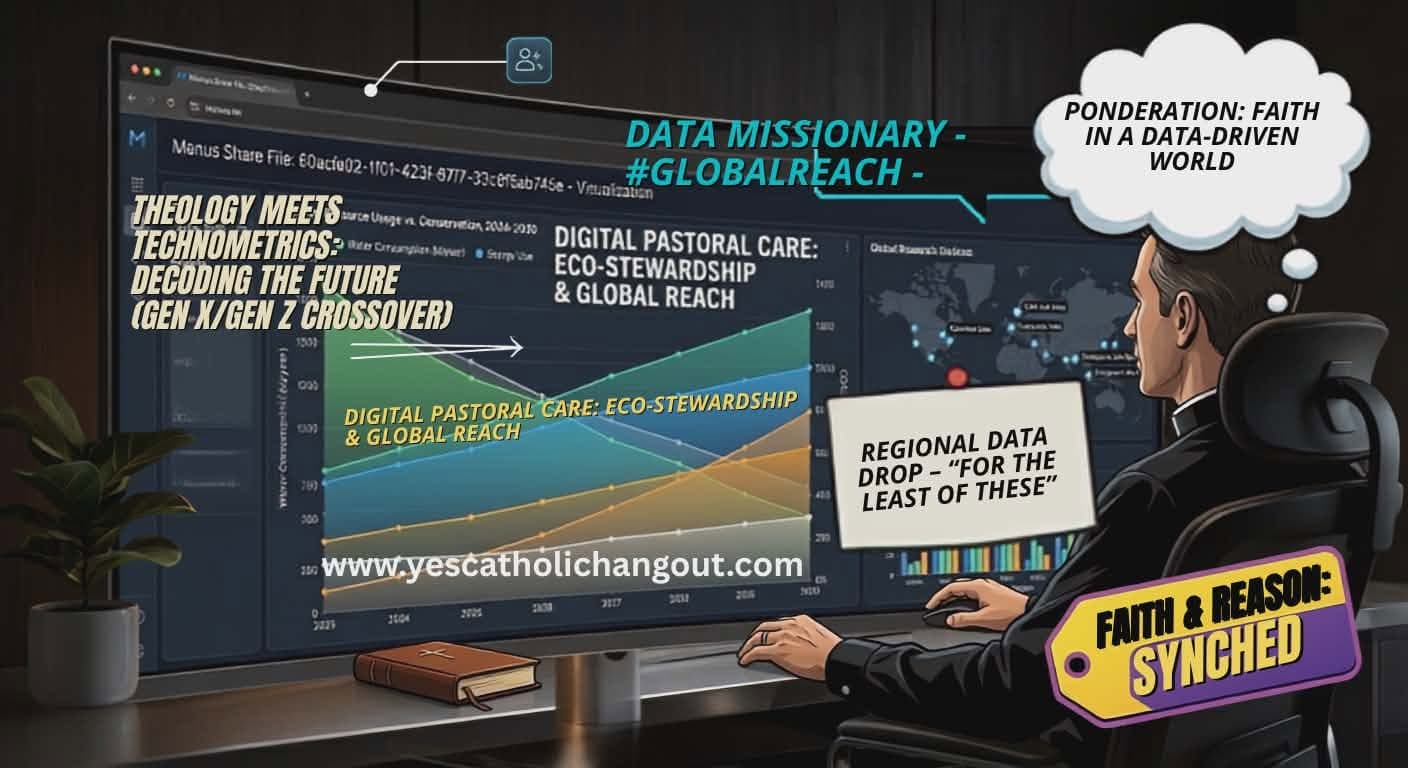
In an age in which machines learn, predict, imitate and persuade, the Church is summoned once again to announce a truth older than code and newer than every innovation: the human person is not a dataset, not a product, not a profile, not an expendable variable in the economy of attention, but a beloved creature made in the image of God and redeemed in the Body and Blood of Christ. The question of artificial intelligence is therefore not first a technological question. It is an anthropological, Eucharistic and spiritual question. It asks not merely what machines can do, but what humanity must never forget it is.
The Eucharist, contemplated viz-à-vis Magnifica Humanitas, becomes the luminous centre of this discernment. The Holy Eucharist reveals that humanity is most magnificent not when it becomes autonomous from God, but when it receives itself as gift and becomes gift for others. Pope Benedict XVI taught that the Eucharist is the "sacrament of charity," the gift by which Jesus Christ makes himself present and reveals the infinite love of God for every man and woman. In the Eucharist, the Church does not offer the world an ideology against technology. She offers a Presence that heals technology from within by restoring its true purpose: service to communion, truth, dignity, justice and peace.
The Eucharist is not an escape from the digital age; it is the sacramental grammar by which the digital age can learn again what it means to be human.
This is why the return of Gen Z and Gen X to the Church cannot be achieved merely by better branding, faster media or religious entertainment formatted for the feed. The Church must certainly speak the language of the digital continent, but she must not reduce the Gospel to a content strategy. She must invite the young and the wounded middle generation to the altar, where the restless heart encounters not an algorithmic suggestion but the living Lord who says, "This is my Body." In that encounter, identity is not manufactured; it is received. Vocation is not optimized; it is discerned. Communion is not simulated; it is given.
The New Babel and the Eucharistic Answer
The age of artificial intelligence has created a new kind of power. It promises efficiency, prediction, personalization and productivity. Yet, as Pope Francis warned, AI is both an "exciting and fearsome tool," because its benefits or harms depend on the moral horizon of those who design, deploy and govern it. It can democratize access to knowledge and assist scientific discovery, yet it can also deepen inequality, manipulate desire, intensify surveillance and enable a throwaway culture in which persons are measured only by utility.
The Church's recent reflection on AI has been clear and prophetic. Antiqua et Nova insists that human intelligence belongs to the whole person, while AI is functional and task-oriented; AI may perform tasks, but it does not think as a human person thinks. Pope Francis likewise reminded the world that decision-making must remain with human beings, and that human dignity depends on safeguarding proper human control over choices made by AI systems. In the sphere of war, he spoke with unmistakable moral clarity: "No machine should ever choose to take the life of a human being."
The biblical image is unmistakable. Every generation is tempted to build Babel: a city of technological splendour but spiritual amnesia, a tower rising upward while the soul collapses inward. The danger is not technology itself. The danger is technology without adoration, intelligence without wisdom, connectivity without communion, and progress without the poor. A civilization can possess astonishing instruments and yet forget the face of the human person.
Against this new Babel, the Eucharist reveals the architecture of communion. Consider the contrast:
Babel says: "Let us make a name for ourselves." The Eucharist says: "Do this in memory of me."
Babel seeks power through uniformity. The Eucharist creates unity through self-giving love.
Babel confuses language. The Eucharist purifies language by returning it to truth, gratitude and praise.
The temptations of the new Babel and their Eucharistic responses:
Human beings reduced to data, markets or profiles. The Eucharistic response: human beings received as persons created in God's image and called to communion.
Technology used for domination, manipulation or exclusion. The Eucharistic response: technology ordered toward service, solidarity, truth and the common good.
Algorithms optimized for profit and addiction. The Eucharistic response: conscience formed by charity, truth, temperance and justice.
Communication accelerated but emptied of meaning. The Eucharistic response: word and sacrament restoring silence, listening and real encounter.
Artificial intelligence treated as an oracle. The Eucharistic response: human decision preserved through wisdom, responsibility and moral discernment.
Anthropological Theoalgorithm: A Catholic Grammar for Ethical AI
I propose here the term Anthropological Theoalgorithm as a pastoral and ethical grammar for our technological moment. It is not a software protocol, nor a slogan baptized for convenience. It is a theological method of discernment. It asks that every algorithmic system be evaluated according to the truth of the human person revealed in Christ, nourished by the Eucharist and ordered toward the glory of God and the good of the human family.
An Anthropological Theoalgorithm begins with a simple but demanding conviction: every line of code touches a human destiny. A recommendation engine can shape desire. A hiring algorithm can open or close the door to work. A medical model can assist care or deepen bias. A social platform can connect the lonely or monetize loneliness. A generative system can educate or deceive. The moral question is therefore not whether AI is impressive, but whether it is truthful, just, accountable and humanizing.
This Catholic grammar converges with what the Rome Call for AI Ethics calls algorethics, the conviction that technological development must be shaped by transparency, inclusion, responsibility, impartiality, reliability, security and privacy. Yet the Christian contribution goes deeper still. It says that ethics is not merely compliance. Ethics is the expression of a rightly formed conscience. The algorithm must be accountable to the human person; the human person must be accountable to truth; and truth, for the Christian, is not an abstraction but a Person.
The principles of an Anthropological Theoalgorithm:
Eucharistic dignity. No person may be treated as disposable, because Christ gives himself for each person.
Human control. AI may assist decisions, but it must not replace human moral responsibility.
Truthfulness. Systems must resist disinformation, hallucination, synthetic deception and manipulative design.
Preferential care for the vulnerable. AI governance must protect children, the poor, workers, migrants, the elderly and those excluded from digital access.
Synodal accountability. Communities affected by AI should be heard in development, deployment and regulation.
Digital asceticism. Not every possible use is spiritually healthy; restraint is part of wisdom.
Missionary creativity. Technology should serve evangelization, catechesis, education, healing and communion.
This is the work of algorithmethics: to form consciences in the global technology industry so that designers, executives, engineers, investors, regulators and users ask not only, "Can we build it?" but also, "Should we build it, for whom, at what human cost and toward what final good?" If AI is trained only on human appetite, it will amplify appetite. If it is governed only by market desire, it will magnify inequity. But if it is placed within a moral ecology shaped by dignity, solidarity and truth, it can become a servant of integral human development.
Ratzinger's Clarity and Carlo's Digital Fire
To speak like Joseph Ratzinger is to insist that truth and love are not rivals. Truth without love becomes cold; love without truth becomes sentimental. The Eucharist is the place where truth and love are perfectly one. Christ does not merely explain love; he becomes food. He does not merely command communion; he creates it by giving himself. Benedict XVI described Christ in the Eucharist as the "food of truth," satisfying the human hunger for truth and freedom.
This is precisely the hunger of Gen Z. Beneath the irony, speed and online fluency of this generation lies a profound thirst for authenticity. They have seen curated identities, performative outrage, synthetic images, influencers without interiority and institutions that sometimes speak more than they listen. They do not need a Church that mimics the algorithm. They need a Church that witnesses to Reality. They need:
Eucharistic adoration and reverent liturgy
Intellectually serious catechesis
Honest answers
Beautiful community
Confession without humiliation
Mission without manipulation
To speak like Carlo Acutis is to add holy simplicity to theological depth. Carlo's programme was beautifully direct: "To always be united with Jesus, this is my life plan." He used the internet not to construct a narcissistic self, but to point beyond himself to Eucharistic miracles and to the living presence of Christ. Carlo shows the digital generation that holiness is not anti-digital; holiness is the right ordering of digital gifts toward Jesus. He did not worship the web. He evangelized through it.
Carlo also teaches the Church a crucial lesson for the AI age: digital creativity must be Eucharistic, not egoistic. The screen must become a window, not a prison. The platform must become a road to encounter, not a theatre of self-display. The Catholic digital missionary must ask whether every post, tool, model, website, podcast and AI system leads persons closer to truth, communion and holiness.
A Recipe for the Return of Gen Z and Gen X
The return of Gen Z and Gen X to the Church requires more than nostalgia. Gen X carries wounds of institutional distrust, family fragmentation, secular fatigue and often quiet spiritual loneliness. Gen Z carries the burdens of anxiety, hyperconnectivity, identity confusion, economic uncertainty and a world in which even images and voices can be artificially generated. Both generations are searching for something the algorithm cannot finally provide: a trustworthy presence.
The Church's recipe is therefore Eucharistic, synodal and missionary. It begins at the altar, but it does not end at the altar. The Mass sends the faithful forth in mission; the Catechism reminds us that the word Missa points to the sending of the faithful to fulfill God's will in daily life. The Eucharist forms a people capable of entering digital culture without being consumed by it.
The pastoral ingredients for welcoming back Gen Z and Gen X:
Beauty. Reverent liturgy, sacred music, silence and visual clarity. For Gen Z: recovery of wonder in a hyperscrolling world. For Gen X: recovery of awe after years of fatigue or cynicism. For Catholic technology: resist ugly, addictive and manipulative design; build humane digital spaces.
Truth. Serious catechesis that respects intelligence. For Gen Z: honest engagement with doubt. For Gen X: honest engagement with moral complexity. For Catholic technology: promote transparency, provenance and fact-checking in AI-generated content.
Belonging. Small groups, mentorship and digital-to-parish pathways. For Gen Z: connection to real community. For Gen X: intergenerational healing and renewed parish trust. For Catholic technology: use technology to connect persons to real communities, not replace them.
Mercy. Confession presented as healing, not shame. For Gen Z: pastoral accompaniment for the anxious and the searching. For Gen X: pastoral accompaniment for broken families and life wounds. For Catholic technology: AI pastoral tools must never replace priests, sacraments or spiritual friendship.
Mission. Carlo-style digital evangelization. For Gen Z: vocation as digital missionary. For Gen X: vocation in family, work, leadership and civic life. For Catholic technology: encourage Catholic technologists to build ethically and evangelize responsibly.
A parish wishing to welcome these generations should not begin by asking how to "capture attention." That is the question of the platform economy. The Church must ask how to restore attention to Christ. Eucharistic adoration is therefore not an optional devotion for the AI age; it is a school of liberated attention. In adoration, the human person learns again to be looked upon by Love without being analyzed, ranked, scored or sold.
Ethical AI Against Unethical AI
The Church is not against artificial intelligence. She is against the dehumanization of the human person. She is against:
AI used to deceive, exploit or surveil
AI used to manipulate elections or intensify addictions
AI used to replace conscience or automate killing
AI that concentrates power in the hands of the few
Synthetic falsehood masquerading as truth
Digital systems that know the user's habits but ignore the user's dignity
Ethical AI, by contrast, is humble about its limits. It admits that statistical prediction is not wisdom. It recognizes that the human being is always more than measurable behavior. It submits to human oversight, independent auditing, social accountability and moral law. It is designed with the vulnerable in view. It resists the temptation to make persons dependent, distracted or disposable. It serves education, healthcare, accessibility, ecological responsibility, pastoral communication and peace.
The warning is urgent because even religious life can be distorted by unethical AI. In 2026, the official Carlo Acutis association warned about fake AI videos that use images of Carlo, his parents or other Church figures to make false claims, urging people to consult official sources. This is not a marginal concern. It is a sign of the times. If even saints can be synthetically ventriloquized, then the Church must become a global teacher of digital discernment.
A Call to the Global Technology Industry
To the global technology industry, the Church says with maternal firmness: do not build a future in which the human person becomes an object managed by invisible systems. Build instead a future in which:
Intelligence remains servant, not idol
Innovation is judged by its capacity to protect the weak
Data does not erase conscience
Profit does not silence truth
Automation does not destroy work without responsibility
The human face remains more important than the machine interface
Algorithmethics must become part of every boardroom, engineering team, product sprint, regulatory framework, university laboratory and venture capital decision. The language of ethics must not be added at the end as decoration. It must shape the beginning, the architecture, the incentives and the deployment. A system trained without conscience can scale harm; a system governed by ethical wisdom can scale service.
The Church can offer to technologists not fear, but formation. She can offer:
The Christian anthropology that prevents reductionism
Catholic social teaching with its principles of human dignity, common good, solidarity and subsidiarity
Synodality as a method of listening to those affected by technological decisions
Above all, the Eucharist, the sacrament in which power becomes self-gift and greatness becomes service
Yes Catholic Hangout and the Digital Pastoral Frontier
The mission of a Catholic digital pastoral strategy today is to create thresholds of encounter. A website, a livestream, a podcast, an AI-assisted catechetical tool or a social media post is not the Church itself. It is a doorway. It must lead to the parish, to the sacraments, to spiritual accompaniment, to works of mercy, to vocational discernment and to the communion of the Body of Christ.
This is where a platform such as Yes Catholic Hangout can become not merely a digital brand, but a missionary ecosystem. Its task is to gather, listen, teach, accompany and send. It can:
Help Gen Z discover that the Church is not an archive of prohibitions but the living household of God
Help Gen X rediscover that returning is not failure, but grace
Invite Catholic technologists to become artisans of ethical AI
Help parishes translate Eucharistic faith into digital responsibility
The synodal secretary and the digital pastoral strategist must therefore walk together. Synodality without digital mission risks remaining local when the wounded are online. Digital mission without synodality risks becoming noisy when the Church is called to listen. Together, they form a new pastoral posture: listening at the speed of compassion, discerning with the patience of tradition, and evangelizing with the courage of Pentecost.
The Eucharistic Civilization of Love
The future will not be saved by artificial intelligence. Nor will it be destroyed by artificial intelligence if human beings recover wisdom. The future will be shaped by worship. What humanity adores, humanity becomes:
If we adore efficiency, we will become impatient with weakness.
If we adore power, we will sacrifice the vulnerable.
If we adore novelty, we will despise memory.
If we adore the Eucharistic Lord, we will learn to become bread broken for the life of the world.
This is the deepest meaning of Magnifica Humanitas. Humanity is magnificent because the Word became flesh. The human body is not obsolete. The human face is not replaceable. The human conscience is not programmable. The human heart is not satisfied by simulation. In Christ, humanity is not overcome but fulfilled; not digitized into abstraction, but redeemed in flesh and blood.
The Church must therefore speak to Gen Z and Gen X with confidence: come home not because the Church has mastered the algorithm, but because Christ is here. Come home to:
The Eucharist, where your fragmented attention can become prayer
Confession, where your history can become mercy
Community, where your loneliness can become communion
Mission, where your gifts can become service
The altar, where artificial intelligence is put back in its proper place because divine love is placed first
The Eucharist is the Anthropological Theoalgorithm of the Church: the divine pattern by which humanity is decoded as gift, reprogrammed by grace, and sent into the world as communion.
In the end, the Church does not oppose the machine with nostalgia. She answers the machine with the mystery of the Incarnation. She does not fear intelligence; she asks intelligence to become wisdom. She does not reject progress; she insists that progress must have a human face. She does not condemn the digital continent; she sends missionaries into it with Carlo's joy and Benedict's clarity. And at the centre of this mission stands the Eucharistic Lord, humble under the appearance of bread, silently disarming the arrogance of every age and teaching humanity to become magnificent again.