
Scrolling Away Our Freedom
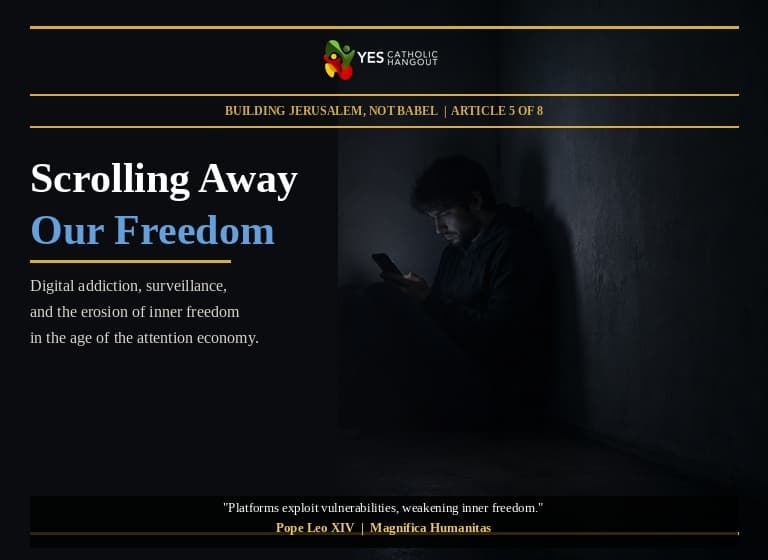
You pick up your phone to check one thing. Twenty minutes later you are still there, moving through content you did not plan to watch, feeling vaguely worse than you did before, wondering where the time went.
You already know this feeling. Most of us do.
But Magnifica Humanitas does something important with that feeling. It names it not just as a bad habit or a lack of discipline. It names it as a justice issue.
And that changes everything.
The Attention Economy
Pope Leo XIV dedicates a significant section of Magnifica Humanitas to what he calls the digital attention economy. The premise is simple and worth sitting with.
The platforms you use every day are not free. You are not the customer. You are the product. The business model of most social media platforms, streaming services, and digital applications is built on one thing: capturing your attention and selling it to advertisers.
To do this effectively, these platforms are designed by teams of engineers and psychologists whose job is to understand human vulnerability and exploit it. Variable reward cycles, similar to those found in slot machines, keep you checking for new notifications. Outrage and controversy are amplified because they generate more engagement than calm, measured content. Infinite scroll removes any natural stopping point. Autoplay removes the moment of deliberate choice.
None of this is accidental. All of it is intentional.
What the Pope Actually Says
Pope Leo XIV is direct. Platforms and services are often designed to capture users' time and attention, exploiting their vulnerabilities and weakening their inner freedom.
That phrase, weakening their inner freedom, is the key. This is not just about wasted time. It is about something more fundamental: the slow erosion of the capacity to think clearly, choose deliberately, and act freely.
When business models thrive on human weakness, the Pope writes, the person is treated as a means rather than as an end. Those who design or finance such systems bear a moral responsibility that cannot be ignored.
This is Catholic Social Teaching applied to your screen time. And it is a harder challenge than most productivity advice because it locates the problem not primarily in your willpower but in the system itself.
The Surveillance Dimension
Beyond addiction, Magnifica Humanitas raises a second and even more unsettling dimension of digital freedom: surveillance.
Every action you take online leaves a trace. Your movements, your purchases, your relationships, your preferences, your fears, your insecurities. All of it is collected, aggregated, and used to build a profile of you that is in many ways more accurate than your own self-understanding.
This data is then used to predict your behavior, influence your decisions, and in some cases manipulate your beliefs. The Pope describes this as a new form of power: the power to profile, predict, and influence behavior, often without individuals being fully aware of it.
When decisions affecting your concrete opportunities, access to credit, employment, essential services, are made by opaque algorithms built on this data, your freedom is not just weakened. It is structurally constrained.
And the most insidious part is that control is exercised not through obvious prohibition but through the architecture of visibility. What gets amplified. What gets buried. What gets rewarded. What gets penalized. You feel free because no one is telling you what to think. But the environment has been engineered to make certain thoughts more likely than others.
What This Does to Young People
Pope Leo XIV is particularly concerned about the impact of all this on children and young people. And the encyclical does not soften its language here.
Psychological and psychiatric literature, he notes, has documented with growing insistence how early and unsupervised exposure to digital devices and social media can negatively impact sleep, attention span, emotional regulation, and relationships, sometimes with tragic consequences.
He goes further. Easy access to violent or degrading content, pornographic and hypersexualized material, and messages that trivialize the body and emotions are not peripheral concerns. They are forming the imaginations and moral sensibilities of an entire generation.
The Pope calls for a genuine alliance between policymakers, educational institutions, and families. He supports age limits, legislative protections, and holding platforms accountable rather than placing the entire burden of protection on individual parents.
This is not a conservative panic about technology. It is a sober, evidence-based assessment of what is happening to young people and a call for structural responses, not just personal ones.
Digital Sobriety as a Spiritual Practice
So what does the Pope propose? Not the destruction of technology. Not a retreat into a pre-digital world. But something he calls digital sobriety.
Digital sobriety is the cultivated capacity to use technology intentionally rather than compulsively. To choose when to engage and when to step away. To be present to the people and the world in front of you rather than perpetually absorbed in a screen.
This is not simply a productivity strategy. It is a spiritual discipline. Because the capacity for genuine prayer, for attentiveness to God and to others, for the kind of slow, patient love that relationships require, depends on a certain quality of inner silence and freedom that the attention economy is specifically designed to destroy.
Carlo Acutis, for all his love of computers and technology, was known for his quality of presence with people. He paid attention. He noticed. He was not distracted. He used technology as a tool and then put it down. His holiness was expressed in part through the way he inhabited his own life rather than escaping it.
That is the model Magnifica Humanitas is pointing toward.
The Harder Question
Here is the question the encyclical implicitly asks each of us: is your relationship with your phone, your social media, your digital habits one of freedom or one of dependence?
Not as a guilt trip. As a genuine inquiry.
Because if the answer is dependence, that is not primarily a moral failure on your part. It is the intended outcome of a system specifically engineered to produce it. And recognizing that is the first step toward something different.
The Church does not call us to a life of digital abstinence. It calls us to a life of freedom. And freedom, in the digital age, requires the same thing it has always required: virtue, community, and the grace of God.
None of those things fit in an app.
Coming Up in This Series
Article 6 turns to work. What does Magnifica Humanitas say about AI and employment? What happens to human dignity when machines replace people? And what does the Church ask of businesses, governments, and workers navigating this transformation?
The series continues. Stay with us.
Yes Catholic Hangout. Digital Faith. Real Mission.