
Pope Leo XIV Appoints Maria Montserrat Alvarado to Lead Vatican Communications
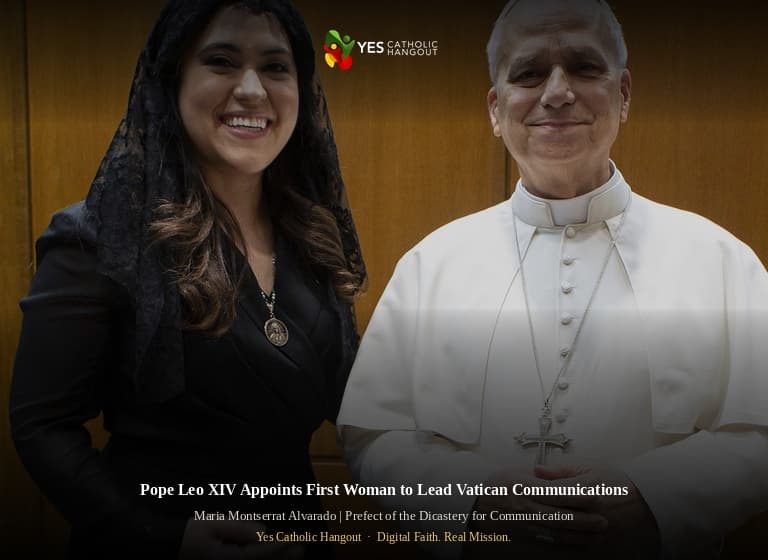
Pope Leo XIV has appointed Maria Montserrat Alvarado, currently President and Chief Operating Officer of EWTN News, as Prefect of the Dicastery for Communication, effective 1 November 2026. Alvarado, born in Mexico City and educated at Florida International University and George Washington University, served in leadership at the Becket Fund for Religious Liberty from 2009 to 2023 before leading EWTN News, where she has overseen international platforms producing content across television, radio, print, digital, and social media in seven languages.
The appointment carries ecclesial significance beyond the ordinary transition of an office. It is presented as a continuation of the path of reform and renewal of the Roman Curia initiated by Pope Francis, especially through the entrusting of positions of responsibility to lay faithful, both men and women. Alvarado will succeed Paolo Ruffini, appointed by Pope Francis in 2018 as the first lay prefect of a dicastery of the Roman Curia, and she is described as the first non-religious woman to be appointed prefect of a dicastery of the Holy See.
"While this appointment was unexpected, I receive it with a sincere desire to serve the Holy Father as he begins his pontificate." — Maria Montserrat Alvarado
From a priestly, synodal, and digital pastoral perspective, the appointment invites the Church to consider anew the spiritual mission of communication. Catholic media is not merely an instrument for transmitting information. At its deepest level, it is a ministry of truth in charity, a service to communion, and a means by which the Church seeks to communicate Christ to the world.
Communication as Service to Communion
The Dicastery for Communication oversees the Holy See's communications systems, including Vatican News, Vatican Radio, L'Osservatore Romano, Vatican Media, the Holy See Press Office, the Vatican publishing house, the Vatican Printing Press, and the Filmoteca Vaticana. The Dicastery's work includes not only operational and technological functions, but also the deepening of the theological and pastoral aspects of the Church's activity in the field of communication.
This point is decisive. The Church's communications mission cannot be reduced to institutional image, technological reach, or media efficiency. It belongs to the evangelizing mission of the Church. It must form consciences, protect truth, safeguard the vulnerable, and make visible the human faces and voices that carry the mark of God's image.
Paolo Ruffini, in his message to the staff of the Dicastery, said that the Dicastery has in its "DNA" the duty to remain constantly attuned to the rapidly changing world of communication and described communication as an instrument of communion that grows over time. This is also the heart of a synodal understanding of media: communication is not a one-way mechanism of control, but a shared ecclesial act of listening, speaking, discerning, and walking together.
The key ecclesial dimensions of Vatican communications and their meaning:
Truth. Communication must seek accuracy, context, and fidelity to the Gospel. Catholic media must resist disinformation, sensationalism, and ideological manipulation.
Communion. Communication should build unity without suppressing legitimate diversity. The Church's voice must be clear, charitable, and open to listening.
Synodality. Communication must include participation, listening, and accountability. Voices from local Churches, women, youth, migrants, the poor, and the wounded must be heard.
Mission. Communication exists to proclaim Christ and serve the human person. Digital strategy must lead persons toward encounter, not isolation or dependency.
A Sign of Synodal Renewal
The appointment of a Mexican-American lay woman to lead the Dicastery for Communication may be read as a sign of the Church's growing attention to the gifts of lay persons, women, and the diverse cultural realities that shape contemporary Catholic life. It reflects the broader ecclesial movement of synodality, in which responsibility for the Church's mission is not confined to ordained ministry alone, but is shared according to vocation, competence, charism, and service.
As a Catholic priest, one can recognize in this appointment an invitation to spiritual humility. The ordained ministry remains indispensable for sacramental life and pastoral governance, but the Church's mission is enriched when lay expertise is welcomed into structures of service. The communication of the Gospel today requires theological depth, professional competence, cultural intelligence, and digital wisdom. It also requires the capacity to speak across languages, generations, platforms, and wounds.
As a synodal recorder, one would note that the appointment also demands a disciplined memory of the People of God. The Church's communications must not become a conversation among elites or algorithms. It must carry the voices of those who are often unheard:
Victims of abuse
Migrants and refugees
Families and the elderly
Young people
The poor
Those who are digitally excluded
Those whose faith is fragile
A synodal communications office must therefore become a listening office before it becomes a publishing office.
Magnifica Humanitas and the Ethical Challenge of Artificial Intelligence
The appointment comes shortly after the publication of Pope Leo XIV's first encyclical, Magnifica Humanitas: On Safeguarding the Human Person in the Time of Artificial Intelligence, which frames the present moment as a pivotal choice: humanity may construct a new Tower of Babel, or it may build a city in which God and humanity dwell together.
This image offers a powerful interpretive key for Catholic communication in the age of artificial intelligence. A Babel-like media culture pursues speed, reach, influence, and control without communion. It reduces persons to data, attention, sentiment, and market segments. A synodal media culture, by contrast, seeks truth with love, uses technology with humility, and places human dignity above algorithmic dominance.
A central principle from Magnifica Humanitas applies directly here: technology is not inherently evil, but it is never neutral, because it takes on the characteristics of those who devise, finance, regulate, and use it. For Catholic media, this means that AI tools cannot be adopted merely because they increase productivity or audience engagement. They must be judged by whether they serve the human person, strengthen communion, protect truth, and remain accountable to moral responsibility.
"Technology is never neutral, because it takes on the characteristics of those who devise, finance, regulate, and use it." — Magnifica Humanitas
The encyclical also insists that AI can imitate and simulate the person, but does not possess moral conscience, empathy, or affective, relational, and spiritual capabilities. This is especially important for the Church. The Church may use digital tools, but she must never allow machines to replace spiritual accompaniment, pastoral judgment, sacramental ministry, or the irreplaceable encounter between persons.
Algorithmethics for Catholic Media
The Church's present task may be described as the development of an algorithmethics worthy of the Gospel. The Rome Call for AI Ethics identifies six principles for ethical AI: transparency, inclusion, accountability, impartiality, reliability, and security and privacy. These principles can become practical criteria for Catholic media and Vatican communications:
Transparency. AI-assisted content, images, translations, summaries, or synthetic media should be clearly identified when relevant. The faithful should never be deceived about whether a human person or a machine generated or mediated content.
Inclusion. Digital communication should serve different languages, cultures, disabilities, and levels of digital access. Technology must not widen the gap between those included and those excluded.
Accountability. Human editors and ecclesial authorities must remain responsible for published content. No algorithm may become a substitute for moral, editorial, or pastoral responsibility.
Impartiality. AI tools must be audited for bias, distortion, ideological manipulation, and discrimination. The dignity of each person must be protected, especially the poor and vulnerable.
Reliability. AI should support verification, documentation, and access to authoritative sources. Speed must never be placed above truth.
Security and privacy. Personal and pastoral data must be protected with strict safeguards. Human vulnerability must never become a resource for extraction.
These principles are not merely technical policies. They are spiritual disciplines. In Catholic communications, AI should assist transcription, translation, archival retrieval, accessibility, multilingual service, and administrative support. It should not replace editorial conscience, pastoral discernment, doctrinal judgment, or the living witness of human communicators.
The danger of AI in religious communication is not only that it may produce factual errors. The deeper danger is that it may simulate authority, intimacy, holiness, or certainty without the body, conscience, suffering, prayer, and responsibility that belong to authentic human and ecclesial life. A disarmed AI is therefore an AI stripped of false authority and placed humbly at the service of persons.
Digital Pastoral Strategy: Human Faces Before Digital Systems
This moment is an opportunity for the Holy See and Catholic media institutions to model a new digital culture. Such a culture should not be driven by clicks, polarization, or artificial urgency. It should be shaped by the Gospel logic of encounter.
A Catholic digital strategy in the spirit of Magnifica Humanitas would:
Place human faces before digital systems
Protect the dignity of persons in every stage of communication, from reporting and editing to translation, archiving, design, distribution, and analytics
Ask not only whether content reached many people, but whether it helped them encounter truth, hope, responsibility, and communion
Include careful AI governance and human editorial oversight
Provide formation for Catholic communicators
Establish clear policies on synthetic media
Protect against deepfakes and misinformation
Maintain a preferential concern for those harmed by digital exclusion or manipulation
Resist the temptation to automate pastoral presence
The Church's communications may be digitally mediated, but they must remain humanly and spiritually accountable.
A Priestly Reading: Communicating Christ in a Wounded Digital World
From the perspective of a Catholic priest, the appointment and the encyclical converge in a single pastoral call: to communicate Christ without reducing the human person to an object of technique. The priest knows that the Word became flesh, not content. The Gospel is not an algorithmic output. It is a living proclamation, entrusted to witnesses, received in faith, and made credible through charity.
This does not mean rejecting modern tools. It means using them in the right order. Technology may carry the Pope's words into every home, assist translation across cultures, preserve archives, and help the Church reach those who live on the digital peripheries. But technology must always remain a servant. It must never become a master, a substitute pastor, or a simulated conscience.
In this sense, Magnifica Humanitas provides the theological horizon for Catholic communications today. It calls the Church to:
Remain human in the age of algorithms
Protect the vulnerable
Resist concentration of power
Build a digital culture where truth is joined to love and communication becomes communion
Conclusion: A Mission of Truth, Communion, and Human Dignity
Maria Montserrat Alvarado's appointment as Prefect of the Dicastery for Communication comes at a moment when the Church is called to renew her media mission under the sign of synodality and in the face of rapid technological change. Read in light of Magnifica Humanitas, this appointment is not only an administrative transition. It is an invitation to deepen the Church's commitment to communication that is truthful, human-centered, accountable, and pastoral.
For Vatican communications, for Catholic media, and for every digital pastoral initiative, the standard is clear. Artificial intelligence may assist the Church's mission only when it:
Serves the dignity of the human person
Strengthens communion
Protects truth
Remains under responsible human and ecclesial judgment
The Church does not communicate in order to dominate attention. She communicates in order to bear witness to Christ, who reveals the fullness of humanity and calls every person into communion with God and with one another.