
Magnifica Humanitas: A Divine Call to Reclaim the Splendor of Human Intellect in the Age of Artificial Intelligence
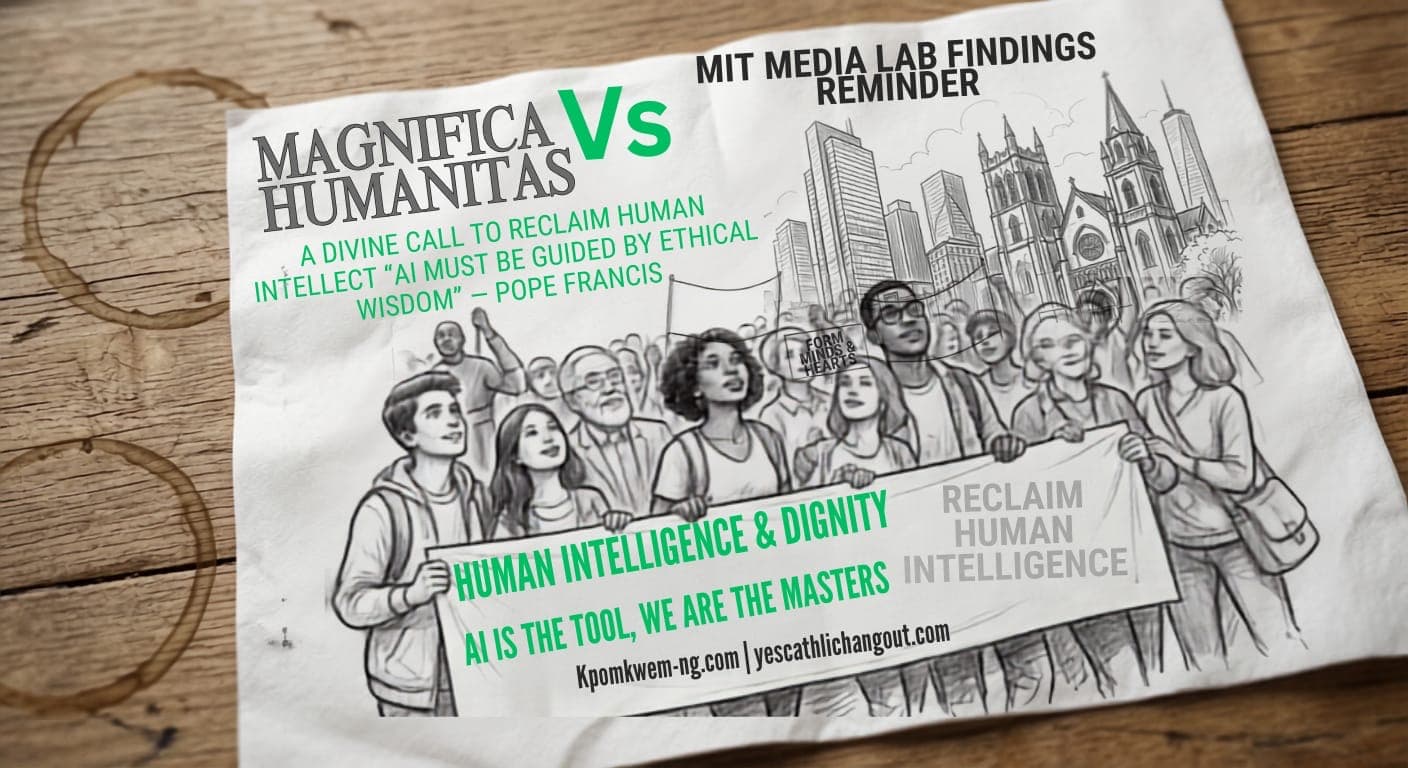
In an era where algorithms curate our thoughts and chatbots draft our reflections, a quiet neurological alarm is sounding from the laboratories of MIT. The data is stark: when artificial intelligence does the thinking for us, our brains begin to dim. But this is not merely a scientific caution. It is a spiritual summons. The Church, in her synodal wisdom, responds with a call to reclaim what Pope Francis has termed the irreducible dignity of the human person: Magnifica Humanitas.
The Brain Goes Dark: What MIT Discovered
Researchers at the MIT Media Lab recently peered into the living brain during a simple task, writing an essay, and what they witnessed should give pause to every educator, parent, policymaker, and believer.
Using electroencephalography (EEG) to map neural activity across 32 brain regions, the study divided 54 participants into three groups: those writing with ChatGPT, those using Google Search, and those relying solely on their own cognition. The results were not subtle. The brain-only group exhibited the strongest, most distributed neural networks, vibrant constellations of connectivity across frontal-parietal and semantic regions, the very architecture of executive function, creativity, and deep synthesis. Search engine users showed moderate engagement. But the ChatGPT group’s neural connectivity was the weakest of all.
“The EEG data doesn’t just suggest cognitive offloading; it provides a direct visualization of the brain going dark. We are witnessing the neurological signature of intellectual outsourcing in real time.”
The numbers are arresting. Expert analysis of the MIT data reported a 47% collapse in brain activity among ChatGPT users compared to the control group. Memory retention cratered: 83% of participants who used AI could not recall key points or accurately quote from essays they had just produced. Their sense of intellectual ownership, the sacred feeling that I wrote this, I thought this, I own this insight, was the lowest of all groups. English teachers assessing the AI-assisted essays called them “soulless.”
Most troubling was the persistence of the effect. When ChatGPT users were later forced to write without the tool, their brains showed reduced alpha and beta connectivity, a lingering under-engagement, as if the neural muscles had atrophied. The cognitive debt, as lead researcher Nataliya Kosmyna termed it, had accumulated.
“What really motivated me to put it out now before waiting for a full peer review is that I am afraid in 6-8 months, there will be some policymaker who decides, ‘let’s do GPT kindergarten.’ I think that would be absolutely bad and detrimental. Developing brains are at the highest risk.”
Why This Matters to the Church, and to You
For Gen Z, raised on screens and fluent in prompts, and for Gen X, the bridge generation that remembers rotary phones yet manages digital teams, this research lands with particular urgency. The MIT findings are not an indictment of technology but a revelation of its hidden cost: when convenience replaces struggle, the soul of learning withers.
The Church has seen this before. Every tool that promises to eliminate human effort carries the risk of eliminating human growth. The Gospel does not call us to a frictionless life but to a cross-bearing one, not because suffering is good, but because effort is formative. The neural pathways of virtue, like the neural pathways of critical thought, require resistance to grow strong.
This is the heart of Magnifica Humanitas: the magnificent humanity imprinted with the image and likeness of the Creator is not a passive consumer of content but an active co-creator of meaning. Human reason, creativity, and moral discernment are not biological functions to be optimized or outsourced. They are sacred gifts to be cherished, cultivated, and defended.
Five Pathways Forward: A Synodal Response
The Magnifica Humanitas mission, rooted in Catholic Social Teaching, Laudato Si’, Fratelli Tutti, and the synodal vision of a listening Church, proposes five pathways for the digital age.
Synodal Listening creates digital and physical spaces where people, communities, nations, and generations listen before judging. In a world of algorithmic echo chambers, the Church must model a different kind of digital encounter, one where silence precedes speech, and curiosity precedes conclusion. The MIT study found that search engine users, who had to evaluate and synthesize information rather than receive it pre-packaged, showed stronger neural engagement and higher satisfaction. The synodal method, conversatio in Domino, is neurologically sound.
Relational Evangelization replaces algorithmic isolation with authentic accompaniment, mentorship, catechesis, and community building.
The same MIT Media Lab that measured cognitive debt has also found that the more time users spend talking to ChatGPT, the lonelier they feel. AI cannot replace the gaze of a mentor, the patience of a teacher, or the warmth of a community. The digital missionary of tomorrow is not a bot but a person who walks alongside.
Ethical AI Governance ensures transparency, accountability, human oversight, and the protection of human dignity in all digital systems.
The Church calls for AI that serves the human person, not the reverse. This means testing educational AI tools before classroom deployment, requiring human-in-the-loop design, and rejecting models that optimize for engagement at the expense of cognition. As Kosmyna insists: “We need to have active legislation in sync and more importantly, be testing these tools before we implement them.”
Integral Human Development directs technological innovation toward education, healthcare, environmental stewardship, poverty reduction, and dignified work. AI that diagnoses disease, predicts crop failures, or translates Scripture for unreached peoples serves Magnifica Humanitas. AI that writes our essays, thinks our thoughts, and numbs our minds does not. The MIT study offers a crucial distinction: when the Brain-to-LLM group, those who first wrote independently and then used AI, later employed ChatGPT, they showed increased brain connectivity, not decreased. The tool enhanced their already-engaged minds. The lesson is clear:
AI must assist struggle, not substitute for it.
Digital Missionary Formation equips young people and adults with skills in technology, data, entrepreneurship, and evangelization to become builders of peace. The future belongs not to those who consume AI but to those who steward it. The Church must form a generation that can code, critique, and consecrate, who understand both the architecture of neural networks and the architecture of the soul.
Adaptation: Faithful to the Message, Flexible in the Method
For Gen X leaders and Gen Z creators alike, the formula is simple: Adaptation: Faithful to the Message, Flexible in the Method.
The Gospel does not change. The means by which it reaches the digital native must evolve. The Church’s mission in the age of AI is not to retreat into analog nostalgia but to advance with synodal courage, using technology as Paul used the Roman roads, not to become Roman, but to make Christ known.
The Magnifica Humanitas mission serves as a bridge between faith and innovation, ensuring that technology remains a servant of humanity rather than its master. Through human-AI collaboration, transparent governance, and community participation, it seeks to transform digital spaces into places of encounter, healing, learning, and conversion. This mission supports Yes Catholic Hangout, the Economy of Francesco movement, synodal engagement, and a global ethical technology ecosystem where every person is welcomed, valued, heard, and empowered.
The Future Belongs to Fraternity
In the age of artificial intelligence, digital manipulation, autonomous systems, economic exploitation, and ideological polarization, humanity must reject the normalization of conflict and embrace a culture of encounter.
Magnifica Humanitas recognizes war as one of humanity’s greatest moral failures. Every war represents a rupture of fraternity, a wound against human dignity, and a rejection of our shared vocation as one human family. There is no truly just war in a world capable of dialogue, cooperation, and synodal discernment. Peace is not merely the absence of violence; it is the presence of justice, solidarity, truth, mercy, and authentic human relationships.
The future does not belong to weapons, domination, or technological control. The future belongs to fraternity, dialogue, ethical innovation, and the flourishing of every human person from conception to natural death.
A Call to Action
The MIT alarm is sounding. The synodal Church is listening. The question is not whether AI will shape our minds; it already is. The question is whether we will shape AI in service of Magnifica Humanitas.
To Gen Z: your digital fluency is a gift. Do not surrender your critical thought to the convenience of a prompt. Struggle with ideas. Write badly, then rewrite. Let your brain light up.
To Gen X: your institutional memory and ethical formation are needed now more than ever.
Mentor the young. Model discernment. Show that wisdom is not outsourced.
To all: join the movement for Ethical Technology, Synodality, and Integral Human Development at www.yescatholichangout.com and www.Kpomkwem-ng.com.