
How Best Can We Respond to the Solemn, Urgent Call of Magnifica Humanitas
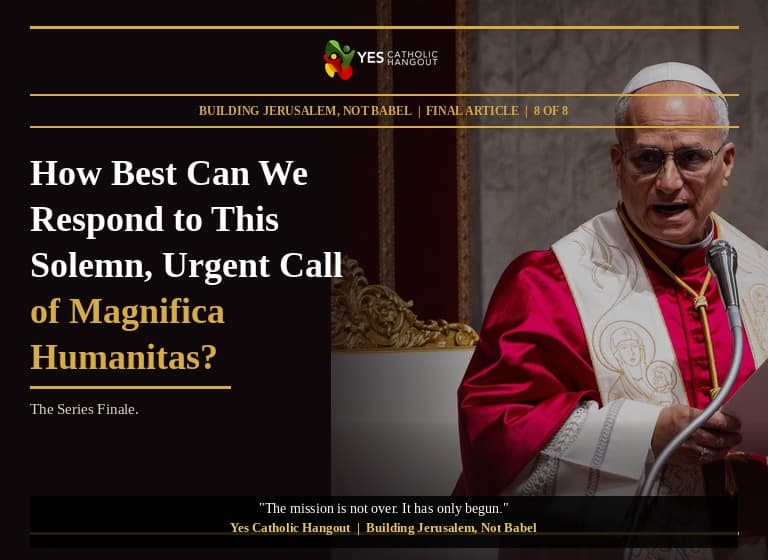
We have covered a lot of ground in this series.
We have looked at what Magnifica Humanitas says about artificial intelligence and human dignity. We have sat with the hidden cost of our devices and the people the digital economy has made invisible. We have examined what the attention economy is doing to our freedom, what AI is doing to work, and what the Church is called to be in digital spaces.
All of it matters. But there is a question that honest readers have probably been carrying since Article 1.
What am I actually supposed to do with all of this?
It is a fair question. And Magnifica Humanitas takes it seriously. Pope Leo XIV does not write a document of this length and depth just to inform. He writes it to move people. Not governments alone. Not tech companies alone. People. Each one. You.
So here, in the final article of this series, we want to answer that question as concretely as we can.
Start With Honesty
The first thing Pope Leo XIV asks of each of us is not an action. It is an attitude. He calls it fidelity to the truth.
In a digital world engineered to distort, manipulate, and overwhelm, the simple commitment to honesty is itself a radical act. It means saying true things, even when true things are not what the algorithm rewards. It means not sharing content you have not verified. It means acknowledging uncertainty rather than performing confidence. It means being willing to say you were wrong.
In your conversations online, in the groups you are part of, in the content you share, you have a choice every single day between contributing to the noise or contributing to clarity. That choice is small. Its cumulative effect is enormous.
Look at Your Habits
The second thing the encyclical invites us to do is genuinely personal. It is to examine our relationship with our devices and our digital habits with honesty and without defensiveness.
Not guilt. Honesty.
How much time do you spend scrolling? What does it do to your mood, your attention, your capacity for prayer? When you put your phone down, do you feel rested or depleted? Are there relationships in your life that are suffering because of the time and energy you give to screens?
Pope Leo XIV calls this digital sobriety. The capacity to use technology intentionally rather than compulsively. To choose when to engage and when to step away. It is not about perfection. It is about freedom. And it begins with an honest look at where you actually are.
Protect the Young People Around You
One of the most urgent practical applications of this encyclical is the protection of children and young people from the harms of the digital environment.
The Pope is specific. Unsupervised access to digital devices at too early an age, easy access to violent or degrading content, and the psychological damage of social media on developing minds are not abstract concerns. They are happening to real children right now, including children in your family, your parish, your community.
You do not have to be a parent to play a role here. You can support the parents in your community who are navigating these pressures. You can advocate for policies that protect minors online. You can refuse to normalize the idea that children having unrestricted smartphone access is simply inevitable.
Small interventions in the lives of young people, an honest conversation, a boundary held, a better alternative offered, can change the trajectory of a life.
Ask Where Your Money Goes
Article 4 of this series confronted us with the hidden human cost behind our devices and digital services. The encyclical’s response to that reality is not primarily guilt. It is responsibility.
This means asking questions about the supply chains behind the technology you use. It means supporting companies and platforms that demonstrate genuine ethical commitments to their workers. It means being willing to pay more for products whose production does not depend on exploitation. It means voting for policies that require transparency and accountability from the tech industry.
None of us can opt out of the digital economy entirely. But all of us can exercise our choices within it more consciously. The accumulation of those choices, multiplied across millions of Catholics worldwide, is not a small thing.
Build Real Community
One of the most countercultural things a Catholic can do in the digital age is invest deeply in real, embodied community.
Not instead of digital connection. Alongside it. The encyclical is clear that physical presence remains irreplaceable. Shared meals. Time with the elderly. Serving the poor. Parish life. These are not nostalgic relics of a pre-digital world. They are the irreducible human goods that no platform can replicate and no algorithm can manufacture.
Pope Leo XIV puts it beautifully. The human heart retains an irrevocable need for genuine closeness. Every investment you make in real relationships, in showing up, in being present, in the slow patient work of actually knowing and being known by other people, is an act of resistance against a culture that wants to reduce human connection to engagement metrics.
Use Your Digital Presence With Purpose
If you are online, be there as yourself. Fully. Faithfully.
You do not need a large platform to make a difference. Carlo Acutis did not have a large platform. He had a mission, a set of skills, and a willingness to use what he had for something greater than himself.
What are your skills? What do you know? What have you experienced of God that someone else needs to hear? The digital world is full of noise. But it is also full of people searching, quietly and desperately, for something real. You might be the person who, in one honest post or one genuine conversation, gives someone exactly what they needed to take one step closer to God.
That is not a small thing. That is evangelization.
Pray
It sounds obvious. But the encyclical ends with it, and so will we.
Pope Leo XIV closes Magnifica Humanitas with the Magnificat, Mary’s song of praise and hope in the face of a world that was not yet what it was meant to be. He invites us to become weavers of hope in our world, sharing who we are and what we have, so that the presence of Jesus may grow among us.
The digital transformation we are living through is real. Its challenges are real. Its dangers are real. But so is the God who holds all of it.
Pray for wisdom in your use of technology. Pray for the workers exploited by the digital economy. Pray for the young people being formed by platforms that do not have their flourishing in mind. Pray for leaders, in the Church, in government, in business, to have the courage to make decisions that serve human dignity rather than just profit.
And pray for yourself. That you will have the clarity to see what is actually happening, the freedom to choose differently, and the courage to be, in every space you inhabit, recognizably human and recognizably faithful.
A Final Word From Yes Catholic Hangout
Eight articles. One encyclical. One series.
We started this journey with a document that most Catholics will never read in full. We hope that in these eight articles we have made it accessible, relevant, and impossible to ignore.
Magnifica Humanitas is not just an important document. It is a gift. A clear-eyed, deeply human, profoundly faithful attempt to help the Church navigate one of the most consequential transitions in human history.
Pope Leo XIV is not afraid of the digital age. He is not retreating from it. He is calling the Church to enter it more fully, more wisely, and more humanly than ever before.
That is the mission Yes Catholic Hangout was built for. And it is the mission we are still running toward.
Whether the series ends here or the conversation continues in your community, your family, your own heart, we are grateful you read along.
The mission is not over. It has only begun.
Yes Catholic Hangout. Digital Faith. Real Mission.