
How AI Gives Small Businesses an Edge, Without Giving Away the Store
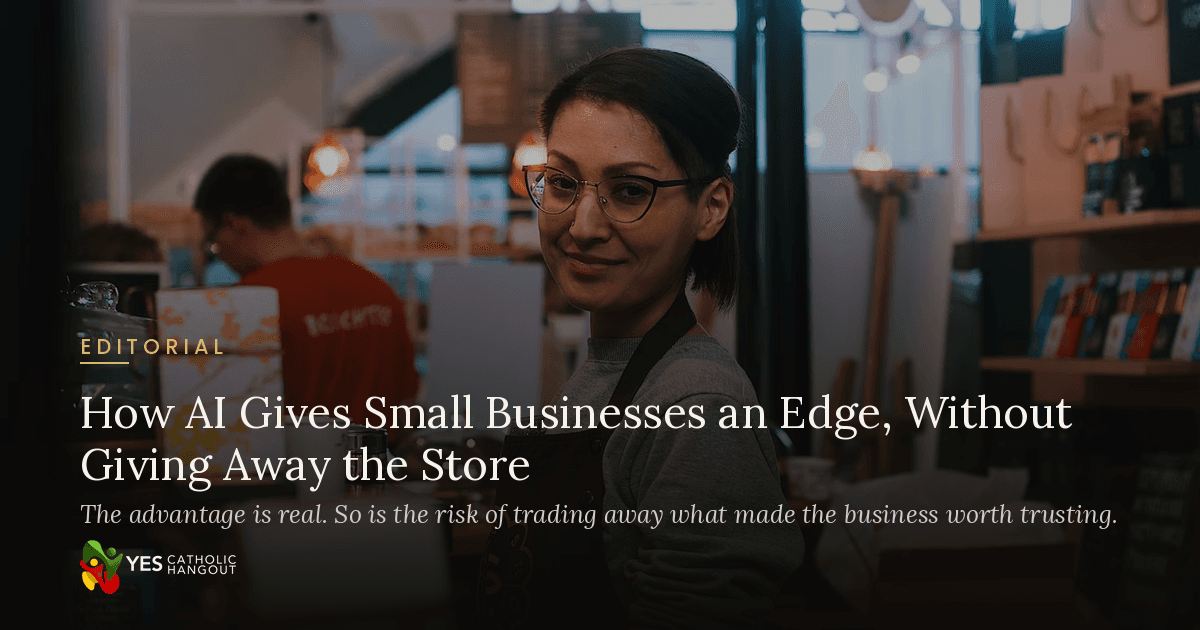
The advantage is real. So is the risk of trading away exactly what made the business worth trusting in the first place
For decades, the sophisticated tools of large enterprises, market analysis, personalised marketing, inventory forecasting, were available mainly to companies with the budget to build or buy them. AI has genuinely narrowed that gap. A small business today can access forecasting, customer service automation, and marketing personalisation that would have required a team of specialists a decade ago, at a fraction of the cost.
This matters for reasons beyond convenience. Small and family businesses are frequently the backbone of local economies, particularly in communities where large employers are scarce. Tools that let a small operation compete more effectively on customer service, efficiency, and reach are not a minor convenience. They are a genuine opportunity for economic participation that previously required capital most small owners do not have.
Where the Edge Actually Comes From
The advantage is concentrated in a few specific areas, and it is worth being precise about them rather than treating AI as a general-purpose solution.
Customer service automation lets a small business respond to inquiries at hours it cannot staff, without losing the personal follow-up that made customers trust it in the first place, provided the automation is used to handle routine questions rather than to replace the owner’s actual relationship with regular customers. Inventory and demand forecasting, once available only to large retailers with dedicated analysts, can now help a small shop avoid the two costliest mistakes in retail: running out of what sells and sitting on what does not. Marketing tools that once required an agency retainer can now help a business identify and reach the customers most likely to want what it offers, at a cost proportional to its actual size.
What Not to Trade Away
The risk sits precisely where the advantage does. A small business’s most valuable asset is frequently not efficiency but relationship, the owner who remembers a regular customer’s name, the trust built over years of consistent, personal service. AI tools that replace this rather than support it trade away the thing that made the business worth choosing over a larger, cheaper competitor in the first place.
This is where discernment matters more than adoption speed. A response drafted by AI and reviewed by the owner before sending preserves the relationship. A fully automated response that a customer can tell is automated, on a matter that mattered to them, damages exactly the trust a small business depends on to survive against competitors with far larger marketing budgets. The tool should extend the owner’s attention, not substitute for it.
Catholic social teaching has long held that economic life exists to serve persons, not the reverse, and a small business relationship is one of the clearest places this plays out in ordinary life. The measure of whether an AI tool serves a small business well is not only whether it saves time or money. It is whether the business remains, after adopting it, recognisably itself to the customers who chose it for a reason technology alone cannot replicate.