
From Innovation to Integral Human Development: Can Artificial Intelligence Help Build a More Fraternal World?
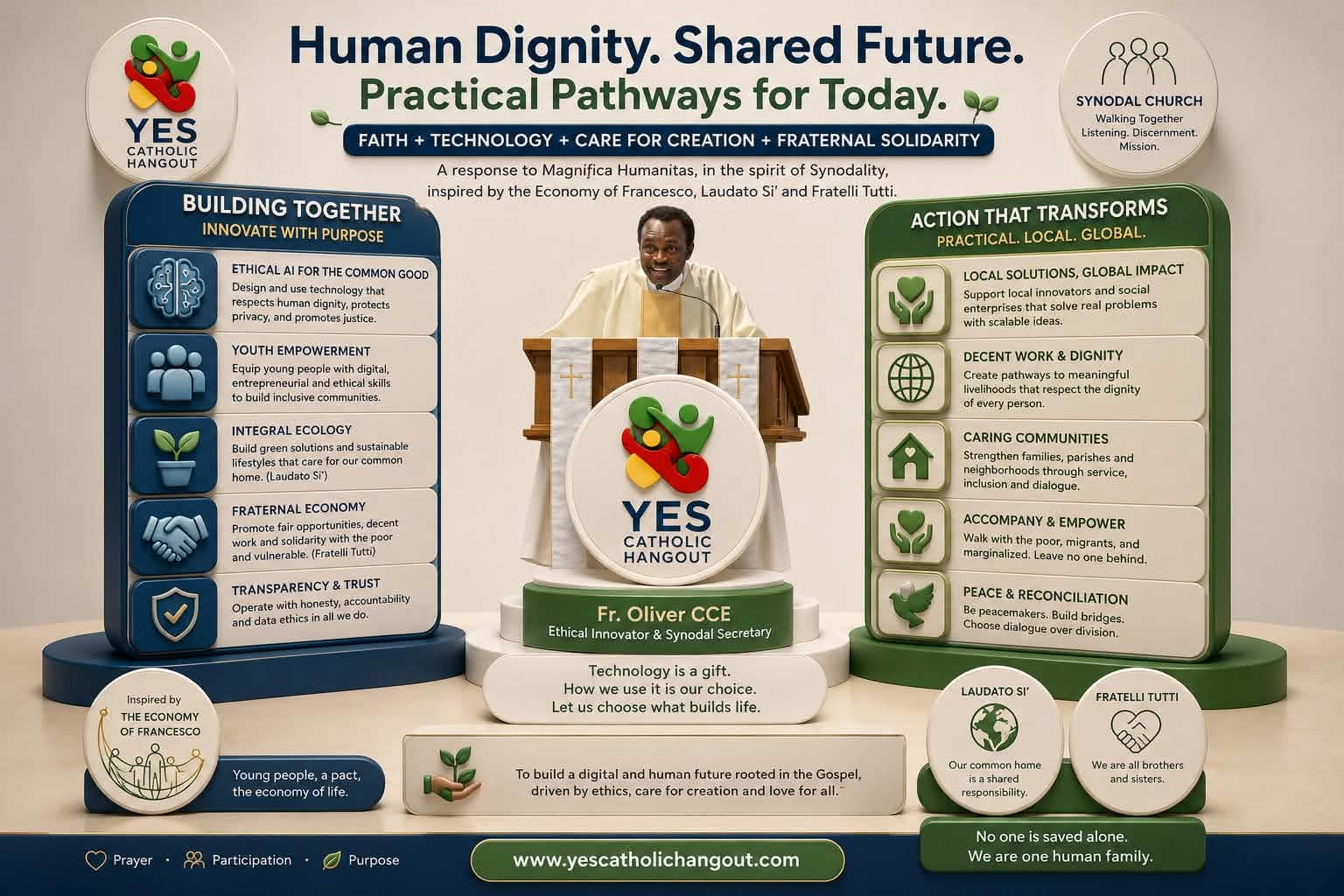
Human Dignity in the Digital Age: Reimagining Technology Through Laudato Si’, Fratelli Tutti, the Economy of Francesco, and Synodality
The Central Question
Can humanity build a digital civilization where artificial intelligence strengthens fraternity, protects creation, generates dignified work, welcomes the migrant and the displaced, and safeguards every person’s God-given dignity? This is not a question reserved for technicians or philosophers alone. It is the defining moral question of the digital age, and it demands a response shaped by the wisdom of the Gospel and the Church’s enduring concern for the human person.
As algorithms increasingly sort passports, predict migration flows, allocate credit, and govern access to work, we must ask whether our technologies are servants of the common good or instruments of exclusion. The Catholic tradition offers a clear principle: the human person is not a problem to be managed but a mystery to be honored.
Human Dignity Before Digital Efficiency
Technology must always remain a servant of the human person, not the other way around. Yet too often, efficiency is elevated above encounter, and data points replace human faces. Algorithmic bias can dehumanize migrants at every stage of their journey, from visa systems that automatically reject certain nationalities to border technologies that treat arrival as a threat rather than a human event.
Catholic Social Teaching insists that efficiency, however impressive, can never justify the diminishment of human dignity. Every design decision carries moral weight. A system that speeds up processing but strips away compassion is not a triumph of innovation, it is a failure of imagination. The Church calls us to build digital tools that recognize the migrant as a brother or sister, created in the image of God and deserving of a future.
Immigration and Human Dignity
This question lies at the beating heart of the article. Migrants are not burdens placed upon prosperous societies. They are partners in building more innovative, compassionate, and resilient communities. Their journeys are marked by courage, skill, grief, and hope. To reduce them to statistics is to deny the humanity that enriches us all.
Web3 and decentralized technologies open remarkable possibilities for displaced peoples. Portable digital identity can allow a refugee to carry credentials across borders without depending on a single authority that may no longer exist. Decentralized finance can provide banking access to the unbanked, enabling remittances, savings, and entrepreneurship beyond the reach of traditional institutions. Blockchain-verified credentials can preserve academic, professional, and medical records when paper documents are lost. DAO-governed community funds can give migrant communities direct voice in the allocation of resources meant for their flourishing.
The digital economy must include those on the margins, not deepen the divide. The Church has long taught that in welcoming the stranger we encounter Christ himself. Pope Francis extends this tradition into the digital realm in Fratelli Tutti, reminding us that fraternity cannot stop at borders, whether physical or virtual.
Web3 as a Tool for Inclusive Prosperity
The architecture of Web3 is uniquely suited to inclusion because it is built on participation rather than centralized control. Self-sovereign identity returns control of personal data to the individual, a profound gift for those whose identities have been fractured by displacement.
Decentralized finance can bypass the gatekeepers who exclude the poor from credit and savings. Smart contracts can encode transparent, fair labor agreements, protecting workers from wage theft and arbitrary dismissal. Decentralized autonomous organizations can create participatory governance in which migrants themselves have a seat at the table. Tokenized community economies can reward contribution, care, and creativity, not merely the accumulation of capital.
These are not utopian dreams. They are concrete possibilities awaiting ethical direction. The Church’s role is not to write the code but to articulate the criteria by which it should be written: justice, participation, subsidiarity, and the preferential option for the poor.
Ethical Innovation and the Economy of Francesco
Pope Francis has repeatedly called upon young economists and entrepreneurs to build an economy that serves the poor and excluded, where success is measured not by profit alone but by human flourishing. This is the spirit of the Economy of Francesco. Innovation becomes truly human when it creates dignified work, fair wages, shared ownership, and pathways out of exclusion.
For migrant and refugee entrepreneurs, ethical technology can lower barriers to entry, connect talent with opportunity, and create markets that value human contribution. The task before us is to form builders who see every app, platform, and protocol as an opportunity to love their neighbor.
Laudato Si’ and Sustainable Digital Innovation
Care for our common home is inseparable from care for the migrant. Climate change is already displacing millions, and the digital tools we build must not worsen the ecological crisis they flee. Sustainable blockchain consensus mechanisms, energy-efficient artificial intelligence, and technology designed for ecological justice are not optional extras. They are moral imperatives.
Digital solutions can also serve climate migration directly, from early-warning systems to decentralized resource coordination for displaced communities. A fraternal digital economy learns from Laudato Si’ that everything is connected: the health of the planet, the dignity of the worker, the rights of the migrant, and the future of generations yet unborn.
Synodality in the Digital Future
No community should have its digital future designed without its voice at the table. Synodality, the Church’s path of listening, participation, discernment, and shared responsibility, offers a vital lens for technology governance. The digital age must be shaped through dialogue among governments, entrepreneurs, universities, faith communities, technology leaders, migrants, and young innovators of every faith and culture.
This means inclusive design processes, multilingual interfaces, accessible infrastructure, and governance models that empower rather than patronize. It means asking migrants not merely what they need, but what they can contribute. The future belongs to everyone, and everyone must help build it.
A Practical Call to Action
The path from innovation to integral human development requires concrete choices. We call upon all who shape the digital future to:
Design artificial intelligence that protects human dignity and resists every form of algorithmic exclusion.
Invest in education and ethical digital literacy for migrant and refugee communities.
Build Web3 economies that reward inclusion, meaningful work, and shared ownership.
Welcome talent while strengthening the social cohesion of host communities.
Develop technologies that care for creation and future generations.
Foster international cooperation for responsible governance of artificial intelligence and blockchain systems.
These steps are not opposed to innovation. They are the conditions under which innovation becomes worthy of the human person.
Closing Invitation
The future will not be defined simply by the intelligence of our machines, but by the wisdom of our humanity. If we choose fraternity over fragmentation, stewardship over exploitation, and dialogue over division, the digital age can become not merely an era of innovation, but a new chapter in the service of human dignity and the common good.
Inspired by: Magnifica Humanitas, Laudato Si’, Fratelli Tutti, the Economy of Francesco, and the Synodal journey of the Church.