
From Hustle to Holy Enough: Why Contentment Is the New Economy
How the Church, priests, the Economy of Francesco, Magnifica Humanitas, and Yes Catholic Hangout can lead Gen Z and Gen X through the Fourth Industrial Revolution
The Economy Nobody Taught Us to Build
Gen Z was handed a world of infinite scrolling, AI acceleration, climate anxiety, gig work, digital comparison, and the pressure to become a personal brand before becoming a whole person. Gen X carried the weight of productivity culture, family responsibility, institutional change, economic shocks, and the quiet exhaustion of always having to adapt. One generation was told to "go viral." The other was told to "keep going." Both are asking the same deeper question: what kind of life is actually enough?
This is where the Church must lead, and not from the sidelines. The priest, the catechist, the Catholic entrepreneur, the digital missionary, the parent, the mentor, and the young creator are all being called to walk together. The Church is not called to run away from the Fourth Industrial Revolution. The Church is called to enter it with the Gospel, with moral clarity, with digital courage, and with a new economic imagination.
That new imagination can be named in one simple but revolutionary word: contentment.
Contentment is not laziness. It is not poverty romanticized. It is not anti-technology, anti-business, or anti-growth. Contentment is the spiritual, social, and economic discipline of knowing what is enough so that everyone can have enough. It is the freedom to build without greed, innovate without domination, consume without addiction, and use technology without becoming used by it.
In the age of artificial intelligence, automation, data capitalism, digital labor, and ecological crisis, contentment is no longer merely a private virtue. Contentment is becoming a new form of economy. It is the economy of enough: enough dignity, enough bread, enough peace, enough community, enough truth, enough care for creation, and enough room for every person to flourish.
Why the Church Must Lead the Way
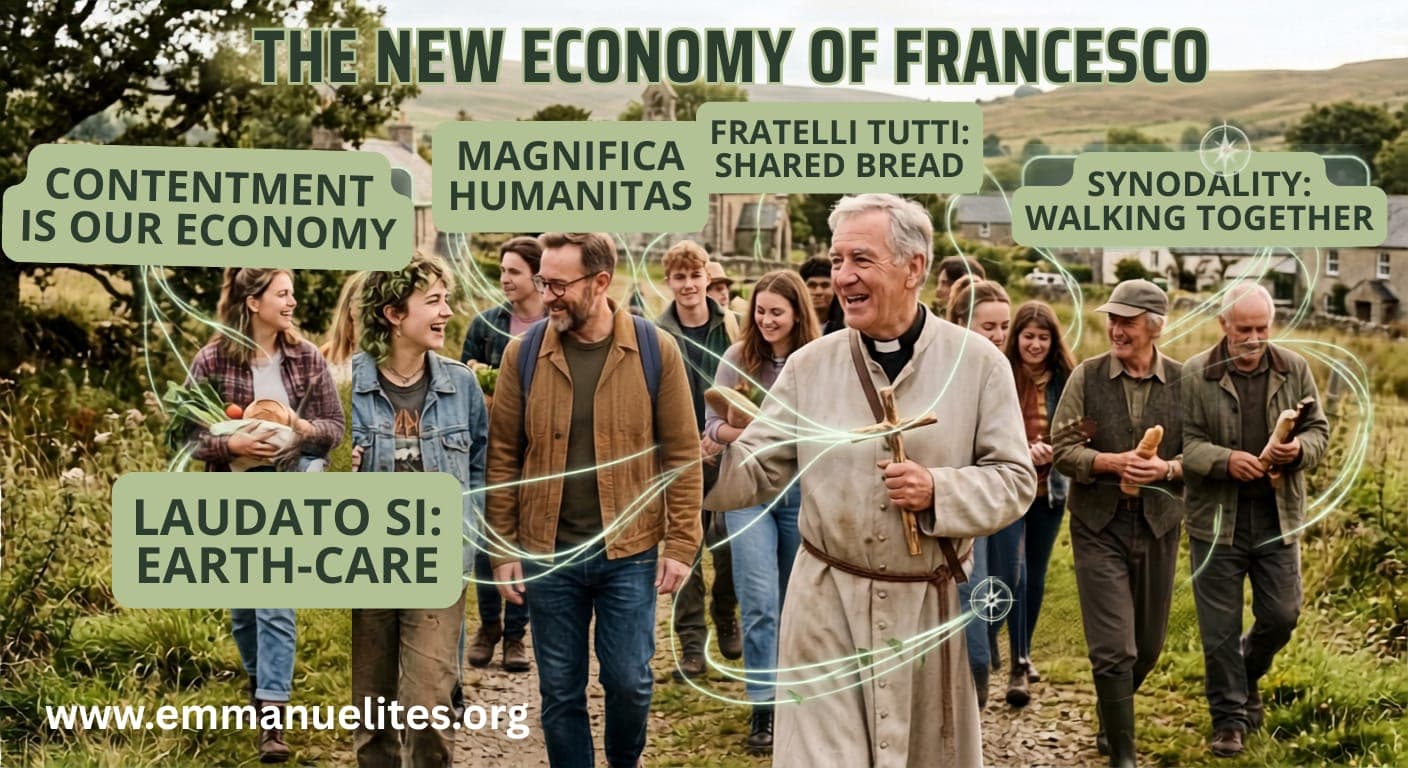
The world does not need a Church that only comments after the damage is done. It needs a Church that walks in front with a shepherd's courage. The image of a priest leading people through a landscape of shared bread, earth-care, Magnifica Humanitas, and synodality is more than a visual symbol. It is a pastoral strategy for the digital age. It says that the Church is not behind history. The Church is walking through history with Christ.
Synodality gives this leadership its method. The International Theological Commission explains that synod indicates the path along which the People of God walk together, and recalls that Saint John Chrysostom described the Church as a name standing for "walking together." That means the priest does not lead by domination, but by accompaniment. He leads by listening, gathering, discerning, blessing, teaching, and sending.
For Gen Z, this matters because authority without listening feels like control. For Gen X, it matters because leadership without responsibility feels like abandonment. A synodal Church gives both generations a different model: elders who listen, young people who participate, priests who accompany, communities that discern, and technology that serves mission rather than ego.
Two contrasting economies define the choice before us. The old economy of pressure says you are what you produce, scale at any cost, consume to belong, compete until you disappear, let technology decide the future, and keep faith private. The new economy of contentment says you are a person before you are a producer, grow what gives life and protects dignity, belong so deeply that consumption loses its power, collaborate so every person can flourish, let human dignity guide technology, and let faith form public choices, digital ethics, and economic life.
Contentment and the Economy of Francesco
The Economy of Francesco is already pointing toward this conversion. Pope Francis gave that movement a radical economic image when he said that a new economy inspired by Saint Francis of Assisi "can and must become an economy of friendship with the earth and an economy of peace," transforming "an economy that kills into an economy of life."
This is not soft language. It is a direct challenge to economic systems that reward extraction, anxiety, war, ecological neglect, and spiritual emptiness. Pope Francis told the Economy of Francesco delegation in 2024 that the world of economics needs change and that young people will change it not merely by becoming powerful, but by loving the economy in the light of God and prioritizing workers, the poor, and the situations of greatest suffering.
He also gave the movement three commands that Gen Z can understand and Gen X can trust: be witnesses, do not be afraid, and hope without tiring. That is the grammar of contentment. A contented person can witness without performing. A contented community can dream without being enslaved by fear. A contented economy can hope without exploiting the poor or wounding the planet.
Contentment therefore becomes the missing bridge between spiritual life and economic transformation. It teaches that "more" is not always better, "faster" is not always wiser, and "profitable" is not always human. It invites a new question at the heart of economic life: does this choice help the human family flourish, or does it feed a machine that never says enough?
Fratelli Tutti: Shared Bread in a Lonely World
Fratelli Tutti speaks directly to a generation that is hyper-connected and still lonely. Pope Francis writes that we need a community that supports and helps us, because no one can face life in isolation, and invites humanity to "dream together" as a single human family. This is a direct rebuke to the loneliness economy, where platforms monetize attention while communities fracture.
The new economy of contentment begins with shared bread. Shared bread means that the economy is not measured only by gross domestic product, stock valuation, platform growth, or personal influence. It is measured by whether families eat, whether workers rest, whether young people can learn, whether elders are honored, whether migrants are welcomed, whether the poor are seen, whether creation is protected, and whether peace is chosen over profit.
This is why contentment is not passive. It is one of the strongest forms of resistance against a system that profits from permanent dissatisfaction. If people are never content, they will keep buying, scrolling, comparing, fighting, and consuming. But when people rediscover enough, they become harder to manipulate. They become free for solidarity.
A contented person is not a defeated person. A contented person is a free person. A contented community is not a weak community. It is a community strong enough to share.
Laudato Si': Earth-Care as Economic Wisdom
Laudato Si' teaches that care for creation, justice for the poor, commitment to society, and interior peace are inseparable. This is essential for the Fourth Industrial Revolution because new technologies do not float above the earth. They depend on minerals, energy, labor, supply chains, data centers, devices, waste systems, and human attention.
An economy without contentment will turn artificial intelligence into another engine of extraction. It will demand more energy, more consumption, more devices, more surveillance, more speed, and more waste. An economy of contentment asks different questions. How much is enough? Who pays the hidden cost? Whose land is damaged? Whose labor is invisible? Whose attention is being harvested? Which communities are left behind?
Contentment is therefore an ecological virtue. It does not reject innovation. It disciplines innovation. It teaches innovators, investors, pastors, parents, students, and creators to ask whether technology is serving life or accelerating exhaustion.
Four Laudato Si' lenses and their contentment economy practices define this discipline. Care for our common home means building technologies that reduce waste, protect creation, and respect ecological limits. Justice for the poor means directing digital training, funding, and mentorship toward those excluded from opportunity. Interior peace means resisting addictive design, comparison culture, and constant digital overstimulation. Social commitment means using platforms to strengthen families, parishes, schools, and local communities. Integral ecology means connecting economic choices with spiritual, human, environmental, and cultural consequences.
Magnifica Humanitas: Human Dignity in the Age of AI
Magnifica Humanitas brings this vision into the age of artificial intelligence. Its core conviction is that technology must remain a servant of humanity, not its master. This matters because the Fourth Industrial Revolution is characterized by technologies that blur physical, digital, and biological life, including AI, robotics, data systems, biotechnology, and connected platforms.
In that environment, the economy of contentment becomes a moral firewall. It protects the human person from being reduced to a dataset, a consumer profile, a productivity metric, a political target, or an algorithmic prediction. It insists that the human person is not valuable because he or she is useful. The human person is valuable because every person bears God-given dignity.
Pope Francis' 2024 World Day of Peace message on artificial intelligence teaches that AI can contribute positively to humanity and peace only if people act responsibly and respect values such as inclusion, transparency, security, equity, privacy, and reliability. That is exactly where Magnifica Humanitas can speak with strength. Ethical AI is not only about better code. It is about better anthropology. It is about knowing what a person is before deciding what a machine should do.
A contentment economy guided by Magnifica Humanitas would ask every digital project a set of moral questions: does it deepen human dignity? Does it build peace? Does it respect privacy? Does it empower the poor? Does it strengthen relationships? Does it protect children? Does it honor workers? Does it leave space for prayer, family, rest, and truth?
Yes Catholic Hangout: A Real-Time Resource Hub for the Economy of Contentment
Yes Catholic Hangout is positioned as a Catholic digital mission infrastructure for the new economy of contentment. In real time, it can become the place where the Church's social teaching becomes training, where synodality becomes digital participation, where Magnifica Humanitas becomes AI ethics formation, and where the Economy of Francesco becomes practical entrepreneurship for human dignity.
Six strategic roles define this positioning.
As a digital formation hub, Yes Catholic Hangout offers courses in product design, data analytics, video editing, frontend development, backend development, ethical AI, and digital evangelization.
As a synodal technology platform, it provides tools and spaces for minority Churches, parishes, youth groups, and diaspora communities to listen, discern, collaborate, and act.
As a contentment economy incubator, it offers mentorship for projects that solve real human problems without exploiting people, attention, or creation.
As an Economy of Francesco bridge, it provides formation for young economists, entrepreneurs, creators, and change-makers committed to an economy of life, peace, and earth-care.
As a Magnifica Humanitas resource center, it offers AI ethics resources, governance templates, workshops, pastoral guides, and human dignity-centered innovation principles.
As a sponsor-a-learner pathway, it provides a practical way for supporters to help vulnerable learners gain digital skills, dignity, independence, and hope.
The strategic message is clear: Yes Catholic Hangout can turn Catholic Social Teaching into digital action. It can become a living classroom, a mentorship network, a synodal platform, a peacebuilding studio, and a skills bridge for those whom the Fourth Industrial Revolution might otherwise exclude.
The Priest as Shepherd of the Digital Economy
The Church must recover the public courage of the priest as a teacher of economic conscience. Priests do not need to become software engineers to lead in the digital age. They need to become shepherds who can ask the right moral questions, bless the right kind of innovation, warn against dehumanizing systems, and gather communities around Christ's vision of abundant life.
A priest leading the way in this economy does five things. He teaches contentment as freedom from greed. He forms young people to use technology ethically. He invites Gen X mentors to accompany Gen Z creators. He builds parish and digital communities where people are heard. He reminds entrepreneurs that business is a vocation when it serves human dignity.
This is not nostalgia. This is mission.
Gen Z needs priests who understand that digital culture is not a side issue; it is where many young people now search for identity, belonging, work, truth, and hope. Gen X needs priests who understand the fatigue of responsibility and can help families build homes of peace in an economy of constant pressure. Both generations need a Church that does not shame ambition, but purifies it. They need a Church that does not fear technology, but humanizes it.
The Catch: Contentment Must Be Built, Not Just Preached
Contentment will not become a new economy by slogans alone. It must become a formation pathway, a business ethic, a parish practice, a platform design principle, a family habit, a youth mission, and a measurable community outcome.
Four groups each carry a wound, a gift, and an invitation. Gen Z carries anxiety, comparison, instability, and digital overload, but also creativity, courage, speed, and global imagination. Their invitation is to build meaningful digital tools without selling their souls to attention culture. Gen X carries burnout, responsibility, institutional fatigue, and economic pressure, but also wisdom, resilience, memory, and mentorship capacity. Their invitation is to guide younger creators with practical wisdom, faith, and moral steadiness. Priests and Church leaders carry the risk of being seen as disconnected from digital life, but also spiritual authority, pastoral care, and sacramental presence. Their invitation is to lead communities into ethical technology, synodal listening, and integral development. Catholic innovators face pressure to scale, monetize, and compete, but carry skill, imagination, and entrepreneurship. Their invitation is to create platforms and businesses that serve dignity, peace, and the common good.
A Manifesto for the New Economy of Contentment
We do not need an economy that makes people rich in devices and poor in relationships. We do not need an economy that makes young people visible but lonely. We do not need an economy that makes families productive but exhausted. We do not need an economy that makes technology powerful but humanity disposable.
We need an economy of enough.
Enough bread. Enough rest. Enough dignity. Enough truth. Enough listening. Enough friendship. Enough mercy. Enough care for the earth. Enough opportunity for the poor. Enough courage from the Church. Enough humility from innovators. Enough hope for young people. Enough wisdom from elders. Enough peace for the human family.
This is the new Economy of Francesco. This is Magnifica Humanitas in action. This is Fratelli Tutti shared as bread. This is Laudato Si' practiced as earth-care. This is synodality lived as walking together. This is Yes Catholic Hangout positioned not as a passive platform, but as a real-time Catholic digital mission for the Fourth Industrial Revolution.
The Church must lead the way. The priest must walk with the people. Gen X must mentor. Gen Z must create. Technology must serve. The economy must become human again.
And the word that can begin the revolution is simple: contentment.
Contentment is our economy. Shared bread is our wealth. Human dignity is our technology. Synodality is our way.