
Ethical Politics in the Digital Age: Human Dignity, Synodality, and the Common Good
Why Catholic Social Teaching Matters More Than Ever in the Age of Artificial Intelligence and Democratic Transformation
As humanity enters an era shaped by artificial intelligence, digital governance, and unprecedented technological innovation, a fundamental question confronts every nation: what kind of politics truly serves the human person?
The answer cannot be found merely in technological advancement, electoral victories, or economic growth. It begins with a deeper truth, affirmed consistently by the Church, that every political system exists to protect the God-given dignity of the human person and to promote the common good.
Politics, viewed through the lens of Catholic Social Teaching, is not simply a contest for power. Rather, it is a noble vocation of service, a practical expression of charity directed toward justice, peace, solidarity, and human flourishing. At a time when digital technologies increasingly shape public opinion, elections, governance, and economic life, this vision has become more urgent than ever.
Politics as an Act of Love
The Christian understanding of politics begins with the conviction that every person is created in the image and likeness of God (Genesis 1:27). Consequently, governments, institutions, and technological systems must always serve humanity, not the other way around.
The Church has consistently taught that political authority derives its legitimacy not from force or popularity alone but from its commitment to truth, justice, participation, and the protection of human dignity.
When political leadership becomes detached from these foundations, democracy risks becoming procedural rather than genuinely human-centred. Elections alone cannot sustain a just society if institutions fail to protect the vulnerable, combat corruption, and encourage genuine civic participation.
Authentic political leadership therefore requires moral courage before administrative competence, ethical vision before technological sophistication, and service before self-interest.
The Digital Revolution Requires an Ethical Revolution
Artificial intelligence is transforming governance at remarkable speed. Governments increasingly employ digital identity systems, predictive analytics, biometric verification, automated public services, and AI-assisted decision-making.
These innovations promise remarkable efficiency. Yet efficiency alone is never the measure of justice.
Technological systems must remain accountable to ethical principles that safeguard privacy, transparency, fairness, and human freedom. Algorithms should never replace conscience, nor should data become more valuable than the persons from whom it originates.
The Church’s vision insists that technology is a tool, never an ultimate authority. Digital governance therefore requires ethical governance. Innovation without responsibility risks deepening exclusion, discrimination, manipulation, and mistrust.
Democracy Needs Participation, Not Spectators
Healthy democracies depend upon citizens who are informed, responsible, and actively engaged.
Catholic Social Teaching has long emphasized participation as both a right and a responsibility. Citizens contribute not only through voting but also through community service, dialogue, accountability, and the pursuit of justice.
Digital technologies can strengthen this participation by expanding civic education, increasing transparency, simplifying public services, and encouraging dialogue across communities. Yet these same technologies can also amplify misinformation, political polarization, manipulation, and exclusion.
For this reason, digital citizenship must be accompanied by ethical formation. The future of democracy depends as much upon virtuous citizens as upon intelligent technologies.
Subsidiarity: Strengthening Communities from the Ground Up
One of Catholic Social Teaching’s most enduring contributions is the principle of subsidiarity.
This principle recognizes that decisions should ordinarily be made at the level closest to the people affected by them. Families, local communities, municipalities, and civil society possess wisdom and responsibility that should not be unnecessarily replaced by distant authorities.
Strong local institutions foster accountability, participation, innovation, and social trust. Digital technologies can support this vision by improving transparency, enabling citizen feedback, expanding local service delivery, and making public institutions more responsive.
Ethical governance strengthens communities rather than weakening them.
Justice Beyond Punishment
Modern societies increasingly recognize that justice involves more than legal penalties. True justice also seeks healing, reconciliation, and restoration.
Catholic tradition consistently affirms that acknowledging historical wrongs can become an important step toward rebuilding trust and renewing national unity. Where communities have experienced injustice, exclusion, violence, or systemic discrimination, sincere dialogue, truth-telling, forgiveness, and appropriate forms of reparation may contribute to authentic reconciliation.
Such processes require humility, courage, and a commitment to the dignity of every person.
Reconciliation is not political weakness. It is moral strength.
Artificial Intelligence Must Remain Human-Centred
The emergence of increasingly autonomous technologies raises profound ethical questions.
Who bears responsibility when automated systems make harmful decisions? How can algorithmic bias be prevented? Who ensures that digital innovation serves the poor rather than deepening inequality?
Catholic Social Teaching offers a clear answer. Human beings, not machines, remain morally responsible for decisions affecting human life. Artificial intelligence should augment human wisdom rather than replace it. Innovation must always be guided by ethical discernment, democratic accountability, and respect for fundamental human rights.
The future should never belong to technology alone. It should belong to humanity.
Synodality: Listening Before Leading
The Synodal journey reminds the Church, and society, that authentic leadership begins by listening.
Listening is not a political strategy. It is an ethical discipline.
Communities flourish when leaders genuinely hear the voices of young people, families, indigenous peoples, migrants, workers, entrepreneurs, educators, and those living on society’s margins. This culture of encounter transforms governance. Dialogue replaces polarization. Participation replaces exclusion. Trust replaces suspicion.
In this sense, Synodality offers not merely an ecclesial methodology but also a valuable ethical contribution to democratic life. A politics that listens becomes a politics capable of serving.
Hope for Democratic Renewal
The challenges confronting modern democracies are undeniable. Political polarization, declining institutional trust, technological disruption, economic inequality, environmental crises, and global instability test the resilience of every society.
Yet Christian hope refuses despair. History repeatedly demonstrates that societies are renewed whenever justice, truth, solidarity, and compassion guide public life. Ethical politics remains possible because the human person remains capable of conversion.
Technology can become a remarkable instrument for peace when directed by conscience. Public institutions can regain trust when they serve transparently. Communities can heal when reconciliation becomes stronger than resentment.
The future belongs neither to ideology nor to algorithms. It belongs to persons who recognize that every political decision ultimately concerns human dignity.
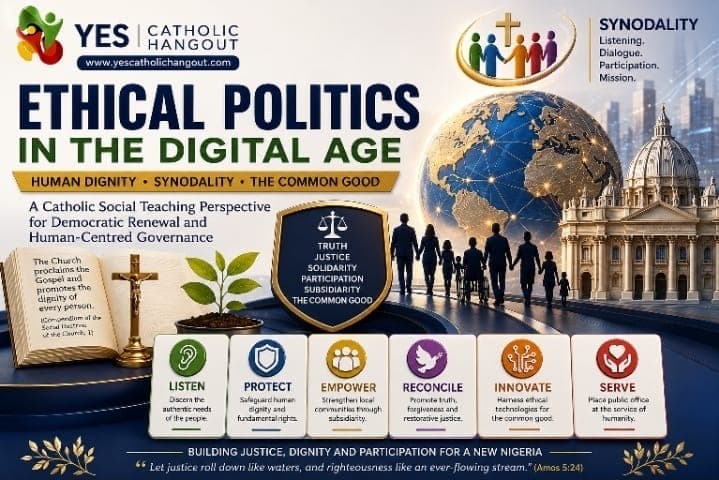
Six Action Words for Ethical Politics
The path toward democratic renewal may be summarized in six enduring commitments:
Listen. Discern the authentic hopes and concerns of every community.
Protect. Safeguard the dignity, rights, and freedoms of every person.
Empower. Strengthen local communities through participation and subsidiarity.
Reconcile. Promote truth, forgiveness, restorative justice, and lasting peace.
Innovate. Develop technologies that serve humanity and the common good.
Serve. Exercise political authority as a vocation of charity and responsibility.
Conclusion
Ethical politics is neither naive nor unattainable. It is the practical expression of love in public life. In an age increasingly shaped by artificial intelligence, digital governance, and global interdependence, the Church’s social doctrine offers a timeless compass: place the human person at the centre, protect the common good, and ensure that every technological and political innovation remains accountable to truth, justice, and fraternity.
Democracy will endure not because it is technologically advanced, but because it remains morally grounded. When political institutions, civic leaders, faith communities, and citizens embrace a culture of listening, responsibility, reconciliation, and service, they contribute to a future worthy of the human person, a future in which technology enhances freedom, governance reflects justice, and politics becomes once again an authentic vocation dedicated to the flourishing of all.