
Ethical Innovation and Synodal Leadership for the Digital Age
A Human-Centred Vision for the Future of Technology, Society, and the Church
By Fr. Oliver CCE | Ethical Innovator | Synodal Secretary | Founder, www.yescatholichangout.com
We stand at an inflection point in human history. Artificial Intelligence, automation, biotechnology, digital finance, and an accelerating constellation of emerging technologies are reshaping every dimension of human life, from the way we work, learn, heal, and govern, to the way we pray, communicate, and form community. The question confronting the global community is no longer whether technology will transform civilisation, but whether civilisation will possess the moral clarity and ethical resolve to ensure that this transformation serves the dignity of every human person.
This is not merely a technical challenge. It is a profoundly spiritual, social, and institutional one, and it demands a response that integrates the best of human wisdom with the deepest commitments of faith.
As a Catholic priest, Ethical Innovator, and Synodal Secretary, I write from the conviction that the future of humanity will not be determined by computational power, market valuations, or the speed of algorithmic processing alone, but by the moral character, spiritual discernment, and ethical responsibility of those who design, govern, regulate, finance, and use the technologies that are rapidly redefining our world. The measure of authentic innovation is not simply its scale or velocity but its capacity to promote human dignity, justice, trust, transparency, accountability, participation, sustainability, peace, integral human development, and the common good.
I. The Urgency of Ethical Innovation
The digital revolution has delivered extraordinary benefits: unprecedented access to information, new frontiers in medical research, platforms for democratic participation, tools for education and formation, and possibilities for economic inclusion that previous generations could scarcely have imagined. Yet alongside these gains, the same revolution has generated profound risks, algorithmic bias that entrenches inequality, surveillance capitalism that erodes privacy, autonomous weapons systems that raise existential moral questions, disinformation ecosystems that corrode democratic institutions, and digital divides that leave billions of people excluded from the prosperity that technology promises.
Artificial Intelligence, in particular, has emerged as the defining technological and ethical challenge of our era. Its capacity to augment human decision-making, accelerate scientific discovery, and optimise complex systems is matched by its potential to displace workers, amplify prejudice, concentrate power, and diminish the very human agency it claims to enhance. The Vatican’s own declaration Antiqua et Nova (2025) has made clear that AI must always remain a tool in the service of the human person, never a substitute for human judgment, moral responsibility, or the irreducible dignity of every person created in the image and likeness of God.
This is why I have committed my ministry and professional life to what I call ethical innovation, the deliberate, systematic integration of moral wisdom, Catholic Social Teaching, and human-centred design into every stage of technological development, governance, and deployment. Ethical innovation is not a constraint on progress. It is the very condition that makes genuine progress possible.
The framework I champion draws deeply on Magnifica Humanitas, the Holy See’s comprehensive vision for ensuring that Artificial Intelligence, automation, robotics, and emerging technologies always remain servants of the human person rather than masters of humanity. This is not abstract theology. It is a practical governance framework with direct applications for legislators drafting AI regulation, executives designing algorithmic systems, engineers writing code, entrepreneurs building digital platforms, educators shaping curricula, and pastors accompanying their communities through technological upheaval.
II. Fratelli Tutti and the Ethics of Digital Fraternity
Pope Francis’s landmark encyclical Fratelli Tutti offers a vision of universal fraternity and social friendship that is urgently needed in the digital age. The encyclical insists that no human being can live in isolation, that we are all interconnected, and that the measure of our civilisation is found in how we treat the most vulnerable. These principles carry direct implications for how we design, govern, and deploy technology.
When algorithms determine who receives a loan, who is offered a job, who is flagged as a security risk, or whose content is amplified or suppressed, the consequences are not abstract. They are deeply personal and often profoundly unjust. Ethical innovation demands that every algorithmic decision be subject to principles of transparency, accountability, and fairness. It demands that the voices of those most affected by technological systems, the poor, the elderly, migrants, persons with disabilities, indigenous communities, and young people in the Global South, be included in the design and governance of those systems.
Fratelli Tutti calls us to build a civilisation of love in the digital sphere as much as in the physical one. This means cultivating digital spaces that foster genuine dialogue rather than polarisation, that build bridges rather than walls, that amplify truth rather than sensationalism, and that protect the dignity of every person rather than reducing human beings to data points to be monetised. Ethical innovation, in this light, is an act of fraternity, a concrete expression of our commitment to the common good.
The encyclical’s vision of international cooperation is equally vital. The governance of Artificial Intelligence cannot be left to a handful of technology companies or wealthy nations. It requires multilateral frameworks grounded in shared ethical principles, inclusive participation, and genuine solidarity. I have argued in international forums that the Church, with its global presence, moral authority, and centuries of intellectual tradition on the common good, is uniquely positioned to contribute to these frameworks, not as a competing interest group, but as a voice for the voiceless.
III. Laudato Si’ and Technological Responsibility for Our Common Home
Laudato Si’ was prophetic in recognising that the environmental crisis and the technological revolution are deeply intertwined. Pope Francis warned against a technocratic paradigm that reduces nature, and indeed human beings, to mere objects of manipulation and consumption. This warning has only grown more urgent as Artificial Intelligence, big data, and automation increasingly mediate our relationship with the natural world.
Ethical innovation must therefore include ecological responsibility at its core. Data centres consume vast quantities of energy and water. The mining of rare earth minerals for electronic devices devastates ecosystems and exploits vulnerable communities. The rapid obsolescence of digital hardware generates mountains of electronic waste. Any claim to ethical innovation that ignores these realities is, at best, incomplete and, at worst, dishonest.
But technology also offers extraordinary tools for ecological stewardship. AI-powered systems can optimise energy grids, predict and mitigate the effects of climate change, monitor deforestation in real time, support precision agriculture that reduces water and pesticide use, and accelerate the transition to renewable energy. The question is not whether technology can serve sustainability, it clearly can, but whether we possess the ethical will to ensure that it does so consistently, equitably, and at scale.
I advocate for what I call green ethical innovation, a framework that integrates environmental impact assessments into every stage of technological development, from design and manufacturing to deployment and disposal. This framework draws on the principles of Laudato Si’ and aligns with the United Nations Sustainable Development Goals, recognising that care for creation and care for the human person are inseparable dimensions of a single moral vision.
IV. The Economy of Francesco and a Human-Centred Digital Economy
The Economy of Francesco movement, inspired by Pope Francis’s call for a new economy that serves the human person, provides a powerful framework for reimagining the digital economy. The movement brings together young economists, entrepreneurs, innovators, and scholars from around the world to develop economic models that prioritise dignity, inclusion, creativity, and sustainability over profit maximisation and technological dominance.
I believe this vision is directly applicable to the digital economy. Today’s technology sector is characterised by extreme concentration of wealth and power, precarious labour conditions for millions of workers, opaque algorithmic systems that shape consumer behaviour and political discourse, and a relentless pressure to scale that often sacrifices quality, ethics, and human wellbeing at the altar of growth.
Ethical innovation offers an alternative. It proposes a digital economy that rewards meaningful work rather than mere productivity metrics, that values long-term value creation over short-term technological disruption, that ensures digital entrepreneurs in the Global South have access to the same tools, capital, and markets as their counterparts in Silicon Valley, and that measures economic success not only in terms of shareholder returns but in terms of social impact, environmental sustainability, and the flourishing of communities.
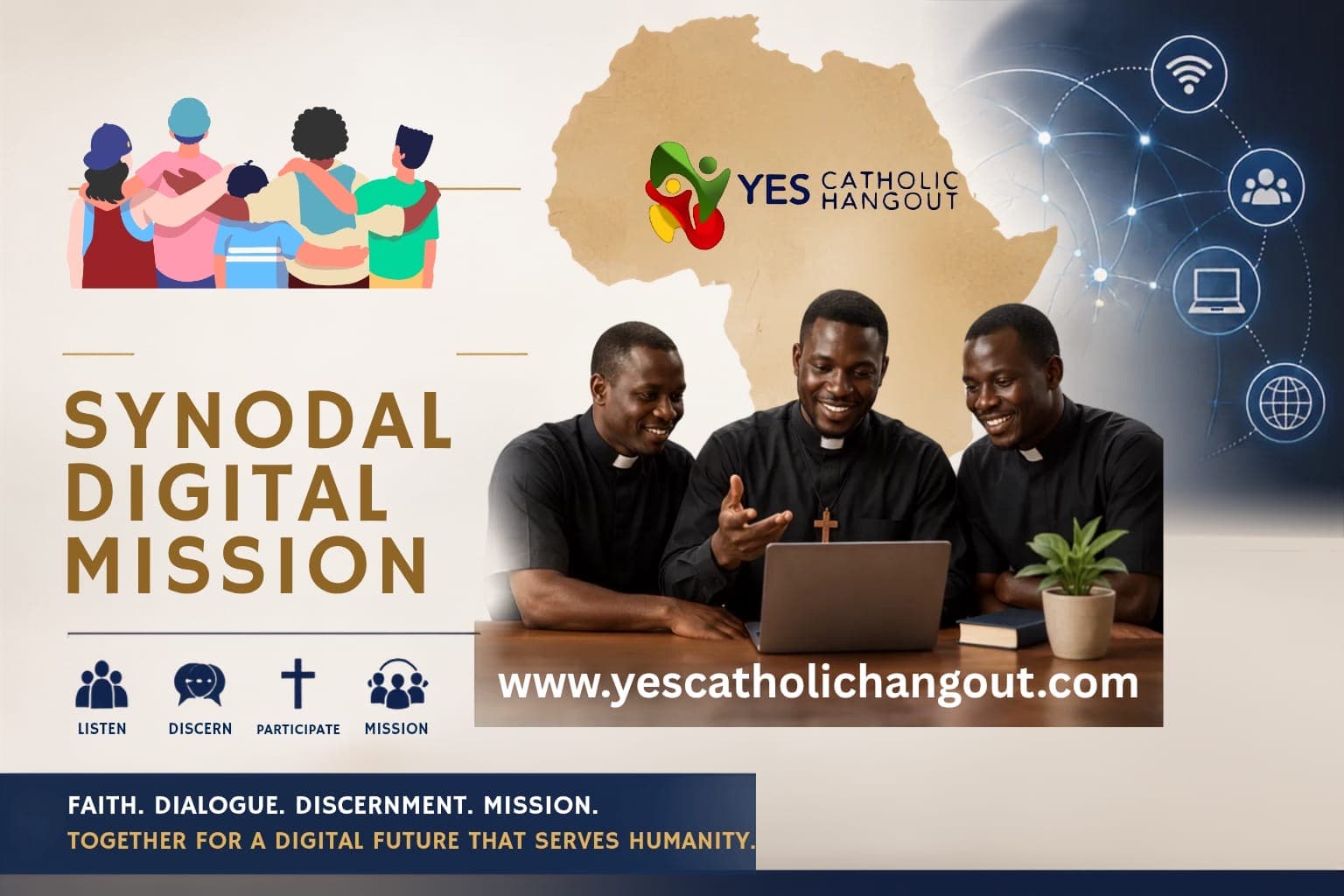
Through my work with www.yescatholichangout.com, I am committed to building a practical expression of this vision, an emerging international platform that seeks to unite faith, ethical technology, education, innovation, entrepreneurship, and digital evangelization within the framework of Catholic Social Teaching. The platform serves as a gathering point for Catholics and all people of good will who believe that technology must serve humanity, not the other way around. It offers resources for ethical entrepreneurship, digital formation, youth engagement, and synodal collaboration, drawing inspiration from the global synodal journey promoted through synod.va.
V. Synodal Leadership as a Governance Model for the Digital Age
Synodality, walking together, listening, discerning, and deciding in communion, is not merely an ecclesial concept. It is a governance philosophy with profound relevance for every institution grappling with the complexities of the digital age.
Traditional hierarchical models of governance, whether in governments, corporations, universities, or healthcare systems, are increasingly inadequate to the challenges posed by rapid technological change. Decisions about AI deployment, data governance, digital rights, and emerging technologies require input from diverse stakeholders, technologists, ethicists, policymakers, affected communities, and the public at large. They require cultures of listening, shared discernment, and collaborative decision-making that are, in essence, synodal.
I propose synodal leadership as a governance model capable of transforming institutions of every kind. In practice, this means creating structures that ensure all voices, especially those that are marginalised or silenced, are heard in decision-making processes. It means fostering cultures of transparency and accountability. It means investing in ongoing formation and education so that leaders at every level possess the moral and intellectual tools necessary for ethical discernment. And it means cultivating the virtue of patience, recognising that authentic dialogue and genuine consensus-building take time, but that the decisions they produce are more just, more durable, and more legitimate than those imposed from above.
The synodal journey of the Catholic Church, as articulated through the Synod on Synodality, offers a living laboratory for this governance model. The Church is learning, sometimes painfully, always hopefully, how to listen across cultures, generations, and perspectives, how to discern the movement of the Spirit in diverse voices, and how to make decisions that honour both unity and diversity. These lessons are directly transferable to the governance of technology, the formation of ethical AI frameworks, and the construction of digital economies that serve the common good.
VI. Yes Catholic Hangout: A Platform for Ethical Innovation and Digital Evangelization
www.yescatholichangout.com represents my concrete contribution to the mission of ethical innovation and digital evangelization. It is not simply a website. It is an emerging international platform designed to bring together Catholics and all people of good will who share a conviction that faith and technology are not opposing forces but complementary dimensions of a fully human life.
The platform offers spaces for formation, dialogue, and collaboration across multiple domains: ethical technology and AI governance; Catholic education and youth formation; entrepreneurship and innovation rooted in the common good; digital evangelization and the New Evangelization; synodal leadership development; and care for creation in the digital age. It draws on the rich tradition of Catholic Social Teaching, the dignity of the human person, subsidiarity, solidarity, the common good, the preferential option for the poor, the universal destination of goods, care for creation, and the dignity of work, and applies these principles to the most pressing questions of our technological era.
In complementing the global synodal journey promoted through synod.va, Yes Catholic Hangout encourages the very qualities that synodality demands: listening, dialogue, discernment, participation, co-responsibility, and missionary outreach. It recognises that the digital sphere is not a separate world but an integral part of the one world in which the Church is called to be present, prophetic, and pastoral.
VII. The Business Case for Ethical Leadership
A common objection to ethical innovation is that it is impractical, that the marketplace rewards speed and scale, not virtue. This objection is not only morally insufficient. It is increasingly empirically false.
A growing body of research demonstrates that organisations grounded in ethical leadership consistently outperform their less principled competitors over the long term. They earn greater public trust. They attract sustainable investment from the rapidly growing pool of ESG-conscious investors. They retain top talent in an era when skilled workers, especially younger generations, increasingly seek purpose-driven employment. They build deeper customer loyalty. They avoid the catastrophic reputational, legal, and financial costs associated with data breaches, algorithmic scandals, and regulatory penalties. And they contribute to the stability of the social and institutional ecosystems on which their own long-term success depends.
The business case for ethical innovation is, therefore, not a concession to idealism. It is a strategy for durable, sustainable success. Companies that embed ethical principles into their governance structures, design processes, supply chains, and stakeholder relationships are not merely doing good. They are doing well. They are building the trust, resilience, and social capital that no amount of venture capital or technological sophistication can substitute.
VIII. Addressing Contemporary Global Challenges
Ethical innovation is not an abstract philosophy. It offers practical frameworks for addressing the most urgent challenges of our time.
Artificial Intelligence Governance. Establishing multilateral, human-centred frameworks that ensure AI systems are transparent, accountable, fair, and aligned with human dignity. This includes advocating for meaningful human oversight of all consequential algorithmic decisions and opposing the development of autonomous lethal weapons systems.
Digital Inequality. Closing the digital divide by ensuring universal access to affordable, reliable internet, investing in digital literacy and formation, and supporting the development of locally relevant content and applications in every language and culture.
Youth Formation. Preparing young people not merely for participation in the digital economy but for responsible, ethical citizenship in the digital age. This requires comprehensive digital formation that integrates technical skills with moral reasoning, critical thinking, media literacy, and an appreciation for the transcendent dimension of human existence.
Ethical Entrepreneurship. Fostering a new generation of entrepreneurs who measure success not only by revenue and valuation but by social impact, environmental sustainability, and the creation of meaningful, dignified work.
Climate Responsibility. Harnessing technology for ecological stewardship while holding the technology sector accountable for its own environmental footprint.
Cybersecurity and Data Privacy. Championing robust data protection frameworks that safeguard individual privacy, ensure informed consent, and hold organisations accountable for the security of the data entrusted to them.
Healthcare Innovation. Ensuring that AI-powered healthcare tools are accessible, equitable, culturally sensitive, and always subject to human clinical judgment.
Education Transformation. Leveraging technology to expand access to quality education while preserving the irreplaceable role of human teachers, mentors, and formators.
Peacebuilding and Democratic Participation. Using digital tools to strengthen democratic institutions, promote informed civic engagement, counter disinformation, and build cultures of peace and dialogue.
IX. A Call to Action
The digital age presents the Catholic Church and the global community with an unprecedented opportunity, and an equally unprecedented responsibility. The technologies we create and deploy in the coming decades will shape the lives of billions of people for generations to come. We cannot afford to approach this moment with complacency, cynicism, or moral abdication.
I call upon Catholic leaders, educators, entrepreneurs, technologists, policymakers, and all people of good will to embrace the vocation of ethical innovation. I call upon governments to develop AI governance frameworks grounded in human dignity and the common good. I call upon technology companies to embed ethical principles into every stage of design, development, and deployment. I call upon universities and research institutions to integrate moral reasoning and Catholic Social Teaching into their technology curricula. I call upon parishes, dioceses, and religious communities to engage seriously with the digital sphere as a genuine frontier of evangelization and pastoral care. And I call upon young people, the digital natives who will inherit the world we are building, to become protagonists of ethical innovation, bringing their energy, creativity, and idealism to the service of a more just, more humane, and more sustainable digital future.
The future is not something we passively await. It is something we build, together, in synodality, with discernment, and in fidelity to the Gospel. Let us ensure that the digital civilisation we are constructing is worthy of the human dignity that God has inscribed in every person.
The measure of our innovation will not be found in the sophistication of our algorithms or the speed of our processors. It will be found in the quality of our mercy, the depth of our solidarity, and the breadth of our commitment to the common good. This is the vision of ethical innovation. This is the promise of synodal leadership. And this is the future to which we are called.
Fr. Oliver CCE is a Catholic priest, Ethical Innovator, Synodal Secretary, and founder of www.yescatholichangout.com, an emerging international platform uniting faith, ethical technology, education, innovation, entrepreneurship, and digital evangelization within the framework of Catholic Social Teaching.