
Disarming Technology, Building Peace: Reclaiming Political Responsibility for Human Dignity in the Age of AI
By Fr. Oliver CCE | Ethical Innovator & Synodal Secretary | Founder, Yes Catholic Hangout
1. A Question of Responsibility
Artificial intelligence is often presented as if it were an impersonal force: an inevitable wave arriving from somewhere beyond public deliberation. Yet every system is designed, trained, financed, deployed and governed by people. Behind an automated decision stand choices about data, priorities, risk and whose experience will count. Behind a digital platform stand choices about attention, profit and the kind of public life that its architecture will encourage. Behind an autonomous weapon stand choices about whether a human being may delegate the most serious judgement of all: whether another person should live or die.
The decisive question of the AI age is therefore not simply what machines can do. It is whether human beings will accept responsibility for what they allow machines to do. Technology can widen human capability, support discovery, connect communities and help address urgent needs. It can also magnify domination, accelerate falsehood, conceal accountability and turn persons into profiles, targets or measurable outputs. Its moral direction is never guaranteed by technical sophistication.
For global societies, and for the Church’s social witness, this is an anthropological question before it is a commercial or strategic one: who is the human person that technology is meant to serve? If that question is postponed, innovation will quietly define the person in its own image. Efficiency will become a substitute for wisdom. Prediction will be confused with understanding. Control will be mistaken for security. The result would not be a more human future, but a more technically managed form of human fragility.
2. Human Dignity Before Technological Power
Catholic Social Teaching begins elsewhere. Human dignity is not earned through productivity, intelligence, wealth, citizenship, connectivity or usefulness to a system. It belongs to every person, especially when a person is vulnerable, excluded, displaced, poor, young, elderly or otherwise unable to make their voice heard. This conviction places a boundary around technological power: no innovation may treat human beings merely as inputs, obstacles or disposable instruments.
The common good is more than the aggregate of individual preferences. It concerns the social conditions that enable people and communities to flourish together. In a digital society, those conditions include trustworthy information, meaningful privacy, fair access to opportunity, freedom from manipulation, and institutions capable of explaining and correcting consequential decisions. Solidarity asks us to see how harms travel across borders and generations. Subsidiarity asks that decisions be made as close as possible to those affected, while ensuring that local communities are not abandoned when problems exceed their capacity. Stewardship reminds us that power is held in trust, not possessed without limit.
These principles are not obstacles to progress. They are a moral compass for progress. They ask whether a new system strengthens agency or weakens it; whether it serves the vulnerable or extracts from them; whether it builds communion or rewards contempt. They also insist that technological policy cannot be left only to those with the capital, expertise or infrastructure to shape it. Citizens, workers, educators, families, faith communities and those most exposed to risk must be participants in the conversation.
The language of innovation can sometimes conceal a refusal to listen. A product is launched before affected communities can contest its assumptions. A public service is automated before people know how to appeal. A moderation system removes speech without explaining its standards. A predictive tool labels a neighbourhood, a child or a job applicant without acknowledging the histories that produced its data. In each case, dignity is endangered when people are made visible to a system but invisible within its decision-making.
3. What It Means to Disarm Technology
To disarm technology is not merely to remove weapons from a battlefield. It is to remove the patterns of domination that can be built into technical systems: manipulation, dehumanisation, polarisation, exploitation and unchecked power. It means asking not only whether a tool is legal or profitable, but whether it makes peace more possible and responsibility more visible.
Disarming technology means refusing to design public communication around the exploitation of fear. It means resisting platforms that turn anger into an economic resource and treat attention as something to be captured at any cost. It means challenging systems that make vulnerable people bear the greatest burden of error while powerful actors remain insulated from consequence. It means preventing technological language from making violence sound clean, distant or inevitable.
The phrase also carries a positive invitation. A disarmed technology is not a weak technology. It is a technology whose strength is placed under ethical direction. It can help a community understand a crisis without reducing people to data points. It can assist a doctor without replacing the relationship of care. It can support a teacher without narrowing a student’s imagination. It can help diplomats identify patterns of risk while leaving the work of trust, truth-telling and reconciliation to human encounter.
This requires a change in the imagination of power. The strongest society is not the one that automates the most decisions or monitors the most lives. It is the one capable of restraint, transparency and repair. It is the one willing to say that some forms of efficiency are too costly, some forms of surveillance are incompatible with freedom, and some decisions must never be delegated to an opaque system.
4. Political Responsibility in the AI Age
Politics cannot outsource its moral work to algorithms. A model may identify patterns, estimate probabilities or organise information, but it cannot bear responsibility in the human sense. It cannot apologise, reconcile, protect a minority because that minority is unpopular, or answer a grieving family. It cannot discern the meaning of a promise. When public authorities use automated systems, human judgement must remain present, trained and accountable.
That accountability begins with transparency. People should know when an automated system is materially shaping a decision about their welfare, liberty, employment, education or access to essential services. They should have a meaningful path to explanation, correction and appeal. Independent oversight must be possible, including for systems developed by private companies and used in the name of public security. Procurement should reward safety, accessibility, labour dignity and public value, not only speed or low cost.
Governments have a responsibility to establish enforceable limits, protect rights across borders and ensure that communities are not divided into those who benefit from AI and those who simply absorb its risks. Technology companies have a responsibility to test systems in real social contexts, disclose foreseeable harms, protect workers whose hidden labour makes automation possible, and avoid business models that depend on manipulation. Researchers have a responsibility to ask what should be built, not only what can be built. Investors and technology leaders must learn that moral seriousness is part of long-term stewardship, not a public-relations accessory.
The principle of subsidiarity is especially important here. Decisions about digital systems should include the people who live with their effects. A national policy cannot replace local knowledge; nor can local action alone answer the global reach of platforms and data flows. Shared standards, democratic oversight and international cooperation are needed precisely because no single institution can carry the whole burden.
5. AI, War and the Work of Peace
The relationship between AI and war exposes the danger of moral distance. When technology makes violence faster, more remote or more automated, the person who authorises it may feel further removed from the person who suffers. This distance can weaken conscience. Autonomous systems intensify the concern because they may select or engage targets with limited human intervention. The question is not only whether such systems can meet a technical threshold. It is whether human beings can preserve moral responsibility when the chain between decision and death becomes difficult to see.
Peace cannot be reduced to the management of threats. It requires justice, dialogue, diplomacy, the protection of civilians, attention to the causes of conflict and the patient rebuilding of trust. AI may assist with humanitarian logistics, early warning, translation or the analysis of complex information. But it cannot reconcile communities by calculation. It cannot substitute for the courage of listening, the recognition of suffering or the decision to seek a future shared with an adversary.
The themes associated with Fratelli Tutti invite societies to resist the fragmentation that makes neighbours into enemies and strangers into problems. Laudato Si’ reminds us that technological power must be placed within an integral vision of human and ecological flourishing, rather than separated from the consequences of its use. The Rome Call for AI Ethics has helped draw public attention to principles such as transparency, inclusion, accountability, impartiality, reliability, security and privacy. These themes belong in a wider conversation about peace, where the goal is not simply to make conflict more manageable but to make human fraternity more credible.
The Church’s developing reflection on AI and peace can contribute precisely by keeping the person at the centre. It need not offer a technical blueprint for every system. Its distinctive contribution is to ask what a culture of encounter requires, whose dignity is being overlooked, and how political choices can protect the possibility of reconciliation. This is a form of realism: peace is difficult, but violence automated and normalised would be a deeper failure of imagination.
6. Synodality as an Ethical Method
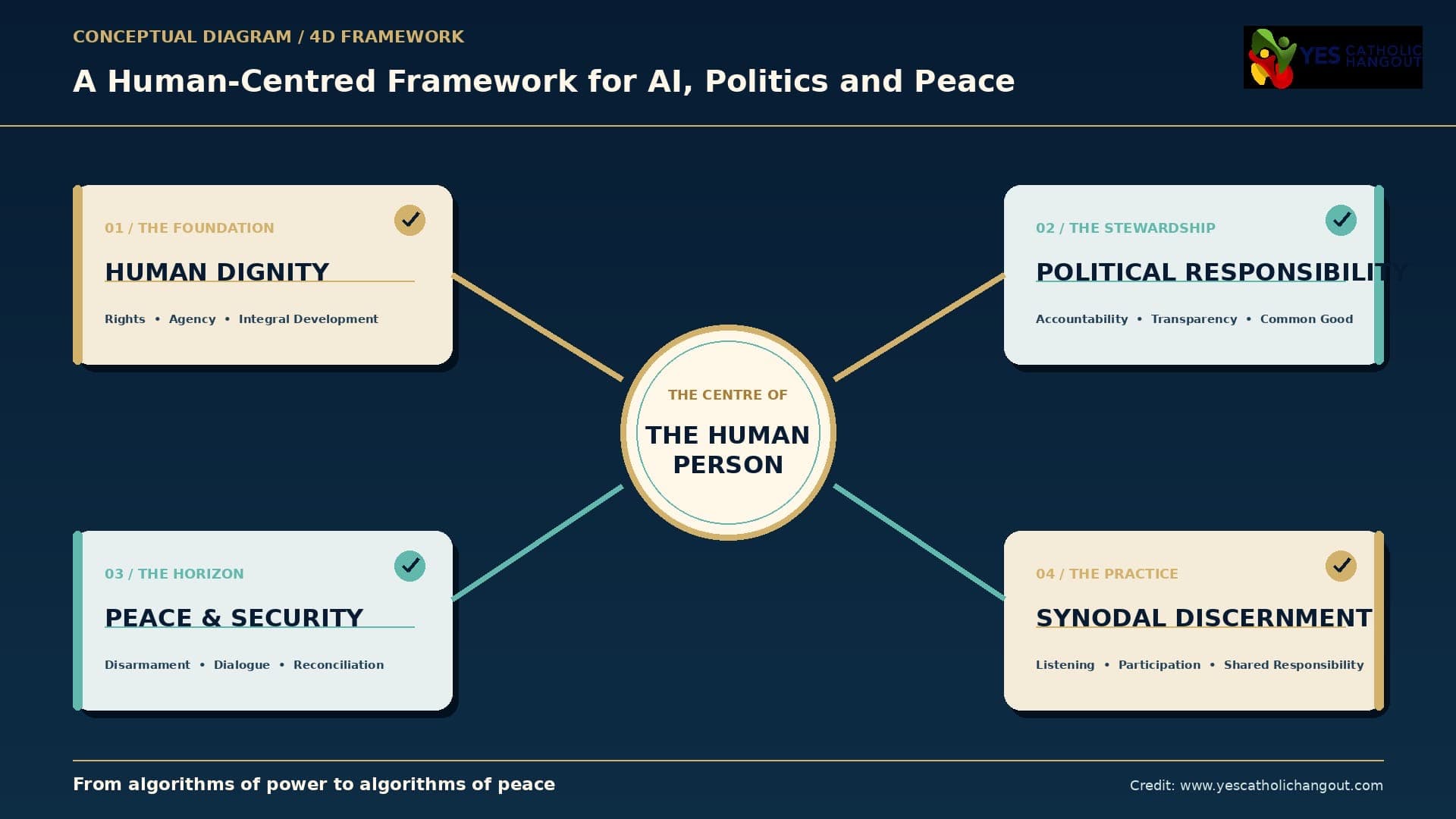
Synodality offers more than an ecclesial vocabulary. It offers an ethical method for a technological age. To listen, encounter, participate, discern and share responsibility is to resist the temptation to treat complex social questions as engineering problems with a single optimised answer.
Listening means more than collecting opinions. It means creating conditions in which those affected by a system can speak without being dismissed as technically uninformed. Encounter means allowing a human story to interrupt an abstract dashboard. Participation means including workers, children, migrants, people with disabilities, older persons, minority communities and those living in conflict zones. Discernment means considering consequences, motives and the shape of the society a decision will form. Shared responsibility means refusing both the fantasy of individual control and the excuse that nobody is accountable because a system is complex.
This method is demanding because it slows the rush toward deployment. Yet slowness can be a form of care. A community that pauses to ask who is missing from the room may prevent harms that no later patch can fully repair. A policymaker who welcomes criticism may strengthen, rather than weaken, public trust. A company that consults those who will use or endure its product may discover a better purpose for it.
Synodality also protects hope from becoming naive. Hope does not deny conflict, error or ambiguity. It creates a disciplined willingness to seek the good together. In schools, parishes, universities, laboratories and public institutions, this can become a practical habit: explain the system, hear the concern, test the impact, revise the design and remain answerable to the people involved.
7. From Algorithms of Power to Algorithms of Peace
The movement from algorithms of power to algorithms of peace begins with concrete responsibilities.
Governments should guarantee rights-based regulation, independent audits, accessible appeal processes and meaningful human control over high-risk decisions. They should invest in digital literacy, public-interest research and international diplomacy that limits the militarisation of emerging technologies.
Technology companies should make safety and dignity visible in product decisions, not only in corporate statements. They should reduce incentives for outrage, disclose material system limitations, protect privacy by design and provide remedies when automated tools cause harm. Their leaders should accept that some markets should not be pursued simply because they can be reached.
Researchers should broaden the question of success. Accuracy matters, but so do explainability, social impact, energy use, accessibility, labour conditions and the distribution of risk. Universities and laboratories should equip technical education with ethics, history, political thought and the voices of affected communities.
Faith communities should become places of patient public reasoning. They can host intergenerational conversations, accompany people whose work is being transformed, challenge dehumanising narratives and teach that care for the vulnerable is a test of any social order. They can also model the discipline of listening across disagreement.
Educators should help young people move beyond both fear and fascination. Students need to understand how systems work, but also how attention, authority, truth and responsibility work. Young people should be invited to create technologies that answer real human needs rather than merely intensify consumption or status competition.
Civil society should monitor power wherever it gathers, connect local experience with global advocacy and protect whistle-blowers, journalists and communities that expose abuse. Citizens should demand evidence, resist the forwarding of dehumanising content and remember that every click can contribute to a culture of either contempt or solidarity.
None of these responsibilities can be fulfilled in isolation. The common good is built through institutions that cooperate without erasing their distinct roles. The goal is not to baptise technology with religious language or to place the Church above democratic debate. It is to bring moral attention into the places where technical choices shape human futures, and to make room for wisdom that cannot be measured only by performance.
8. Choosing a Human Future
The debate about AI will be decided not only in laboratories and legislatures, but in ordinary habits of attention. It will be decided by whether we reward truth more than virality, relationship more than convenience, and responsibility more than plausible deniability. It will be decided by whether those with power use it to enlarge the freedom of others or to make themselves impossible to question.
Human dignity is not an old principle waiting to be updated by technology. It is the measure by which technology must be judged. Peace is not the quiet produced when dissent has been suppressed. It is the work of people who recognise one another, negotiate in good faith and build institutions strong enough to protect the weak. Political responsibility is not an outdated burden. In an age of powerful systems, it is the condition for freedom.
The challenge of the AI age is not simply to build more intelligent machines, but to form more responsible human beings. To disarm technology, humanity must first disarm the logic of domination that shapes its use, and choose instead to make innovation an instrument of dignity, encounter, justice, and peace.