
Conserving Creation Begins by Protecting Human Dignity and Our Common Home: A Synodal Vision for the Future
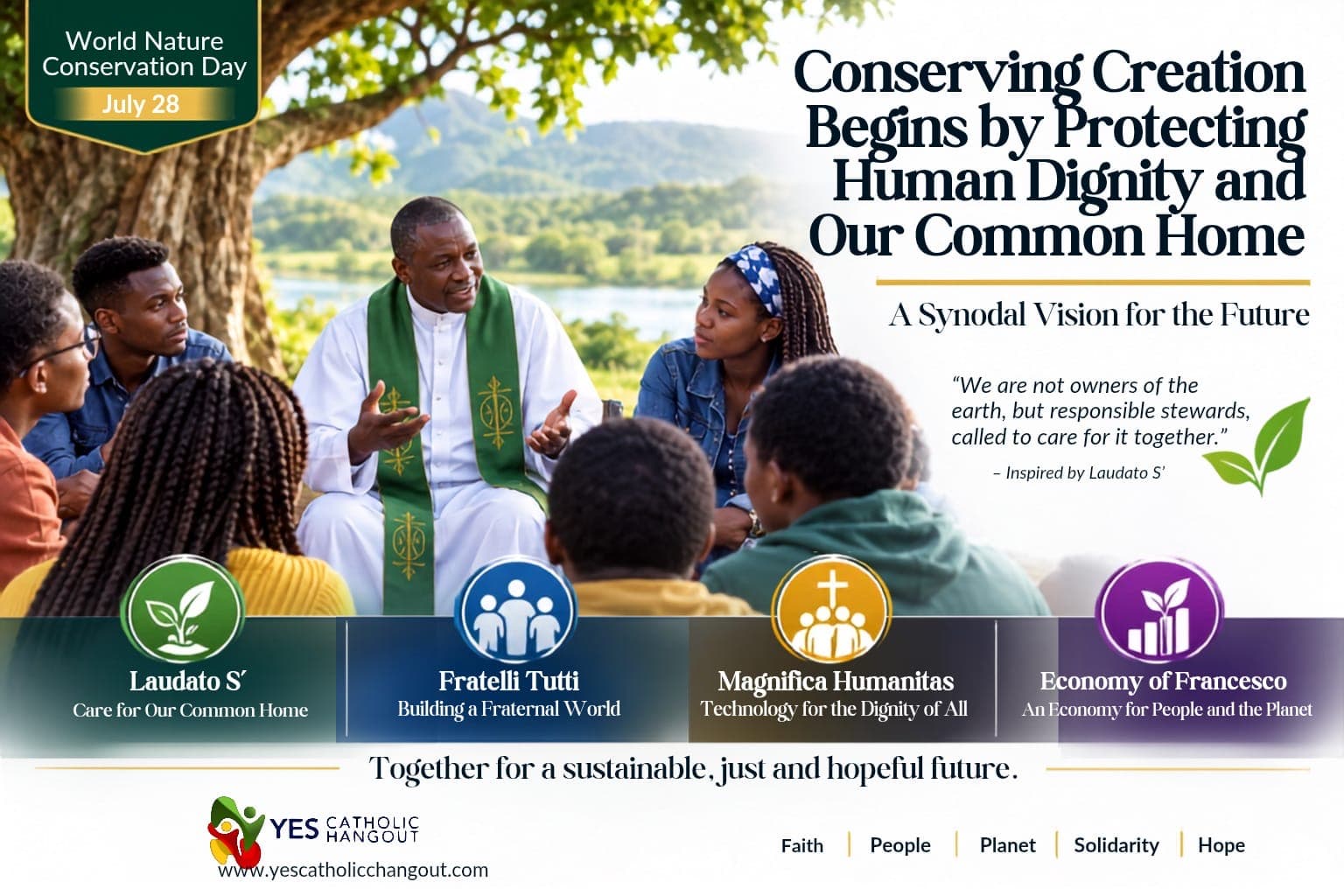
A Reflection for World Nature Conservation Day
By Fr. Oliver CCE | Ethical Innovator | Synodal Secretary | Founder, www.yescatholichangout.com
1. Opening: A Day to Remember What We Hold in Common
On 28 July, the world pauses to observe World Nature Conservation Day. It is a day of remembrance and responsibility, an invitation to look again at the forests, rivers, oceans, and creatures that surround us, and to ask ourselves what kind of inheritance we are preparing for those who will inherit the earth after us. The date does not belong to any single nation or creed. It belongs to humanity. And yet, for the Christian conscience, it carries a resonance that runs far deeper than ecological awareness alone. It touches the very meaning of creation, the dignity of the human person, and the moral vocation of every believer.
For too long, conservation has been spoken of almost exclusively in the language of policy and science. We discuss carbon budgets, biodiversity indices, emission targets, and protected zones. These are necessary and good. But if they remain detached from a deeper anthropology, from a vision of the human person as sacred and social, they risk becoming technical exercises that leave the heart untouched. Authentic conservation does not begin with a strategy. It begins with a conviction: that every human being is created in the image and likeness of God, and that the earth is a common home entrusted to our care.
This conviction changes everything. Protecting a rainforest becomes a moral act; defending indigenous land rights becomes a spiritual act; rejecting the throwaway culture becomes an act of love. When we conserve creation, we honour the Creator, protect our brothers and sisters, especially the poorest, and respond to a call written into our humanity.
The central thesis of this reflection is therefore simple but far-reaching. Authentic conservation begins not merely with protecting forests, rivers, oceans, and wildlife, but with safeguarding the dignity of every human person and cultivating moral responsibility toward our common home.
2. The Author’s Voice: A Catholic Contribution to the Global Dialogue
This article is offered from the perspective of Fr. Oliver CCE, an Ethical Innovator, Synodal Secretary, and Founder of www.yescatholichangout.com. It is written as a constructive Catholic contribution to the global dialogue on ethical innovation, environmental stewardship, synodality, Artificial Intelligence, and integral human development. It does not claim magisterial authority, nor does it offer the final word on technical questions. Its aim is more modest and necessary: to place these conversations within the horizon of human dignity and the grammar of faith, hope, and love.
In a moment when public discourse is often fragmented and polarised, the Church has a distinctive vocation. She is called to listen before she speaks, to accompany before she judges, and to propose before she imposes. She is called to be a synodal Church, walking together with the whole human family and discerning, in the signs of the times, the promptings of the Holy Spirit. This article seeks to embody that spirit. It is an exercise in what Pope Francis has called the art of encounter: a way of thinking and speaking that refuses to pit creation against creature, ecology against economy, technology against transcendence, or progress against the poor.
The perspective offered here is therefore both theological and practical. It is theological because it roots conservation in the doctrine of creation and the moral law inscribed in human conscience. It is practical because it recognises that ideas must eventually become actions, that principles must find flesh in policies, lifestyles, businesses, educational curricula, and community initiatives. The Church does not offer a technical blueprint for solving the environmental crisis. She offers something prior and more enduring: a vision of the human person and the common good that can guide and animate every technical solution.
3. The Interconnected Crisis: When Creation Suffers, Humanity Suffers
To speak of an environmental crisis today is already to speak of something larger than melting ice caps or disappearing species. The degradation of our planet is inseparable from the moral, technological, economic, and spiritual crises that mark our age. These crises are not separate emergencies that happen to coincide. They are symptoms of a single deeper wound: the failure to recognise the sacred dignity of the human person and the intrinsic value of the created world.
Consider the evidence. Deforestation destroys habitats, displaces communities, and intensifies the vulnerability of the poor. Pollution poisons rivers and the children who drink from them. Climate change alters weather patterns and exacerbates hunger, migration, conflict, and inequality. The same logic of consumption that empties the seas also empties neighbourhoods of hope. The same instrumental rationality that treats workers as units of production treats forests as timber and oceans as dumping grounds.
At the root of all this is a truncated vision of the human person. When we forget that men and women are made for communion rather than consumption, we treat one another and the world as raw material for our projects. The technological mind, untethered from moral responsibility, exploits both people and planet. The economic mind, detached from the common good, measures success by profit alone. The political mind, reduced to short-term calculation, postpones decisions that future generations will pay for.
This is why any authentically Christian response to the environmental crisis must be integral. It cannot address the climate without addressing injustice. It cannot promote sustainability without promoting solidarity. It cannot speak of biodiversity without speaking of human dignity. The cry of the earth and the cry of the poor, as Pope Francis so often reminds us, are one cry. To separate them is to misunderstand both.
4. Magnifica Humanitas: The Human Person at the Centre
The teaching letter Magnifica Humanitas calls the Church and the world to recover a confident and integrated humanism. It reminds us that every authentic progress, whether scientific, technological, economic, or political, must be measured against one decisive criterion: does it serve the human person in his or her totality? This is not a sentimental question. It is a rigorous moral test. And it is the test that must be applied to every environmental policy and every innovation that claims to advance conservation.
The question can be stated simply: does this protect human dignity while safeguarding creation? Every technological innovation, every public policy, every scientific discovery, and every economic model must first answer it. An agricultural technology that increases yields while poisoning farmworkers fails the test. A renewable energy project that displaces a vulnerable community without consultation fails the test. A carbon trading scheme that allows wealthy nations to continue polluting while poorer nations bear the cost fails the test. Conversely, a modest initiative that restores a local watershed while creating dignified work for the unemployed passes it beautifully.
This criterion prevents conservation from becoming either a technocratic obsession or a romantic abstraction. It reminds us that the poor are not obstacles to environmental progress but its primary beneficiaries and partners. Indigenous peoples are not museum pieces of the past. They are living witnesses to sustainable ways of dwelling on the earth. Children and the unborn are not absent from our calculations. They will inherit either a garden or a wasteland.
Magnifica Humanitas also challenges the reduction of the human person to a consumer, a user, or a data point. In the digital age, this reduction has become pervasive. Against this flattening, the Christian vision affirms that every human being is a mystery of freedom and relationship, destined for communion with God and others. Conservation must therefore create the conditions for human flourishing: clean air and water, fertile soil, stable climates, just economies, peaceful communities, and the space in which persons grow in wisdom and love
.
5. Ethical AI and Technology: Servants, Not Masters
Artificial Intelligence is often discussed in tones of either euphoria or anxiety. Some celebrate it as the key to solving humanity’s greatest problems; others fear it as a force beyond our control. A Catholic ethical perspective refuses both extremes. It asks instead how AI and other emerging technologies can be directed toward the common good, including the good of creation, while remaining firmly subject to moral responsibility and human oversight.
The potential is real. Ethical AI can help monitor biodiversity, track endangered species, and detect illegal logging or fishing. It can improve sustainable agriculture by analysing soil conditions, weather patterns, and crop health, enabling farmers to produce more with less waste. It can strengthen disaster preparedness by modelling floods, fires, and storms, giving communities precious time to prepare and evacuate. It can support environmental research by processing vast datasets and revealing patterns that would otherwise remain hidden. It can reduce waste through smarter logistics, better supply-chain transparency, and more efficient use of energy and materials. In all these ways, AI can become an instrument of stewardship.
But this potential is not automatic. Technology is never neutral. It carries the values of those who design, deploy, and profit from it. Without ethical constraints, AI can accelerate exploitation, concentrate power, amplify inequalities, displace workers, undermine privacy, and erode the relationships that sustain communities. It can even be used to greenwash harmful practices while obscuring deeper damage.
That is why responsible digital governance is indispensable. AI must be transparent, accountable, and explainable. Its development must include diverse voices, especially those of the poor, the marginalised, and the young. Its environmental costs must be honestly assessed and minimised. And its use must remain subordinate to human judgment. A machine can analyse data but cannot love. It can optimise efficiency but cannot discern the common good. It can predict consequences but cannot repent. Human oversight is not a brake on progress. It is the condition of its humanity.
In this light, ethical innovation is not the enemy of conservation but one of its most promising allies. What is required is a generation of technologists, entrepreneurs, and policymakers who see their work as a vocation of service to the human person, the common home, and future generations.
6. Fratelli Tutti: Conservation as Universal Fraternity
Pope Francis’s encyclical Fratelli Tutti invites us to imagine a world in which every human being is recognised as a brother or sister. This is not a vague aspiration. It is a moral and political programme. It means that the boundaries of our solidarity cannot stop at national borders, racial categories, religious identities, or generational divides. We are members of one human family, and the earth we inhabit is a common inheritance entrusted to us all.
Environmental conservation is one of the most concrete expressions of this universal fraternity. When a nation protects a river, it is not only serving its own citizens. It is serving the downstream neighbours who depend on the same water. When a community plants a forest, it is not only improving its own landscape. It is contributing to the global lungs that sustain all life. When a young person campaigns for climate action, she is not only defending her own future. She is defending the future of children yet unborn in lands she may never visit. Conservation is therefore an act of communion. It says, in deeds more than words, that my well-being is bound up with yours, and that the flourishing of the earth is a shared responsibility.
This vision stands in contrast to the mentality of isolation, competition, and hoarding that too often characterises our world. Environmental decisions are frequently made by the powerful for the powerful, while the consequences are borne by the weak. The wealthiest nations consume resources at rates that would require several planets if extended to all. The cries of island nations and drought-stricken farmers are drowned out by voices whose profits depend on inaction. Fratelli Tutti calls this what it is: a failure of fraternity and a betrayal of justice.
The response is not a naive globalism that erases differences, but a solidarity that respects them. Every nation, culture, religion, and generation has something to contribute. Indigenous peoples offer ancestral wisdom. Scientists offer rigorous knowledge. Faith communities offer the language of vocation, gratitude, and conversion. Young people offer urgency; elders offer memory. Businesses offer creativity; governments offer coordination. The task of conservation is to bring these gifts into conversation and forge a shared commitment to the earth and to one another.
7. Laudato Si’: Care for Creation as Vocation
Five years before Fratelli Tutti, Pope Francis had already given the Church and the world Laudato Si’, a profound encyclical on care for our common home. Its title, “Praise be to you,” is drawn from the Canticle of the Creatures by Saint Francis of Assisi, and it sets the tone for everything that follows. Care for creation is not first a burden or a problem. It is a vocation, a way of life rooted in gratitude, stewardship, ecological conversion, and love for future generations.
The ecological vocation begins with gratitude. When we look at the world with eyes of faith, we do not see a random collection of resources waiting to be exploited. We see a gift. The sun, the rain, the soil, the seeds, the animals, the seasons, all are given freely by a Creator who loves us. Gratitude teaches us to receive the earth with reverence, to use it with moderation, and to return it to the Creator with care.
From gratitude flows stewardship. The human person is not the owner of creation but its steward. Genesis speaks of our call to till and keep the garden, to cultivate and to protect it. These two verbs describe the double movement of all authentic development: to bring forth the earth’s fruitfulness and to guard its integrity. Stewardship means that we are answerable for the gifts entrusted to us and may not consume the inheritance of our children.
This stewardship requires what Laudato Si’ calls ecological conversion: a transformation of our hearts, minds, and ways of life. We must change not only our technologies and policies but also our desires, habits, and imaginations. We must learn to see waste as a moral failure, consumption as a spiritual question, and the natural world as a neighbour rather than a commodity. Ecological conversion is a lifelong journey sustained by prayer, education, community, and the beauty of the world itself.
Crucially, Laudato Si’ insists that care for creation is inseparable from the defence of the poor. The same economic forces that degrade ecosystems also degrade human lives. The poor are the first to suffer from climate change, pollution, deforestation, and the loss of biodiversity. Indigenous peoples, whose cultures are often most intimately attuned to the land, are frequently displaced by extractive industries. Vulnerable communities, who have contributed least to the environmental crisis, are often the most exposed to its consequences. To protect creation without protecting the poor is therefore a contradiction. It would be like bandaging a wound while leaving the source of the bleeding untouched.
8. The Economy of Francesco: Flourishing Without Exclusion
The Economy of Francesco, inspired by the life and witness of Saint Francis of Assisi, calls for an economy that is at the service of the human person and the earth. It is an economy that refuses the false choice between prosperity and care, between innovation and tradition, between profit and people. It affirms that authentic economic development must balance innovation, entrepreneurship, environmental sustainability, decent work, ethical investment, and long-term responsibility.
This is a vision that business leaders, investors, and policymakers need to hear. The economy is not an autonomous machine governed by impersonal forces. It is a human institution shaped by choices, values, and laws. When those choices are oriented only toward short-term profit, the result is ecological destruction, social fragmentation, and spiritual emptiness. When oriented toward integral human development, the economy creates goods, sustains communities, and preserves the earth.
The Economy of Francesco proposes several orientations. First, businesses should measure success not only by financial returns but by their contribution to human flourishing and ecological resilience. Second, ethical investment should direct capital toward enterprises that respect workers, protect the environment, and serve the common good. Third, decent work must ensure that economic activity does not exploit the vulnerable. Fourth, long-term responsibility means that today’s decisions must not mortgage the future of our children.
These principles are not hostile to entrepreneurship. They liberate it. The most vibrant economies of the future will be those that learn to innovate within the limits of the earth and the dignity of the person. The entrepreneurs who will be remembered are not those who extracted the most wealth in the shortest time, but those who built economies of care: economies that produce renewable energy, restore ecosystems, eliminate waste, create dignified employment, and include those the market would otherwise leave behind.
The transition will require courage, imagination, and sacrifice. It will require policies that internalise environmental costs and protect the poor from transition shocks. It will require consumers who choose wisely, investors who screen ethically, and workers who organise responsibly. It will require business leaders who can look their grandchildren in the eye and say, “We built something that honoured both people and planet.”
9. Synodality: Walking Together Toward a Shared Future
The Church is called to be a synodal community: a people who walk together, listen to one another, discern the signs of the times, and accompany one another toward the Kingdom of God. This synodal identity is not merely an internal structure. It is a way of being in the world with profound implications for conservation.
Synodality means listening first. Before proposing solutions, the Church must listen to those most affected by environmental degradation: the poor, indigenous communities, young people, scientists, farmers, refugees, and workers. Each voice carries part of the truth. The scientist cannot replace the elder who knows the rhythms of the land. The policymaker cannot replace the mother who struggles for clean water. The theologian cannot replace the young activist who feels the urgency of the hour. Synodality gathers these voices in respect, trusting that the Holy Spirit speaks through the whole assembly.
Synodality also means discernment. Not every proposal, however well-intentioned, serves the common good. Some technologies create new dependencies; some reforms harm the communities they seek to help; some conservation projects reproduce colonial patterns. Discernment requires patience, prayer, and the courage to ask difficult questions. The Church exercises moral judgment not by imposing a technical blueprint, but by illuminating the ethical criteria that guide every choice.
Furthermore, synodality means accompaniment. The Church does not stand apart, dispensing advice from a distance. She walks with parishes reducing their environmental footprint, schools integrating ecological education, businesses aligning profit with purpose, and governments crafting laws that protect both people and planet. This accompaniment is the pastoral face of conservation.
Finally, synodality means inspiration. The Church keeps alive a vision of human flourishing that transcends mere utility. She reminds the world that we are children of a loving God who has entrusted the earth to our care. Conservation is not a desperate effort to stave off catastrophe, but a hopeful participation in the renewal of all things in Christ.
10. Practical Pathways: From Vision to Action
Vision without action remains a dream. Action without vision becomes arbitrary. The following pathways are offered as concrete ways in which individuals, parishes, schools, businesses, governments, and technology companies can move from the vision outlined above to practical conservation of our common home.
For individuals, the journey begins with conversion and consistency. It means examining one’s daily consumption, reducing waste, using energy responsibly, choosing sustainable transport, eating with gratitude and moderation, and resisting the throwaway culture. It means supporting ethical businesses, investing conscientiously, and voting for leaders who prioritise the common good. It means cultivating wonder, the habit of seeing the beauty of the created world and responding with reverence.
For parishes and faith communities, conservation becomes an expression of the Church’s mission. Parishes can undertake energy audits, install solar panels, eliminate single-use plastics, plant gardens, and care for local green spaces. They can preach and teach about creation as a gift, integrating ecological themes into liturgy, catechesis, and pastoral care. They can reach out to the poor in their neighbourhoods, recognising that care for creation and care for the vulnerable are one work.
For schools and universities, education is the primary pathway. Young people need to learn not only the science of ecology but also the ethics of stewardship. They need to encounter the beauty of the natural world, the wisdom of indigenous cultures, and the urgency of climate science. They need to be equipped with the skills to build sustainable economies, design ethical technologies, and participate actively in democratic life. Education forms the imagination, and the imagination will shape the future.
For businesses, the pathway is responsible innovation. This means adopting circular business models, reducing emissions, protecting workers, respecting supply chains, and reporting transparently on environmental and social impact. It means seeing sustainability not as a public relations exercise but as a genuine expression of corporate vocation. It means joining initiatives such as the Economy of Francesco and allowing their principles to shape strategy and culture.
For governments and international institutions, the pathway is just governance. This means setting and enforcing ambitious environmental standards, supporting renewable energy, protecting biodiversity, and ensuring that the costs of transition are borne fairly. It means listening to scientists, respecting indigenous rights, and honouring international commitments. It means recognising that the atmosphere, the oceans, and the great forests are global commons that no nation can claim as its own.
For technology companies, the pathway is ethical design. This means building AI and digital systems that are transparent, accountable, energy-efficient, and respectful of human dignity. It means using technology to protect biodiversity, improve agriculture, predict disasters, and promote solidarity. It means refusing to develop technologies whose purpose is exploitation, surveillance, or environmental destruction. It means placing human oversight at the centre of every automated system.
These pathways are not exhaustive, but they are representative. They show that conservation is not the work of a single actor or sector. It is the work of the whole human family, acting in its diverse spheres according to a shared vision of the common good.
11. Conclusion: Conservation as an Act of Love
On World Nature Conservation Day, the world is invited to remember what it so easily forgets: that the earth is not a warehouse of resources but a home, that creation is not a possession but a gift, and that conservation is not merely a technical duty but a moral and spiritual vocation. This article has argued that authentic conservation begins with the protection of human dignity and the cultivation of responsibility toward our common home. It has drawn on the wisdom of Magnifica Humanitas, Fratelli Tutti, Laudato Si’, the Economy of Francesco, and the synodal path to show that this vocation is both intellectually rigorous and pastorally urgent.
The conclusion is therefore a call to love. Conservation is ultimately an act of love: love for God the Creator, who spoke the world into being and saw that it was good; love for every human person, especially the poor and vulnerable, who bear the heaviest burden of ecological destruction; love for future generations, who will inherit the earth we leave behind; and love for our common home, the fragile and beautiful planet that sustains us all.
This love is not weak. It is strong enough to change lifestyles, reform economies, guide technologies, and reshape policies. It is patient enough to accompany the slow work of ecological conversion, courageous enough to confront the powerful and defend the voiceless, and hopeful enough to believe that a different world is possible.
The road ahead is demanding, but it is not without light. The Creator who entrusted the earth to our care also gives us the grace to care for it well. The Church, called to be synodal, is also called to be missionary, carrying this vision to every corner of the world. The human heart, wounded by sin but redeemed by love, remains capable of choosing the good and embracing the beautiful.
May this World Nature Conservation Day be not only a day of awareness but a day of commitment. May we renew our promise to be stewards, not masters; brothers and sisters, not strangers; prophets of hope, not prophets of despair. May we walk together, in the spirit of synodality, toward a future in which every human person flourishes in dignity and every creature finds its place in the harmony of creation. This is the vision. This is the vocation. This is the love that must now become our way of life.
Pax et Bonum