
Building an Ethical AI Ecosystem: A Synodal Path for Human Dignity, Integral Ecology, and Fraternal Economy
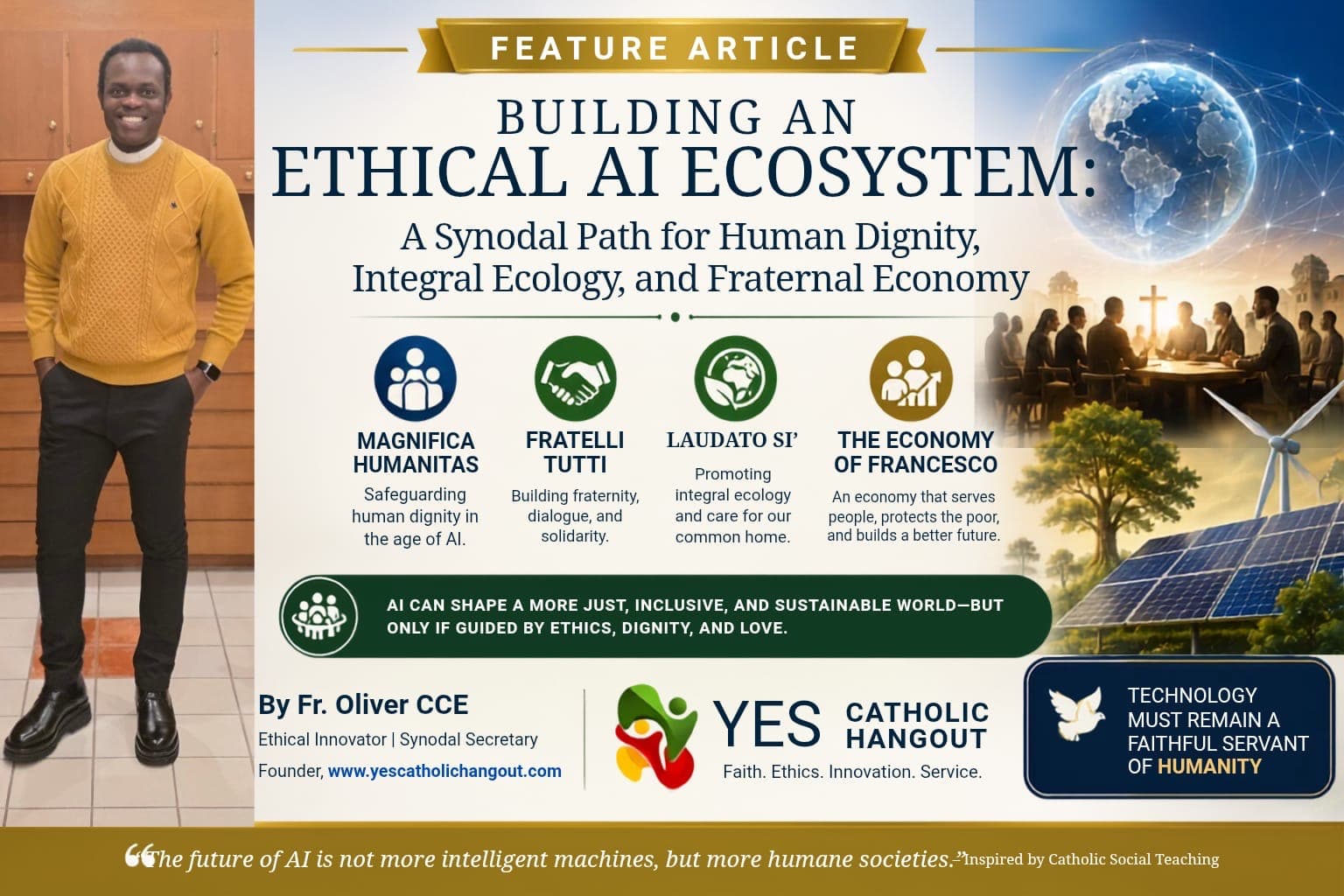
Artificial Intelligence has become one of the defining realities of our age. It is transforming education, healthcare, communication, governance, finance, labour, and even the ways in which people seek meaning and build relationships. While these developments present extraordinary opportunities, they also confront humanity with profound ethical questions that cannot be answered by technological innovation alone.
The Church therefore approaches Artificial Intelligence neither with fear nor with naive optimism, but with hope rooted in the Gospel. Every technological revolution invites a deeper examination of what it means to be human. The central question is not whether machines can think, but whether humanity will continue to think, choose, love, and act according to truth and charity. Technology must always remain at the service of the human person, whose dignity is bestowed by God and can never be reduced to data, productivity, or economic value.
This conviction resonates with the Church’s contemporary social teaching. Fratelli Tutti calls the world to rediscover fraternity and social friendship amid growing fragmentation. Laudato Si’ reminds us that humanity, technology, economics, and the natural world are inseparably connected within an integral ecology. The vision of the Economy of Francesco invites a new economic imagination that places persons before profit and measures success by inclusion, solidarity, and the common good. Together, these perspectives provide a coherent moral horizon for navigating the digital age.
Within this horizon, the emerging vision of Magnifica Humanitas highlights the urgent responsibility to safeguard the dignity of every human person in the era of Artificial Intelligence. It reminds us that technological progress reaches its fullest meaning only when it strengthens freedom, protects conscience, nurtures authentic relationships, and serves the flourishing of every person and every community.
A Synodal Way for the Digital Age
The Church’s synodal journey offers more than an internal ecclesial method. It proposes a way of living and discerning that speaks powerfully to our technological future. Synodality begins with listening, listening to God, to one another, to the poor, to young people, to scientists, entrepreneurs, educators, policymakers, and those whose voices are often overlooked.
Artificial Intelligence raises questions that cannot be answered by engineers alone. They require philosophers, theologians, economists, jurists, environmental scientists, psychologists, educators, and pastoral leaders to engage in sustained dialogue. Such collaboration reflects the very essence of synodality: walking together in pursuit of truth and the common good.
An ethical AI ecosystem therefore cannot emerge from competition alone. It requires cooperation, transparency, accountability, and shared responsibility among governments, universities, businesses, civil society, faith communities, and international institutions. The future of technology must become a shared moral project.
Human Dignity: The First Principle
Every technological system should begin with one non-negotiable question: how does this serve the human person?
Artificial Intelligence should never diminish human freedom or replace moral responsibility. Algorithms may assist decision-making, but they cannot substitute conscience. Machines may process information, but they cannot exercise wisdom. Automation may improve efficiency, but it cannot replace compassion, mercy, or love.
Human dignity is not earned through intelligence, productivity, or economic contribution. It is an inherent gift rooted in the image of God. Consequently, every AI system should be evaluated not only by technical performance but also by its impact on justice, inclusion, privacy, human rights, employment, education, and the protection of vulnerable persons.
Integral Ecology in the Digital Economy
The digital revolution also carries ecological responsibilities. Artificial Intelligence depends upon vast energy resources, critical minerals, global supply chains, and expanding data infrastructures. Ethical reflection therefore cannot be separated from environmental stewardship.
As Laudato Si’ teaches, everything is connected. The environmental cost of technological development, electronic waste, resource extraction, and energy consumption must become integral considerations in AI governance. Innovation that damages creation ultimately harms humanity itself.
Responsible technological progress therefore requires sustainable design, renewable energy, responsible production, circular economic models, and ecological accountability. Care for creation and care for humanity belong to the same moral vocation.
A Fraternal Economy for the Digital Future
The digital economy possesses immense potential to reduce poverty, improve healthcare, expand education, and create new opportunities. Yet it also risks widening inequality through technological monopolies, exclusion, algorithmic bias, and unequal access to digital infrastructure.
The Economy of Francesco challenges society to imagine an economy where innovation serves inclusion rather than concentration of power. Artificial Intelligence should empower workers, entrepreneurs, farmers, educators, healthcare professionals, and local communities rather than displacing them without support or participation.
Economic development must therefore be measured not solely by productivity but by its contribution to human flourishing, meaningful work, social cohesion, and intergenerational justice.
Young People as Ethical Co-Creators
Young people stand at the centre of this digital transformation. They are not merely future users of Artificial Intelligence. They are already its designers, innovators, entrepreneurs, educators, and citizens.
The Church has a unique opportunity to accompany them through education that integrates technological competence with moral formation. Digital literacy must be complemented by ethical literacy. Critical thinking must be accompanied by virtue. Innovation must be guided by responsibility.
An authentic formation prepares young people not only to build intelligent technologies but also to cultivate wisdom, humility, compassion, and service.
Africa’s Gift to the Global Conversation
Africa brings distinctive strengths to the global discussion on Artificial Intelligence. Its traditions of community, solidarity, respect for elders, intergenerational responsibility, spirituality, and resilience offer essential correctives to purely technocratic models of development.
Rather than remaining only a consumer of imported technologies, Africa can become a contributor to ethical innovation by integrating scientific excellence with cultural wisdom and moral reflection. The continent’s youthful population, entrepreneurial spirit, and growing digital capacity position it to participate actively in shaping a more human-centred technological future.
The global conversation on AI will be richer when every culture contributes its wisdom while respecting the universal dignity of every person.
Toward a Global Ethical AI Ecosystem
The path forward requires more than regulation. It requires a renewed moral imagination. An ethical AI ecosystem should rest upon six enduring pillars:
Human Dignity. Recognising every person as possessing inalienable worth.
Truth and Transparency. Ensuring honesty, explainability, and accountability in technological systems.
Synodal Discernment. Fostering participation, dialogue, and shared responsibility.
Integral Ecology. Protecting creation while advancing innovation responsibly.
Inclusive Innovation. Ensuring that technological progress benefits every people and every nation.
Global Solidarity. Strengthening international cooperation in pursuit of justice, peace, and the common good.
These pillars invite governments, businesses, universities, research institutions, civil society, and faith communities to collaborate in building technological systems worthy of the human family.
A Hope-Filled Horizon
The future of Artificial Intelligence will not be determined solely by the sophistication of algorithms but by the depth of our moral vision. Humanity’s greatest innovation has never been technology itself. It has always been our capacity to seek truth, to practice justice, to forgive, to create, and to love.
The Gospel reminds us that authentic progress is measured by our service to one another. A synodal Church therefore offers the world not merely ethical principles but a way of walking together, listening, discerning, accompanying, and building a civilisation of love in which technology serves humanity rather than mastering it.
If Artificial Intelligence is guided by wisdom, virtue, compassion, and faith, it can become a powerful instrument for peace, integral human development, and care for our common home. In such a future, innovation will no longer be measured only by what machines can accomplish, but by how deeply they enable human persons and communities to flourish.
Only then will Artificial Intelligence truly become an expression of authentic human creativity, remaining always a faithful servant of humanity and never its master.