
Beyond Fear and Hype: Rehumanizing Artificial Intelligence through Discernment, Responsibility and the Common Good
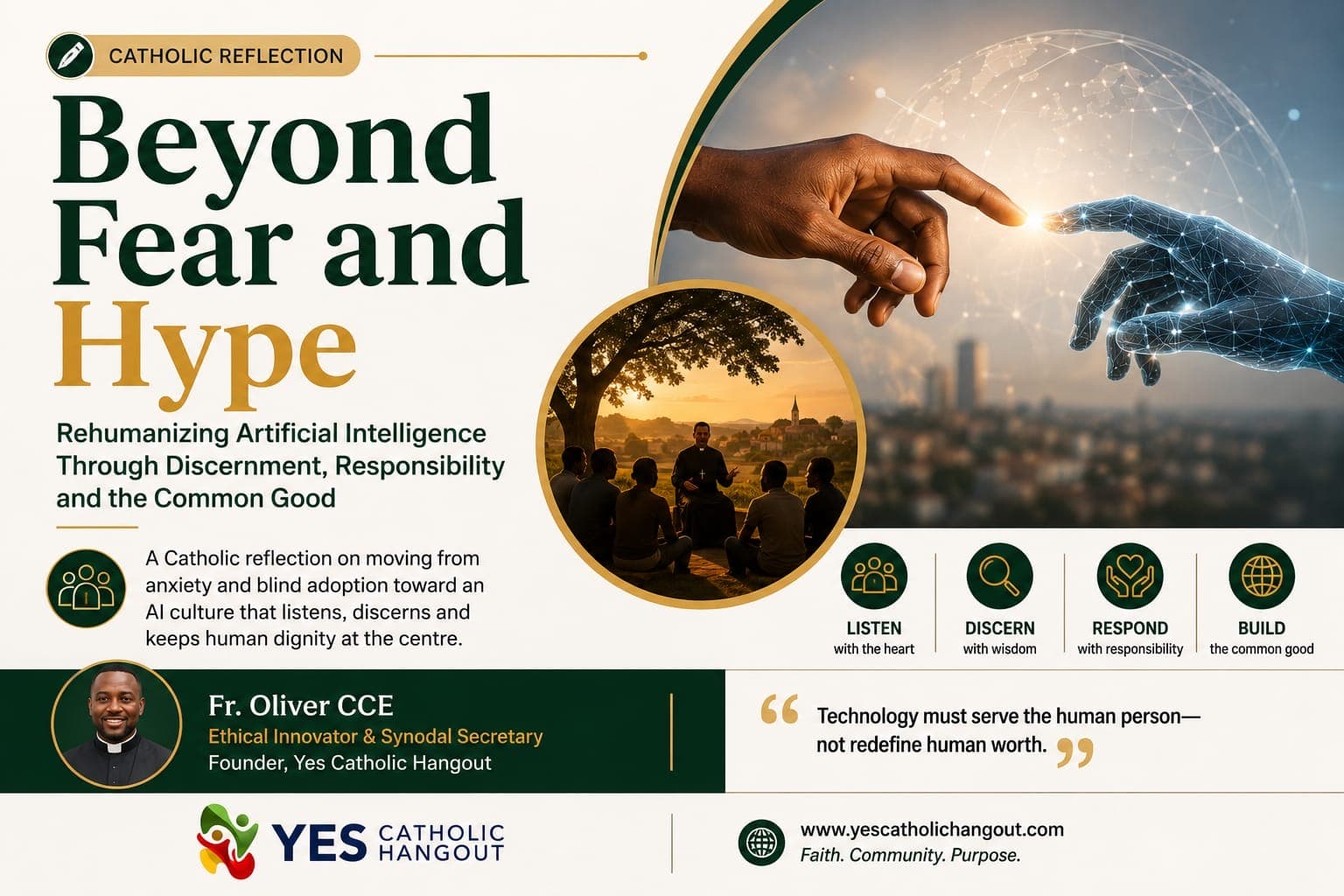
By Fr. Oliver CCE | Ethical Innovator and Synodal Secretary | Founder, Yes Catholic Hangout
Feature article draft authored from the perspective of Fr. Oliver CCE. This is not an official Vatican News publication or endorsement.
1. The Question Beneath the Machine
Artificial intelligence is already being met with a striking range of human reactions. Some people distrust it and keep their distance. Others use it quietly, unsure how to speak about a tool that may alter their profession or expose how their work is done. Many approach it with anxiety: will my skills still matter? Will my privacy survive? Will a decision about my livelihood be made by a system no one can explain?
There is also superficial adoption, in which the newest application is treated as a shortcut before anyone asks what it is for. There is excessive trust, as though an automated answer must be more objective than a human judgment. And there is thoughtful integration, in which people test what technology can do while retaining responsibility for what it should do.
These responses are understandable. Yet they do not reach the deepest question. The question is not only what artificial intelligence will become, but what kind of human person and society we are becoming through our relationship with it. Technology does not simply extend our abilities. It can also train our habits, reorder our priorities and quietly define what we consider valuable.
The Catholic tradition begins elsewhere: with the dignity of the person, created for relationship and called to responsibility. The recent Note Antiqua et Nova, issued jointly by the Dicastery for the Doctrine of the Faith and the Dicastery for Culture and Education, invites this wisdom into the present moment: “With wisdom both ancient and new (cf. Mt. 13:52), we are called to reflect on the current challenges and opportunities posed by scientific and technological advancements, particularly by the recent development of Artificial Intelligence (AI).” [1]
This is neither a rejection of innovation nor a celebration of novelty. It is an invitation to moral attention.
2. Discernment as the Bridge
Public debate about AI often oscillates between fear and hype. Fear sees only threat and can lead to paralysis. Hype sees only possibility and can lead to surrender. Neither should determine humanity’s future. Between them stands discernment: the patient work of asking what serves the person, what damages communion, who bears the risk and who receives the benefit.
For Pope Francis, discernment is not merely clever analysis. In Gaudete et Exsultate, he writes: “The only way is through discernment, which calls for something more than intelligence or common sense. It is a gift which we must implore.” [2] He connects this need to a “culture of zapping” in which every passing possibility is presented as equally good. That description has particular force in a digital economy of continuous prompts, instant outputs and permanent distraction.
Discernment gives innovation a human horizon. It asks a developer to consider the people represented in training data, a manager to consider the worker behind a productivity metric, a teacher to consider the student whose formation cannot be reduced to a polished answer, and a family to consider whether a convenience is strengthening or weakening its bonds.
This is why AI must remain a tool at the service of the human person, never a measure of human worth. An automated system may sort, predict, translate, summarize or generate. It does not thereby acquire the moral responsibility of a person, nor does it make a person less worthy when the person is slower, poorer, older, disabled or excluded from the latest platform. Antiqua et Nova states the boundary plainly: “the responsibility for the ethical creation and implementation of AI systems falls on us humans, whether developers or end users, since AI systems are not capable of moral judgment themselves.” [3]
3. A Social Question, Not Only a Technical One
Catholic Social Teaching offers a durable grammar for this discernment. Human dignity, the common good, solidarity and subsidiarity are not decorative principles to be added after a product is built. They are criteria for deciding what should be built, how it should be governed and whose voice must be heard.
The Compendium of the Social Doctrine of the Church calls these principles the “very heart of Catholic social teaching.” [4] Its account of the common good is especially important in a world tempted to confuse aggregate efficiency with human progress: “The common good does not consist in the simple sum of the particular goods of each subject of a social entity.” Rather, it belongs to everyone and to each person, and can be safeguarded only together. [5]
Applied to AI, the common good asks more than whether a system is profitable or popular. Does it widen access to knowledge or deepen a digital divide? Does it help a rural clinic serve patients or extract value from communities without accountability? Does it support a worker’s judgment or deskill the worker and intensify surveillance? Does it preserve the conditions for truthful public conversation, or reward the fastest circulation of outrage?
Solidarity directs attention to those who carry the heaviest burdens: children, migrants, the poor, people with disabilities, workers whose roles are being transformed, and communities whose languages and histories are poorly represented in digital systems. Subsidiarity insists that decisions should not be pulled unnecessarily toward distant institutions or opaque platforms. Local knowledge, professional judgment, family life and the wisdom of communities must not be treated as obstacles to scale.
Fraternity adds a further test. In Fratelli Tutti, Pope Francis warns that digital relationships can have “the appearance of sociability” without building real community. “Digital connectivity is not enough to build bridges. It is not capable of uniting humanity.” [6] AI can improve communication, but no generated message can substitute for the slow work of listening, forgiveness, presence and shared responsibility.
4. What Must Not Be Outsourced
The ethical risks of AI are concrete. Biased data can reproduce discrimination while giving it the appearance of neutral calculation. Misinformation and deepfakes can damage the dignity of persons and weaken trust in institutions. Data collection can turn private life into a permanent resource for prediction and control. Pope Francis describes the danger with unsettling precision: “people’s lives are combed over, laid bare and bandied about, often anonymously.” [7]
The answer is not simply a longer terms-of-service document. It includes truthful communication, meaningful consent, privacy safeguards, transparent responsibility and a firm refusal to circulate material that degrades people, promotes hatred or exploits the vulnerable. Antiqua et Nova urges those who produce and share AI-generated content to verify its truth and to avoid sharing words and images that violate human dignity. [8]
Work and education require equal care. AI may complement human labor, but it can also make workers deskilled, monitored and pushed toward harsher or more repetitive tasks. Students may receive useful critique, yet lose the struggle through which critical thinking, memory, judgment and intellectual character are formed. The Rome Call for AI Ethics therefore links technological innovation to a responsibility for education across the humanities, science and technology, and “for and with younger generations.” [9]
Human creativity also deserves protection. Creativity is not only the production of an attractive artifact. It is attention, memory, interpretation, experience and the courage to make something accountable to another person. A classroom, newsroom, parish or studio that uses AI well should not ask merely, “Can this be generated?” It should ask, “What human work, relationship or act of understanding must remain present?”
Nor can the ecological cost of digital systems be ignored because their outputs appear weightless. The hardware, energy and water behind AI belong to the real world. Antiqua et Nova highlights environmental concerns about the water and energy required to run the necessary hardware. [10] In Laudato Si’, Pope Francis observes that humanity has developed technological power without necessarily developing “a sound ethics, a culture and spirituality genuinely capable of setting limits” to guide it. [11] He also reminds us: “We have the freedom needed to limit and direct technology; we can put it at the service of another type of progress, one which is healthier, more human, more social, more integral.” [12]
The most serious boundary concerns life and death. Speaking to the G7, Pope Francis called for an effective and concrete commitment to human control and stated: “No machine should ever choose to take the life of a human being.” [13] This is not a marginal question. It reveals the principle at stake wherever automated systems influence access to justice, employment, healthcare, education or safety: human judgment must not disappear behind a screen.
5. The Promise of Ethical Integration
A responsible Catholic reflection on AI must also resist the temptation to see only danger. Properly governed, these tools can support education, healthcare, communication, accessibility, evangelization and sustainable development. They can help a teacher adapt material, a clinician organize information, a person with a disability access communication, a parish translate resources, or a researcher identify connections across languages and disciplines.
Pope Francis’s 2024 Message for the World Day of Peace expresses this possibility with a demanding measure: “if artificial intelligence were used to promote integral human development, it could introduce important innovations in agriculture, education and culture” and contribute to human fraternity. Yet the true test is how such systems include “the least of our brothers and sisters, the vulnerable and those most in need.” [14]
This measure changes the conversation. The best use of AI is not necessarily the most impressive use. It may be the quiet application that allows a blind student to read, helps a remote health worker communicate, preserves a minority language, reduces waste or gives a small community access to expertise without surrendering its agency. Innovation becomes credible when it strengthens participation rather than concentrating power.
6. Toward an Anthropological Theoalgorithm
I propose the term Anthropological Theoalgorithm for a framework that begins before the code and reaches beyond compliance. Its central question is simple: who is the human person this technology is meant to serve?
The phrase joins three forms of attention. “Anthropological” keeps the person, body, conscience, relationships and social belonging in view. “Theo” recalls that human dignity is not manufactured by performance, purchasing power or computational capacity. “Algorithm” acknowledges the concrete systems through which choices are organized and consequences distributed.
An Anthropological Theoalgorithm would ask, at every stage: whose dignity is at stake? Who has been absent from the design? What relationships will this system strengthen or weaken? Can its decisions be challenged? What happens when it is wrong? Does it protect the vulnerable? Are its energy and material costs compatible with care for creation? Does it leave enough room for human judgment, responsibility and hope?
This is not a substitute for technical standards, law or professional ethics. It is the moral orientation that makes those instruments meaningful. Ethical AI is not merely a system that passes a checklist. It is a vocation to strengthen relationships, protect the vulnerable and advance authentic human flourishing. The aim is not to make machines more human, but to ensure that humans remain humane in the way they design, deploy and limit machines.
7. Choosing Wisdom Together
The work ahead belongs to many communities. Governments must protect rights, establish accountability and ensure that the benefits of innovation do not become the privilege of a few. Technology companies must design for transparency, safety, accessibility and human control, not only for speed and market dominance. Educators must teach both digital competence and the habits of attention, truthfulness and judgment that technology cannot supply.
Faith communities can offer spaces in which people ask not only what is possible but what is faithful to the human person and the common good. Families can practice forms of presence that no platform can automate. Young people should not be addressed merely as consumers of technology; they should be welcomed as co-responsible citizens and creators of the future. The Rome Call is right to describe education as a commitment to build a future for and with younger generations. [9]
The Church’s contribution is not a partisan program or a fear of the future. It is a witness to the conviction that every person is more than a data point, every community more than a market, and every act of intelligence accountable to love. The future of AI will be shaped not only in laboratories and boardrooms, but in classrooms, homes, hospitals, workplaces, parishes and public decisions.
We can move beyond fear, hype and blind trust. We can choose discernment over reaction, responsibility over convenience and solidarity over extraction. The goal is not simply to build more powerful artificial intelligence. It is to become wiser about the purposes for which intelligence, artificial or human, is used. If technology is placed at the service of dignity, fraternity, integral development and care for our common home, innovation can become an instrument of hope rather than a replacement for it.
Sources and Notes
Dicastery for the Doctrine of the Faith and Dicastery for Culture and Education, Antiqua et Nova: Note on the Relationship Between Artificial Intelligence and Human Intelligence, 28 January 2025, para. 1. Official Vatican portal: vatican.va
Pope Francis, Gaudete et Exsultate: Apostolic Exhortation on the Call to Holiness in Today’s World, 19 March 2018, para. 166. Link
Antiqua et Nova, 28 January 2025, para. 39. Official Vatican portal: vatican.va
Pontifical Council for Justice and Peace, Compendium of the Social Doctrine of the Church, 2004, para. 160.
Compendium of the Social Doctrine of the Church, 2004, para. 164.
Pope Francis, Fratelli Tutti: Encyclical Letter on Fraternity and Social Friendship, 3 October 2020, para. 43.
Fratelli Tutti, 3 October 2020, para. 42. Link
Antiqua et Nova, 28 January 2025, para. 89. Official Vatican portal: vatican.va
Pontifical Academy for Life and partners, Rome Call for AI Ethics, 28 February 2020, Education section.
Antiqua et Nova, 28 January 2025, environmental concerns section. Official Vatican portal: vatican.va
Pope Francis, Laudato Si’: Encyclical Letter on Care for Our Common Home, 24 May 2015, para. 105.
Laudato Si’, 24 May 2015, para. 112.
Pope Francis, Address to the G7 Summit, Borgo Egnazia, 14 June 2024.
Pope Francis, Message for the 57th World Day of Peace: Artificial Intelligence and Peace, 1 January 2024, sec. 5.
The article’s theological framework and quotations are based solely on the supplied verified Church-source research. Quotations are used sparingly and identified by document and paragraph or section where the research provided that locator.