
Artificial Intelligence Faces a Growing Crisis of Trust: Building an Ethical Technology Ecosystem for the Human Person
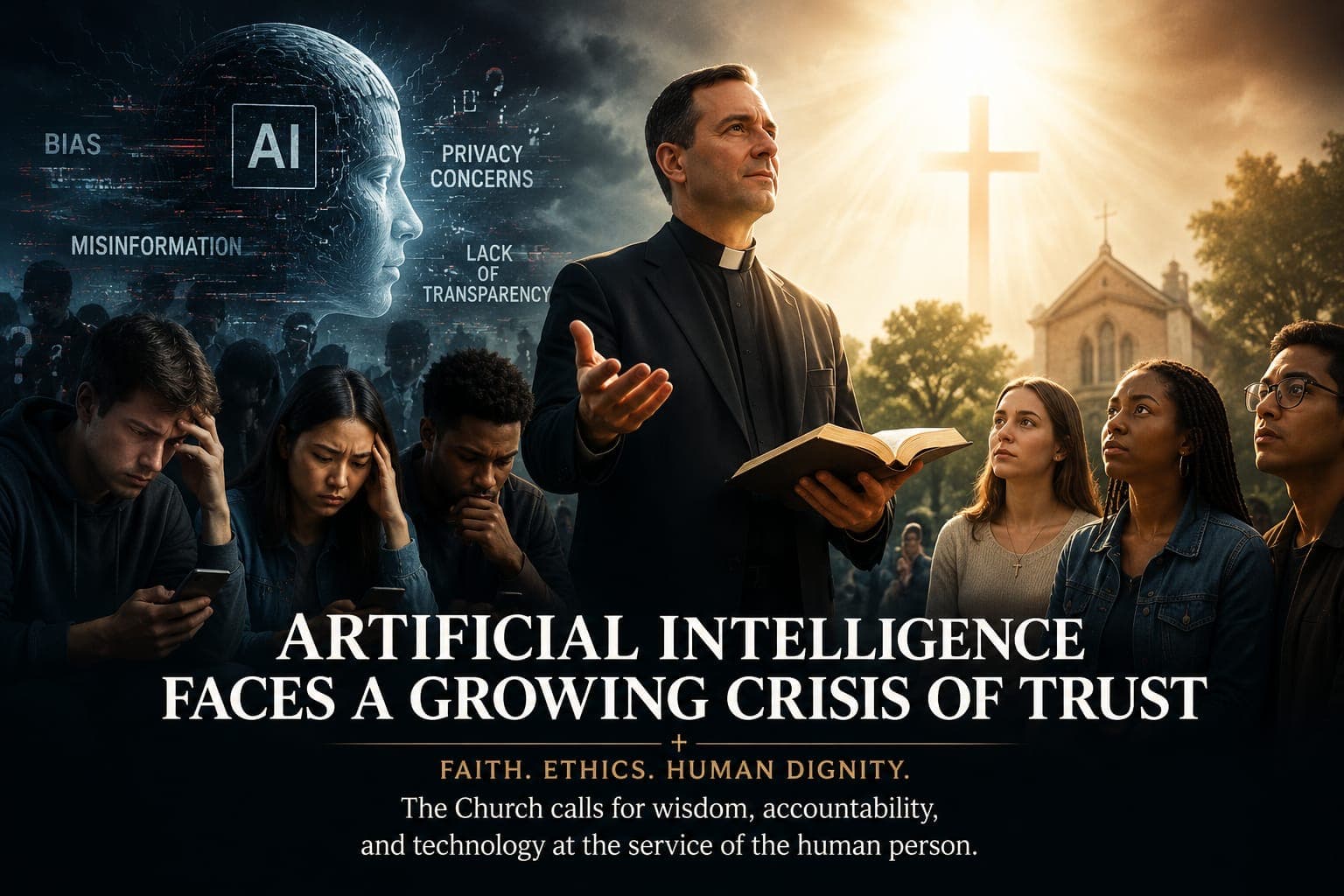
Artificial Intelligence has rapidly become one of the defining technologies of our age. It influences how people communicate, work, learn, receive healthcare, conduct business, and participate in civic life. From education and scientific discovery to humanitarian response and economic development, AI offers opportunities that previous generations could scarcely imagine. Yet alongside these remarkable advances, a growing unease has emerged. Across many societies, confidence in artificial intelligence is increasingly being tested by concerns about transparency, misinformation, digital manipulation, privacy, bias, cybercrime, and the broader impact of automation on human life.
The challenge facing humanity today is therefore not simply technological but profoundly ethical and anthropological. The central question is no longer whether AI will continue to evolve, but whether its development will remain genuinely ordered toward the flourishing of the human person. Technology can expand human capability, but it cannot by itself generate trust. Trust is born where truth, responsibility, accountability, and authentic relationships are cultivated.
For this reason, the conversation surrounding artificial intelligence cannot be left solely to engineers, economists, or policymakers. It also belongs to educators, families, philosophers, theologians, journalists, community leaders, and all those concerned with the common good. The Church enters this dialogue not as a competitor to scientific innovation but as a companion, offering an enduring moral vision that places every human person at the centre of technological progress.
Beyond Innovation: The Need for Wisdom
Modern societies often celebrate innovation as an unquestionable good. New systems promise greater efficiency, increased productivity, and unprecedented convenience. Yet history consistently reminds humanity that technological capability and moral wisdom are not identical.
A society may possess extraordinary technical knowledge while simultaneously struggling with loneliness, injustice, misinformation, or social fragmentation. Artificial intelligence illustrates this reality with particular clarity. Sophisticated algorithms can analyse enormous quantities of data in seconds, but they cannot determine the moral meaning of justice, compassion, forgiveness, or human dignity.
The distinction between innovation and wisdom therefore becomes increasingly important. Innovation asks what technology can accomplish. Wisdom asks whether its application genuinely serves humanity.
The Christian intellectual tradition has long affirmed that authentic progress is measured not merely by technical achievement but by integral human development. Scientific advancement reaches its fullest purpose when it promotes the dignity of every person, strengthens social relationships, protects the vulnerable, and contributes to peace.
Understanding the Crisis of Trust
Public confidence in AI has been challenged by several interconnected developments.
The spread of sophisticated deepfakes has blurred distinctions between authentic communication and fabricated content. Misinformation can now circulate with unprecedented speed, eroding confidence in public discourse and democratic institutions. Opaque algorithms often influence employment opportunities, financial decisions, healthcare, and access to information without adequate transparency regarding how those decisions are reached.
Concerns regarding digital surveillance, personal privacy, cybersecurity, and unauthorized data collection have also intensified. Many individuals worry that they possess little understanding or control over how their personal information is gathered, analysed, or monetized.
Automation likewise generates understandable anxiety. While AI creates new possibilities, many workers fear displacement, widening inequality, or diminished human agency within increasingly automated systems.
Bias within algorithms presents another significant challenge. Artificial intelligence reflects the quality of the data upon which it is trained. Where historical injustices, incomplete information, or structural inequalities exist, technological systems may unintentionally reproduce or amplify them.
These concerns illustrate a deeper truth: technological excellence alone cannot produce public confidence. Trust emerges when people believe that innovation is guided by ethical responsibility, transparent governance, and a genuine commitment to the common good.
The Human Person at the Centre
Catholic social teaching consistently affirms that every social, economic, and technological system must serve the human person rather than reducing persons to instruments of efficiency or profit.
Artificial intelligence should therefore remain a tool that assists human creativity rather than replacing human moral responsibility. Machines may process information rapidly, but they cannot substitute for conscience, compassion, or ethical discernment.
Digital transformation becomes truly human only when it protects personal freedom, strengthens communities, respects cultural diversity, safeguards human rights, and encourages authentic participation.
Technology must never diminish the irreplaceable value of encounter between persons. Rather, it should deepen opportunities for dialogue, collaboration, education, healthcare, and service.
Building an Ethical Technology Ecosystem
If trust is to be renewed, responsibility must be shared. Ethical artificial intelligence cannot be sustained through isolated initiatives. It requires an integrated ecosystem in which every sector of society contributes to cultivating a responsible digital culture.
Families represent the first school of ethical formation. Parents and caregivers help young people develop habits of truthfulness, prudence, empathy, and responsible digital citizenship before technological choices become deeply ingrained.
Schools and universities contribute by integrating ethical reflection into scientific and technological education. Students should learn not only how AI functions but also how it affects society, human rights, justice, and democratic participation.
Faith communities offer spaces for dialogue about meaning, conscience, responsibility, and human dignity. They remind society that technological progress must always remain oriented toward the service of life and the common good.
Governments bear responsibility for establishing legal frameworks that encourage innovation while protecting fundamental rights, ensuring transparency, accountability, and public trust.
Technology companies carry a unique obligation to embed ethical considerations throughout the design, development, deployment, and continual evaluation of AI systems. Responsible innovation requires openness to independent review and meaningful engagement with affected communities.
Civil society organizations amplify the voices of vulnerable populations and help ensure that technological development remains attentive to those whose perspectives might otherwise be overlooked.
Journalists play an essential role by communicating developments accurately, exposing misinformation, encouraging informed public debate, and strengthening democratic accountability.
Researchers contribute through interdisciplinary collaboration that joins technical excellence with ethical reflection, social science, philosophy, law, and theology.
Young people should not merely inherit technological systems but actively participate in shaping them. Their creativity, digital fluency, and commitment to justice offer valuable insights for responsible innovation.
Local communities provide practical wisdom rooted in lived experience. Ethical technology must respond to real human needs rather than abstract assumptions detached from everyday life.
Together, these partners form an ethical technology ecosystem in which innovation and responsibility advance together.
A Synodal Vision for Technology.
The Church’s experience of synodality offers valuable insights for technological governance.
Synodality begins with listening. Before designing technological solutions, developers should first understand the lived realities of those whom technology intends to serve.
Participation should precede automation. Communities affected by technological systems deserve meaningful opportunities to contribute to their design and evaluation.
Inclusion should come before optimization. Efficiency cannot become an excuse for excluding vulnerable populations or overlooking cultural diversity.
Discernment must precede deployment. Ethical reflection should accompany innovation from its earliest stages rather than appearing only after unintended harms emerge.
Accountability should precede expansion. Developers, institutions, and governments should remain transparent regarding the capabilities, limitations, and risks associated with artificial intelligence.
This synodal approach encourages collaborative wisdom rather than isolated decision-making. It recognizes that sustainable technological progress flourishes when diverse voices—including those frequently excluded—participate in shaping our shared digital future.
The Anthropological Theoalgorithm
Within this broader ethical vision, the concept of the Anthropological Theoalgorithm, proposed by Fr. Oliver CCE, seeks to offer an integrative framework for responsible artificial intelligence.
Rather than viewing AI exclusively through technical or economic categories, the Anthropological Theoalgorithm begins with a theological and anthropological understanding of the human person. It proposes that every stage of technological development should be evaluated according to principles that safeguard authentic human flourishing.
These principles include:
Human dignity as the foundational criterion for every technological decision.
Truth as the indispensable basis for trustworthy information and communication.
Freedom that respects personal agency while resisting manipulation.
Responsibility shared among developers, institutions, and users.
Communion that strengthens authentic relationships rather than replacing them with technological substitutes.
Integral human development that embraces spiritual, cultural, intellectual, social, and economic dimensions of life.
Solidarity that ensures technological progress benefits all peoples, especially those most vulnerable.
Mercy that encourages compassionate responses within increasingly digital societies.
Justice that protects rights, promotes fairness, and confronts discrimination.
Ecological responsibility recognizing that digital innovation also carries environmental consequences.
Ethical innovation in which creativity remains permanently accountable to moral responsibility.
The Anthropological Theoalgorithm therefore proposes that artificial intelligence should strengthen authentic human relationships rather than diminish them. Technology serves humanity best when it promotes encounter, cooperation, education, healing, and peace.
Practical Steps Toward Trustworthy AI
Building confidence in artificial intelligence requires sustained commitment across generations and institutions.
Ethical AI literacy should become a lifelong educational priority, enabling children, young people, adults, and older generations to understand both the opportunities and limitations of emerging technologies.
Independent transparency and accountability mechanisms should encourage regular evaluation of high-impact AI systems, helping ensure fairness, safety, and public confidence.
Human oversight must remain central wherever AI influences decisions affecting healthcare, justice, education, employment, financial services, or fundamental rights.
Particular attention should be devoted to protecting children and vulnerable persons online through stronger safeguards against exploitation, manipulation, harmful content, and digital abuse.
International cooperation remains essential because artificial intelligence transcends national boundaries. Shared ethical principles and collaborative governance can strengthen trust while respecting legitimate cultural diversity.
Leadership formation is equally important. Tomorrow’s innovators require not only technical competence but also ethical maturity, intercultural sensitivity, and a deep commitment to the common good.
Responsible innovation should continually promote peace, justice, environmental stewardship, and integral human development rather than allowing technological progress to become disconnected from humanity’s deepest aspirations.
Hope for the Future
Artificial intelligence undoubtedly presents complex challenges. Yet these challenges should not lead to fear or resignation. Every generation has encountered transformative technologies requiring renewed ethical reflection. The present moment offers an opportunity to deepen cooperation between science, philosophy, public institutions, faith communities, and civil society.
The Church contributes to this conversation through a vision rooted in hope. She affirms scientific inquiry, encourages responsible innovation, and invites humanity to remember that technological progress finds its fullest meaning only when it serves life, dignity, and fraternity.
The future of artificial intelligence will ultimately depend not only upon increasingly powerful machines but upon increasingly wise people. Lasting public trust will emerge where innovation is guided by truth, ethical responsibility, transparency, and an unwavering commitment to the dignity of every human person.
In accompanying this journey, the Church offers dialogue rather than domination, discernment rather than fear, and hope rather than pessimism. By fostering an ethical technology ecosystem in which science, conscience, and solidarity advance together, humanity can help ensure that artificial intelligence becomes not merely a symbol of technological achievement, but a genuine instrument for peace, justice, and the flourishing of the entire human family.