
Anthropological Theoalgorithm: A Catholic Framework for AI Governance
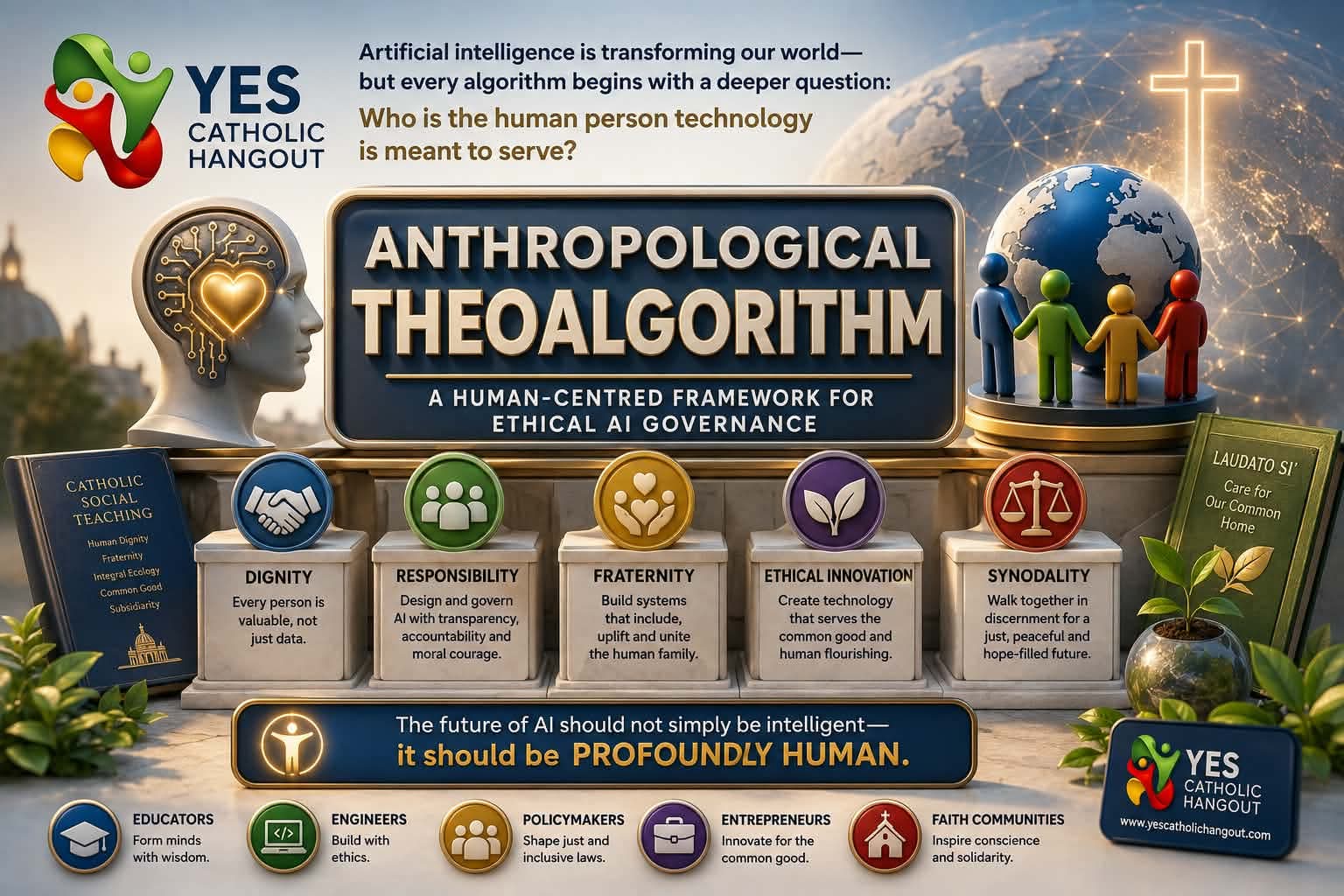
Fr. Oliver CCE presents a theologically grounded model for ordering artificial intelligence to the service of the human person
Fr. Oliver CCE, an ethical innovator and synodal secretary from the Archdiocese of Halifax-Yarmouth, has presented a theologically grounded framework for the governance of artificial intelligence and economic life. The Anthropological Theoalgorithm and its applied discipline, Algorithmethics, propose that every AI system must first be measured against what it says about the human person. Addressed to the Dicastery for Culture and Education, the submission offers the African Church’s sustained engagement with digital transformation as a gift to the universal Church.
The Central Question
The question at the heart of the proposal is not merely technical. It is anthropological and theological:
Can artificial intelligence be ordered to serve the whole person and the whole human family, rather than to sort, exclude, or displace them?
This is the moral question of our technological age. It cannot be answered by engineers alone, economists alone, or theologians alone. It demands the wisdom of the whole People of God, discerned through the sensus fidei, and expressed in a language intelligible to both the academy and the marketplace.
The contribution, born from the peripheries of the universal Church, seeks to align itself with the vision of the Holy Father as articulated in Fratelli Tutti and Laudato Si’, with the evangelically inspired economic vision of the Economy of Francesco, and with the moral foundations of the Rome Call for AI Ethics.
The Anthropological Theoalgorithm
At the centre of the proposal stands the Anthropological Theoalgorithm: a diagnostic model that evaluates whether an artificial intelligence system’s design rests upon a true account of the human person or upon a reduced, instrumentalised one.
Before the algorithm decides, who does it say we are?
The Anthropological Theoalgorithm holds that every AI system silently presupposes an anthropology. Where that anthropology recognises the human person as imago Dei, relational, embodied, and ordered toward communion, the technology can become a servant of human flourishing. Where it reduces the person to data, behaviour, or utility, it becomes, however powerful, a subtle form of violence.
This model is not opposed to technical excellence. It is the safeguard that gives technical excellence a human face. The framework is animated by the ancient insight of exitus and reditus: every creature comes forth from God and is ordered back to God. A technology that respects this movement does not confine the person to what can be measured, predicted, or sold.
From Theology to Practice: Algorithmethics
Algorithmethics is the applied engineering discipline that translates this theological anthropology into auditable instruments. It provides design checklists, data classification taxonomies, AI-agent access matrices, and algorithmic audit criteria that can be used by developers, regulators, and pastoral workers alike.
Algorithmethics is not abstract theology. It is a working practice already deployed, and it makes the invisible visible: the values embedded in code, in data, and in governance. By rendering theological norms into measurable criteria, Algorithmethics enables the sensus fidei to speak with precision in the digital age.
Together, the Anthropological Theoalgorithm and Algorithmethics form a bridge between the Church’s doctrinal vision and the concrete decisions being made in laboratories, boardrooms, and parliaments.
Four Pillars of Catholic Social Grounding
The framework rests upon four pillars drawn from the Church’s social doctrine. Each pillar is offered not as a pious aspiration but as a practical criterion by which AI systems, policies, and economies may be evaluated.
Human Dignity as First Principle. Every design decision, from data collection to model deployment, must be measured against the inviolable dignity of the person. Where efficiency or profit would compromise that dignity, the project must be reordered. A system is not justified by efficiency alone, it is justified only when it serves the person it touches. Imago Dei is the non-negotiable reference point of Algorithmethics. This principle requires informed consent rather than opaque extraction, human oversight rather than unchecked automation, and accountability rather than the diffusion of responsibility across layers of code.
Fraternity Beyond Borders. Digital systems must actively include migrants, the poor, and the marginalised, refusing the comfortable indifference that technology so often masks. This requirement flows directly from the vision of social friendship set forth in Fratelli Tutti. Fraternity is not a vague benevolence. It is a structural commitment to design technologies that expand the circle of recognition, that treat every user as a neighbour, and that refuse to externalise the costs of innovation onto the vulnerable.
Integral Ecology. The governance of AI must connect worker dignity, planetary health, and computational sustainability. The energy consumed by a model, the conditions of those who label its data, and the waste it generates are not externalities but moral facts. Environmental cost, energy use, computational sustainability, and the human labour hidden in supply chains, must be a governance criterion, not an afterthought. This pillar is grounded in Laudato Si’ and its call for an integral ecology that embraces every creature and every system that touches the gift of creation.
An Economy of Life. The Economy of Francesco calls us to build an economy measured by human flourishing, not profit alone. Success must be measured by the flourishing of the person and the community, not by market capitalisation alone. KPOMKWEM LTD’s four operational pillars, certified devices, skills training, dignified employment, and last-mile delivery, offer a concrete model of such an economy. They demonstrate that a fraternal digital economy is not a utopia but a practice already taking shape in local communities.
A Framework in Action: Three Levels of Application
The Anthropological Theoalgorithm and Algorithmethics are applied at three interlocking levels, each corresponding to a distinct sphere of ecclesial and civic responsibility.
At the level of institutional design, the framework shapes internal governance through data classification protocols, AI-agent access matrices, and algorithmic audit criteria. The principle of subsidiarity guides each community to embed the Anthropological Theoalgorithm in its own procedures.
At the level of policy formation, Catholic institutions and bishops’ conferences are equipped to assess AI legislation, national data protection regimes, and the use of automated systems in social services. The framework offers a common moral vocabulary and a set of audit instruments.
At the level of international advocacy, the framework supports an African and Catholic contribution to the United Nations, UNESCO, and other global forums. The peripheries must speak at the centre of global governance, ensuring that algorethics does not become a Western-only conversation and that the preferential option for the poor is inscribed in the architecture of international AI governance.
Web3 and the Emerging Digital Economy
The Anthropological Theoalgorithm is uniquely positioned to guide the Church’s engagement with the emerging Web3 ecosystem. Web3, with its decentralised architectures, blockchain-based governance, token economies, and smart contracts, presents both an unprecedented opportunity and a profound ethical risk.
The Church needs a framework capable of evaluating not merely isolated algorithms but entire decentralised ecosystems. The Anthropological Theoalgorithm interrogates the anthropology embedded in a protocol’s incentive structures, governance rules, and access permissions, asking whether the system recognises the human person or reduces him or her to a wallet address, a token balance, or a node in a network.
Web3’s promise of financial inclusion for the unbanked aligns powerfully with the Church’s preferential option for the poor. Yet without ethical guardrails, decentralised finance risks replicating old inequities in new digital forms. Algorithmethics offers concrete instruments to prevent this drift. The Church can become the moral architect of Web3 governance, ensuring that decentralised technologies serve human communion rather than atomisation.
Proof of Concept: KPOMKWEM LTD
The framework is not merely an abstract concept. It is working engineering practice already bearing fruit. KPOMKWEM LTD, operating in Nigeria, demonstrates a four-pillar operational model encompassing certified devices, skills training, dignified employment, and last-mile delivery.
The proof points are concrete and verifiable:
A five-tier data classification taxonomy that maps information to appropriate levels of protection and access.
An AI-agent access matrix that assigns permissions according to role, purpose, and accountability.
Alignment with Nigeria’s NDPR/NDPA, demonstrating that Algorithmethics can work within existing legal and regulatory frameworks.
A fraternal digital economy rooted in local community and real human development, not in speculation or extraction.
KPOMKWEM LTD is a laboratory of the sensus fidei in action: a preferential option for the poor expressed in code, commerce, and community.
A Distinctive Voice
What makes this framework different from the many other proposals now circulating in the field of AI ethics?
It is not secular utilitarianism dressed in Catholic language. It does not reduce the moral life to the maximisation of aggregate welfare or the calculation of risk. It is not anti-technology pessimism, it does not reject the digital age but seeks to baptise it. It is not a Western-only framework, it arises from African pastoral experience, African economic creativity, and the African Church’s distinctive reading of the signs of the times. And it is not merely theoretical abstraction, it has been tested in practice and aligned with existing standards such as the Rome Call for AI Ethics and Nigeria’s NDPR/NDPA.
The framework is robust for six reasons: it is tested in practice, it is grounded in established Catholic Social Teaching, it is compatible with existing technical and legal standards, it is offered humbly as a contribution, not as the final word, it is globally applicable, and it is auditable, translating principles into concrete instruments rather than vague aspirations.
In this lies its distinctive voice: an African contribution to the universal Church, bridging theology and engineering, intelligible to both the bishop and the developer.
A Synodal Gift
This framework is an expression of synodality: the Church walking together, listening to the signs of the times, and bringing every voice to the table of discernment. The African Church offers its discernment on technology to the universal Church, in humility and in hope.
It is a gift of the peripheries to the centre.
It reminds the whole Church that the Spirit speaks through the margins as well as the established centres, through the young Church as well as the ancient, through the poor as well as the powerful. The Anthropological Theoalgorithm and Algorithmethics are therefore offered not as a finished doctrine but as a working framework tested in practice, a sign that the Church in Africa can both receive the gifts of the universal Church and offer gifts of its own.
Acknowledgements
The initiative draws upon the pioneering work of several institutions that have discerned that the algorithmic age demands not silence from the Church, but wisdom. Gratitude is extended to the Pontifical Academy for Life and the RenAIssance Foundation for establishing algorethics as a field of genuine ecclesial concern and for the Rome Call for AI Ethics, which laid indispensable groundwork for all subsequent reflection.
Appreciation is also offered to the Dicastery for Culture and Education for its sustained attention to the relationship between faith, culture, and technology; to the Pontifical Gregorian University for its commitment to forming minds at the intersection of theology and digital governance; and to the Economy of Francesco movement for inspiring a new generation of economic thinkers rooted in Gospel values.
Calls to Engagement
In a spirit of respectful dialogue and ecclesial solidarity, the proposal sets out seven specific requests for consideration:
To the Dicastery for Culture and Education, that the framework be received as a contribution to the Church’s ongoing discernment on the governance of artificial intelligence.
To the Pontifical Gregorian University and the RenAIssance Foundation, that it be considered for academic engagement, further development, and integration into programmes of research and formation.
To the Pontifical Academy for Life, that its instruments be incorporated into the ongoing algorethics dialogue, especially in healthcare, labour, and social assistance.
To Catholic Bishops’ Conferences, particularly in Africa, that the framework’s regional applicability be assessed and its instruments adapted to local realities.
To the Catholic Bishops’ Conference of Nigeria, that the framework be formally endorsed and forwarded alongside the existing Family Department concept note.
To the United Nations AI Advisory Body and UNESCO, that the framework be considered during open consultation periods, so that the African and Catholic moral voice may shape the emerging global architecture of AI governance.
To academic partners in Rome and Halifax, that the framework be engaged as a subject of continued study, refinement, and theological reflection.
Closing
“Technology is a gift. How we use it is our choice. Let us choose what builds life.”
Fr. Oliver CCE
The purpose of the Anthropological Theoalgorithm and Algorithmethics is simple: to ensure that as artificial intelligence and digital economies reshape the world, they do so in service of the human person, made in the image of God, and never the reverse.