
AI Parenting Tips: Keeping Kids Creative, Safe, Honest
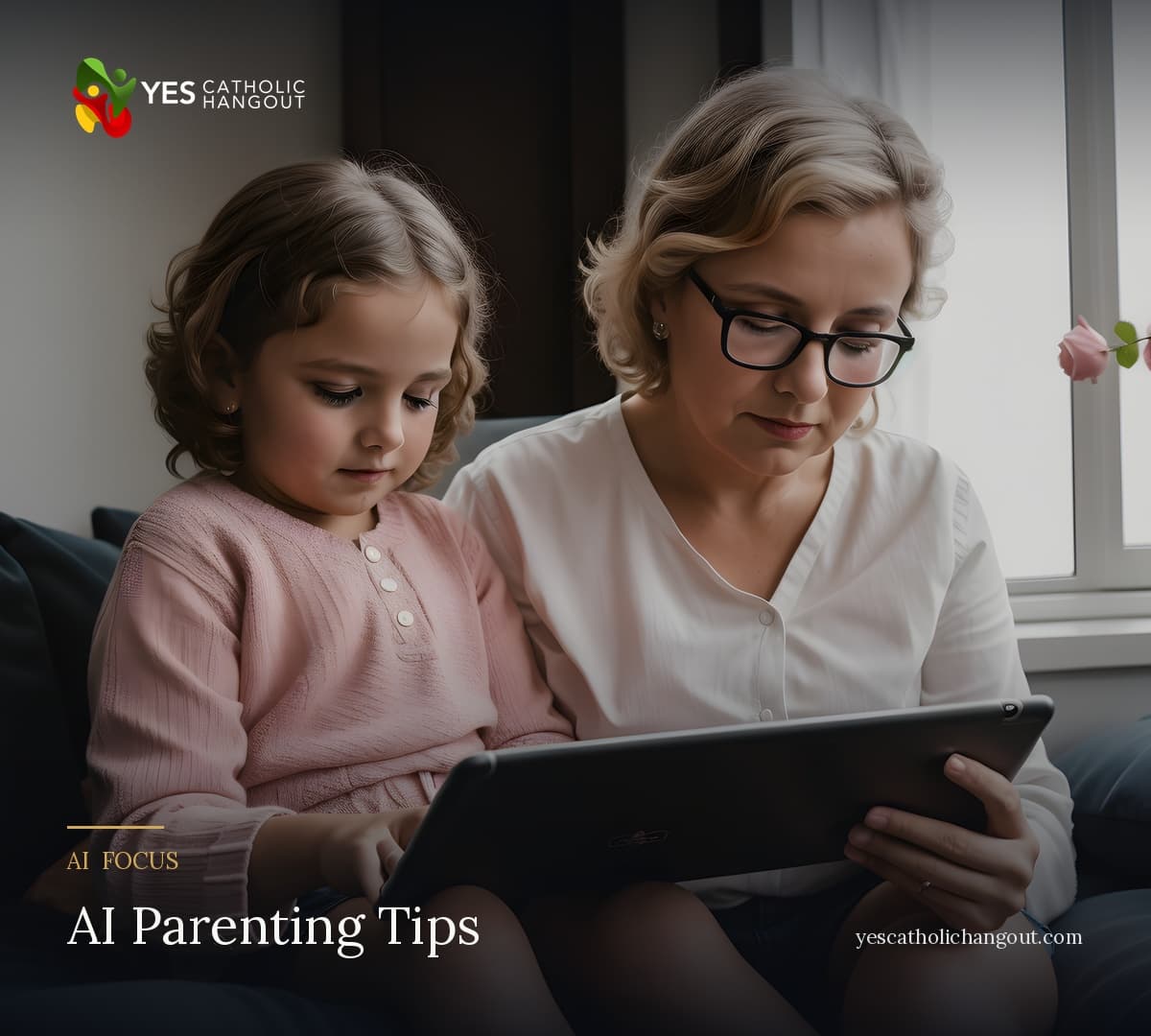
A child sits before a glowing screen, asking a machine to finish a story, solve a riddle, draw a picture that only lived in imagination a moment ago. The parent watching from the doorway feels something between wonder and worry. This scene is now ordinary in Catholic homes on every continent, and it raises a question Pope John Paul II could not have anticipated in his exact form, yet answered in its essence: who forms the child, and toward what end.
Familiaris Consortio insists that parents remain the first and irreplaceable educators of their children. No algorithm, however capable, can inherit that office. Artificial intelligence can inform a home. It cannot parent one. The task before Catholic families today is not to fear the machine or to surrender to it, but to keep it in its proper place: a tool ordered toward the human good, never a substitute for the communion of love that Familiaris Consortio calls the very soul of the family.
Magnifica Humanitas offers the deeper reason why this matters. The document insists that human dignity is not a variable to be optimized but a truth to be safeguarded, especially where technology touches the formation of persons. A child is not a dataset to be shaped by engagement metrics. A child is a person, willed by God, whose creativity, conscience, and capacity for truth are gifts no system designed for retention can be trusted to protect on its own.
This is where parents must exercise real vigilance. Many AI tools are not built with a child’s formation in mind. They are built to hold attention. Parents who understand this distinction are already ahead: they can use AI as an instrument for wonder and skill, while refusing to let it become the silent shaper of a child’s imagination, appetites, or sense of self.
Practically, this begins with creativity. AI can be a genuine aid to a child’s imagination when a parent stays present in the process. A child who asks an AI tool to help brainstorm a story, or to explain how a bridge stands, or to generate ideas for a school project, is using a tool the way a pencil or an encyclopedia has always been used, as an extension of curiosity, not a replacement for it. The danger is not the tool. The danger is absence: a child left alone with a machine that never tires of answering, never redirects toward prayer, never says “that is enough for today.”
Parents do well to sit with their children during these moments, at least often enough that the child learns AI is a servant of their thinking, not a substitute for it. Ask the child to explain, in their own words, what the AI produced. Ask them to improve on it. Creativity that only receives from a machine withers. Creativity that uses the machine and then goes further than it, flourishes.
Safety follows naturally from this same presence. Fratelli Tutti reminds the Church that authentic fraternity requires protecting the vulnerable from systems that would otherwise use them without regard for their good. Children are, in this sense, the most vulnerable users of any AI platform: unable to fully judge what is being asked of them, what is being recorded about them, or what values are quietly embedded in the answers they receive.
Concrete safety looks unglamorous but is essential. Parents should know which AI tools their children use, what data those tools collect, and whether the platform is designed for adult conversation repurposed for a child’s use. Screens belong in shared spaces of the home more often than private ones. Conversations about what the child is asking these tools, and what the tools are answering, should be as normal as conversations about a school day. Safety is not surveillance for its own sake. It is the ordinary vigilance Familiaris Consortio describes as belonging to parents who take seriously their irreplaceable role as first educators.
Honesty is the subtlest of the three, and perhaps the most urgent. AI systems can produce answers with total confidence and no guarantee of truth. A child forming their sense of what is real, what is right, and what is possible, needs to learn early that fluency is not the same as truth, and that a machine’s certainty is not the same as wisdom.
Here Laudato Si’ offers an unexpected but fitting caution. Pope Francis warned against a technocratic mindset that treats every problem as solvable by the next tool, without asking whether the tool itself deforms the way we see reality. Applied to parenting, this means teaching children to question AI output rather than absorb it uncritically, to notice when an answer flatters rather than informs, and to return always to parents, to Scripture, to the Church’s teaching, and to their own reasoned conscience as the final measures of truth. Honesty with a machine also means honesty about a machine: naming its limits aloud, so the child does not mistake a well-phrased answer for a trustworthy one.
The Economy of Francesco adds a final and hopeful dimension. That movement calls young people to imagine an economy that serves life rather than extracting from it. Children who grow up learning to use AI critically, creatively, and honestly are being formed as exactly the kind of person that movement hopes to raise: not passive consumers of whatever technology offers, but discerning stewards capable of building systems that serve the human family rather than exploit it.
This is, in the end, the deepest continuity between an ancient exhortation on the family and today’s questions about artificial intelligence. Familiaris Consortio never mentions a chatbot. It does not need to. Its vision of the family as the first school of humanity, where love, discernment, and truth are learned before anything else, is precisely what parents need in an age when machines can talk but cannot love, can answer but cannot form a conscience, and can imitate wisdom but never possess it.
Practical guidance, gathered:
Stay present when children use AI tools, rather than leaving them unsupervised with an always-available answer machine.
Ask children to explain and extend what AI produces, so creativity remains theirs.
Learn what each tool collects and whether it was built for children at all.
Keep AI use in shared spaces of the home where conversation stays open.
Teach children to question AI answers rather than absorb them as settled truth.
Return, always, to parents, to prayer, and to the Church’s teaching as the true measure of what is right.
The child at the glowing screen is not a problem to be solved. She is a person to be formed, in a home where the deepest intelligence was never artificial, but always the patient, watchful love of parents who remain, as the Church has always taught, the first and best educators their children will ever have.